Residential Homes & Townhouse Complexes
We help residential homeowners, townhome associations, and multi-family structures protect their building envelope, clear gutters, wash windows, and maintain lasting curb appeal.
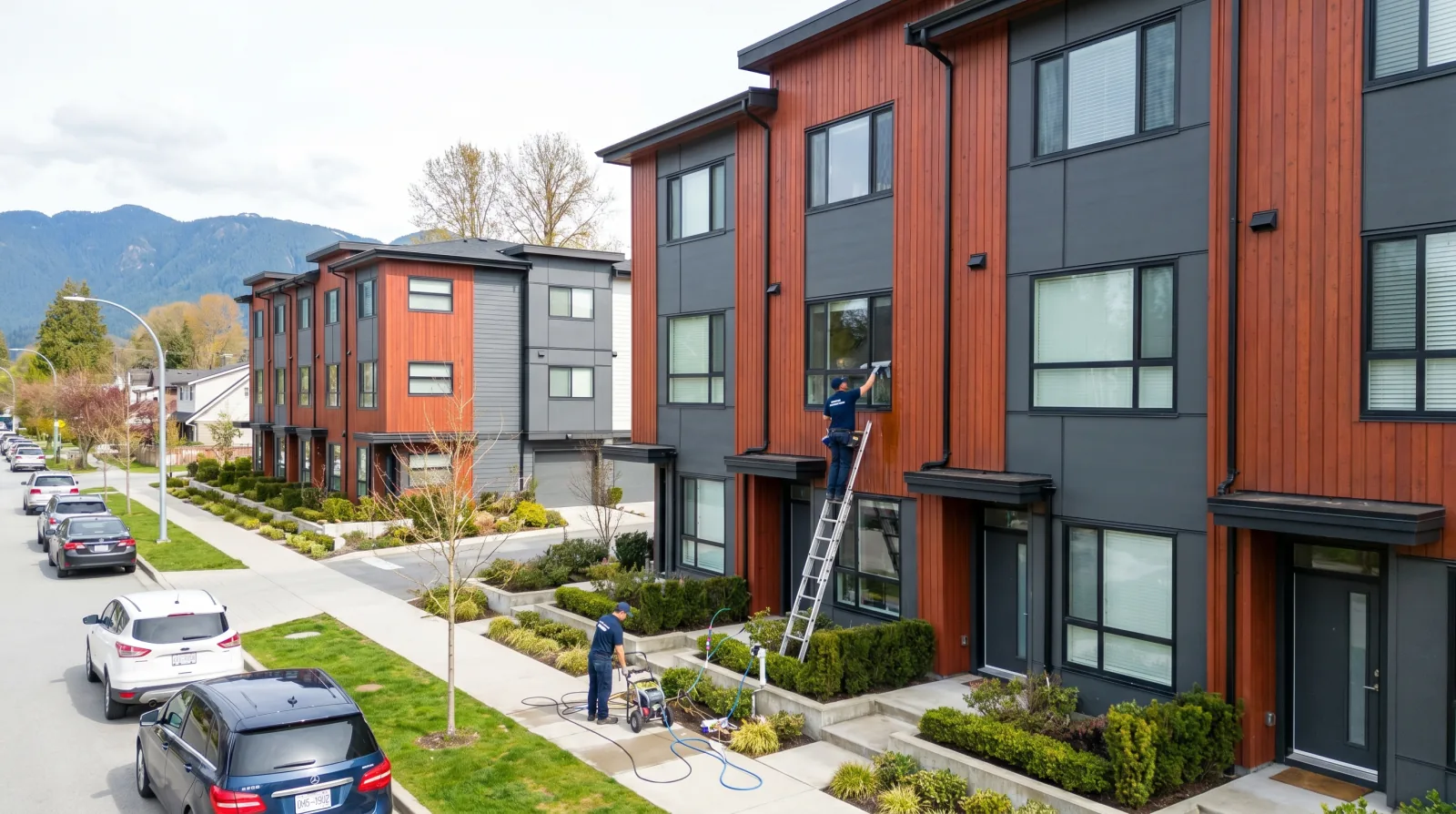
Common Challenges Faced
- Window grime, moss growth on sidings, and clogged gutters that cause water run-off stains.
- Finding a fully insured, WorkSafeBC-registered contractor to work safely around family houses and low-rises.
- Cracked coatings or split sealants on balconies exposing framing to moisture decay.
Why Choose Allweathercoating
- Complete Protection: We carry full WCB coverage and broad-form liability insurance (adjusted upwards depending on the danger and scale of the job for worker safety), shielding homeowners from project risks.
- Durable Local Solutions: Using commercial-grade elastomeric paints and sealants suited for coastal humidity.
- Low Disruption: Our clean, professional technicians work efficiently, leaving your gardens and entrances tidy.
Pacific Northwest Humidity and Low-Rise Cladding Systems
Residential homes and townhouse complexes in Metro Vancouver exist in a humid coastal environment. The local climate, characterized by prolonged wet seasons and cool temperatures, places unique demands on residential building envelopes. Unlike high-rise concrete structures, low-rise residential buildings are typically wood-frame constructions, making them vulnerable to moisture-induced decay, wood rot, and structural damage if water penetrates the outer cladding.
Wood-frame structures require effective drainage systems to prevent water accumulation. Stucco, fiber-cement boards, and wood sidings act as the primary weather barrier, but they are not completely waterproof. Under the BC Building Code, low-rise residential constructions must incorporate rainscreen systems. A rainscreen creates a drainage cavity between the exterior cladding and the inner sheathing membrane. This cavity allows wind-driven rain that passes the cladding to drain down and escape through weep holes, while allowing air movement to dry out residual moisture before it reaches the wood studs.
Biological growth is a persistent issue for residential properties in shaded locations. The high humidity of areas like North Vancouver encourages moss, algae, and mildew growth on roofs and sidings. Moss holds water against asphalt shingles and wood siding, accelerating material decay and staining surfaces. Regular soft-washing using low-pressure equipment and organic cleaning solutions is required to remove these growths without damaging the building cladding or destroying landscaping plants.
Wood decay fungi thrive in environments where wood moisture content remains above 20 percent. In coastal British Columbia, damp building materials that are not allowed to dry because of poor ventilation or cladding leaks quickly fall prey to rot. When structural wall studs or plywood sheathing rot, their load-bearing capacity is lost. This can lead to structural floor sagging and roof sagging, creating a safety hazard for occupants. Resolving these wood rot issues requires costly replacement of structural timbers and framing members, which is why keeping the exterior cladding watertight and clean is a necessary maintenance step.
Townhouse Strata Associations: Segmented Maintenance Duties
Townhouse complexes operate under a shared responsibility model that can complicate envelope maintenance. Under the BC Strata Property Act, the strata corporation is responsible for repairing and maintaining common property, which includes roofs, exterior siding, gutters, and common walkways. However, individual townhouse owners are responsible for maintaining their private patios, internal spaces, and private balcony walking surfaces, depending on the registered strata plan.
Clear division of maintenance duties prevents structural damage. When a gutter overflows or a deck membrane leaks, the resulting water damage can affect multiple units. Strata councils must implement annual inspections of the entire building exterior to catch defects before they cause costly disputes. We work with townhouse strata boards to perform inspections of exterior caulking, wood trim, and balcony flashings, providing clear reports that identify common property defects requiring corporation-funded repairs.
Long-term planning protects townhouse property values. Like high-rise towers, townhouse complexes are mandated to conduct depreciation reports. These reports outline the expected lifespans of roofs, siding, and gutters, helping strata boards budget for major replacements. By executing preventative maintenance, such as replacing window caulking every 8 years and washing siding every 2 years, strata associations extend the life of these capital assets, keeping maintenance fees stable and preventing special levies.
Gutter and Downspout Drainage Engineering
Managing rainwater run-off is the first step in protecting a residential building envelope. With Vancouver's heavy seasonal rain, gutter systems must capture and direct thousands of liters of water away from the building foundation. Clogged gutters, misaligned downspouts, or failing perimeter drains can direct water into crawlspaces and basements, causing mold growth and structural shifting.
Regular gutter flushing is required to prevent water overflow. In residential areas with mature trees, such as West Vancouver, leaves, pine needles, and moss quickly fill gutter troughs. During heavy downpours, clogged gutters overflow, spilling water down the fascia boards and siding. This continuous water exposure rots wood soffits, damages window frames, and saturates the soil at the foundation line. Annual gutter clearing and downspout flushing before the winter rain season is necessary to support proper drainage.
Perimeter drainage systems must function correctly to keep basements dry. Downspouts discharge rainwater into underground drain tile systems that channel water away from the foundation. If these perimeter drains are blocked by dirt or root intrusion, water pools against concrete foundation walls. Under hydrostatic pressure, moisture seeps through concrete micro-cracks, causing damp basements and efflorescence. We inspect downspout connections and recommend regular drainage reviews to protect the building sub-structure.
Residential Balcony and Deck Waterproofing Standards
Residential decks and balconies are highly valued spaces, but they are also vulnerable building envelope components. Because they are horizontal projections, they receive the full impact of rain, snow, and UV exposure. If the deck waterproofing is compromised, water will seep into the underlying joists, causing dry rot that compromises structural safety.
Sheet vinyl (PVC) membranes are the standard waterproofing choice for wood-frame townhome decks. These membranes, certified under CAN/CGSB 37.54 standards, are glued directly to tongue-and-groove plywood decks, with all seams heat-welded to form a watertight seal. PVC vinyl is durable and provides a clean walking surface, but it relies on the quality of the welded joints. Caulking must be maintained around railing post penetrations and door thresholds to prevent water from slipping behind the membrane.
Liquid-applied polyurethane coatings provide an alternative solution for concrete residential balconies. These elastomeric coatings cure to form an unbroken rubber barrier that bonds to the concrete. They are ideal for complex decks with structural columns or multiple changes in elevation, as they eliminate seams. The concrete substrate must be completely dry before application to prevent blistering. Regular inspections of the deck edge flashings are required to verify water drains clear of the siding below.
Contractor Selection and Safety Standards for Residential Work
Hiring contractors for residential envelope work requires careful verification of credentials and safety standards. Low-rise residential projects often attract uncertified operators who lack proper training or insurance. If an uninsured worker falls on a residential property, the homeowner or strata corporation can face severe legal liability and financial claims.
Homeowners must verify WorkSafeBC compliance before work begins. Any contractor operating on a residential site must provide a valid clearance letter confirming their active registration and good standing with WorkSafeBC. This documentation shields the property owner from liability in the event of a workplace accident. In addition, contractors must carry broad-form liability insurance to cover accidental property damage, such as water ingress caused by exposed rooflines during repairs.
Fall protection safety must be maintained on all residential roofs. Even on two-story homes, working near roof edges requires fall protection systems under WorkSafeBC regulations. Crews must install temporary anchor points, use safety harnesses, and secure work zones on the ground to protect residents from falling debris. By maintaining these standards, we execute residential projects safely, professionally, and in full compliance with local regulations.
Rainscreen Cavity Architecture and Stucco Siding Rehabilitation
Low-rise wood-frame stucco cladding requires careful detail inspection, particularly in older buildings built during the Vancouver leaky condo era. Stucco is naturally rigid and porous, meaning it cracks as the building frames settle or undergo thermal cycles. When water penetrates these cracks in a building without a rainscreen, the moisture is trapped against the plywood sheathing, leading to dry rot in the load-bearing studs.
Modern stucco systems rely on rainscreen design to manage water. Rainscreen assemblies feature wood furring strips or plastic drainage mats installed over the water-resistive barrier, separating the stucco cladding from the structural wall. This 10-millimeter gap creates an air cavity that allows water to drain to the exterior and dry out through wind movement. When repairing older, face-sealed stucco buildings, we inspect the flashing systems at window perimeters and floor transitions, retrofitting metal drip edges to shed water away from the stucco joints and prevent moisture accumulation.
Siding Washing Chemistry: Low-Pressure Soft Washing Systems
Cleaning residential siding requires selecting the appropriate method for each cladding material. Stucco, wood cladding, vinyl siding, and fiber-cement panels degrade under high water pressure. High-pressure washing forces water past cladding joints, saturating sheathing membranes, soaking structural framing, and tearing building paper, which creates water leaks inside wall cavities.
Soft washing is the industry standard for safe residential exterior cleaning. Soft washing utilizes low-pressure spray pumps, operating below 300 pounds per square inch (PSI), combined with specialized chemical wash solutions. The cleaning solution, formulated with sodium hypochlorite and biodegradable surfactants, is applied to the siding to kill mold, algae, and lichen at their root level. The solution is allowed to dwell before being rinsed away with low-pressure water, leaving the siding clean and undamaged. This method protects cladding joints, maintains painted finishes, and protects the structural wood frame behind the wall assembly.
Low-Rise Roofing and Flashing Junction Maintenance
The intersections between residential sloped roofs and vertical cladding panels are primary leak points in multi-family townhouse complexes. When rainwater drains down shingle valleys, it concentrates at the roofline transitions. To divert this water flow away from the siding wall assembly, kick-out flashings (kicker flashings) must be installed at all roof-to-wall termination points. In older complexes, these flashing details are frequently missing or sealed over. Without proper metal flashings, water slips behind the cladding boards, rotting the underlying plywood sheathing. Regular inspections of step flashings, counter-flashings, and valley troughs are necessary to maintain water shedding integrity.
Ventilation, Attic Baffles, and Siding Breathability
Attic and wall cavity ventilation is critical for controlling moisture levels in low-rise wood-frame homes. In the cool, wet Pacific Northwest climate, warm air inside the home contains moisture vapor. If this vapor passes through the ceiling envelope and enters a cold attic with blocked ventilation grates, it condenses on the underside of the roof sheathing. This condensation leads to wood mold and attic rot. Attics must feature clear airflow pathways, supported by structural baffles installed between the roof rafters to keep insulation from blocking the soffit vents. Exterior siding must also breathe; vapor-permeable house wraps are installed beneath the rainscreen siding to let moisture escape while blocking liquid water ingress.
Siding Materials: Durability and Maintenance Schedules
Different residential cladding materials require specialized maintenance cycles to maintain their protective qualities. Cedar siding requires painting or staining every 5 years to block moisture absorption and UV cracking. Fiber-cement siding panels (e.g., HardieBoard) require high-grade polyurethane sealant at butt joints, with joints checked annually for splitting. Vinyl siding is highly durable but requires washing to prevent moss buildup in the interlocking panels. Strata townhome associations should schedule full siding washdowns every 2 years and inspect all perimeter caulking joints around windows and doors every 5 years to prevent water ingress.
Window Frame Perimeter Caulking and Flashing Details
In wood-frame residential assemblies, window penetrations represent the most frequent point of water ingress. The interface between the window flange, the sheathing membrane, and the cladding must be detailed to shed water. We install high-performance sealant beads around window frame perimeters to seal structural transitions. For these installations, material compatibility is checked; we select silicone sealants for non-porous glass-to-metal joints because of their high elasticity and UV resistance, and polyurethane sealants for porous wood-to-stucco junctions. We also inspect sub-sill flashings and end-dams to verify that wind-driven water collecting in the window sill track drains outward, protecting structural framing from dry rot.
Attic Insulation and Mold Prevention Mechanics
Attic mold development is often driven by air leakage from the heated living spaces below. When warm, humid air migrates through unsealed ceiling penetrations—such as recessed pot light fixtures, electrical conduits, or ceiling hatches—it enters the unheated attic space. During Vancouver winters, this warm vapor meets the cold roof plywood, condensing into liquid water. To prevent mold colonization, we install 6-mil polyethylene vapor barriers and seal penetrations with expanding foam. Supporting this with clear soffit ventilation maintains low relative humidity in the attic, protecting the roof framing from structural decay.
In addition to mold growth, moisture condensation can compromise structural insulation. Wet fiberglass batts or cellulose insulation lose their thermal resistance value, which increases heating costs for townhome residents. Damp insulation also absorbs musty odors and weight, causing drywall ceilings to sag and crack. Maintaining clear air circulation through soffit vents and attic vents is necessary to protect both structural framing and energy efficiency in residential buildings.
Recommended Services for Residential Homes
High-Rise Window Cleaning
Allweathercoating provides safe, efficient high-rise window cleaning for strata towers, commercial buildings, office towers, and mixed-use properties across Vancouver, North Vancouver, West Vancouver, and Burnaby.
View Service DetailsCommercial Window Cleaning
Allweathercoating provides professional commercial window cleaning for office plazas, retail complexes, institutional buildings, and low-to-mid rise properties in Vancouver, Burnaby, and the North Shore.
View Service DetailsGlass Canopy and Awning Cleaning
Allweathercoating cleans and maintains glass entrance canopies, awnings, and overhead glazing for restaurants, retail storefronts, office lobbies, and strata entrances across Vancouver, Burnaby, and the North Shore.
View Service DetailsFrequently Asked Questions
Do you clean gutters, sidings, and windows for residential townhomes and detached houses?
Yes, we provide professional siding washing, window cleaning, gutter flushing, and exterior waterproofing repairs for townhome complexes, single-family houses, and low-rise residential properties.
Protect Your Strata or Commercial Building Today
Contact Vancouver’s commercial exterior maintenance specialists. Get fully insured high-rise window cleaning, waterproofing, and building envelope repair.