Structural Silicone Renewal & Marine Envelope Care in Coal Harbour
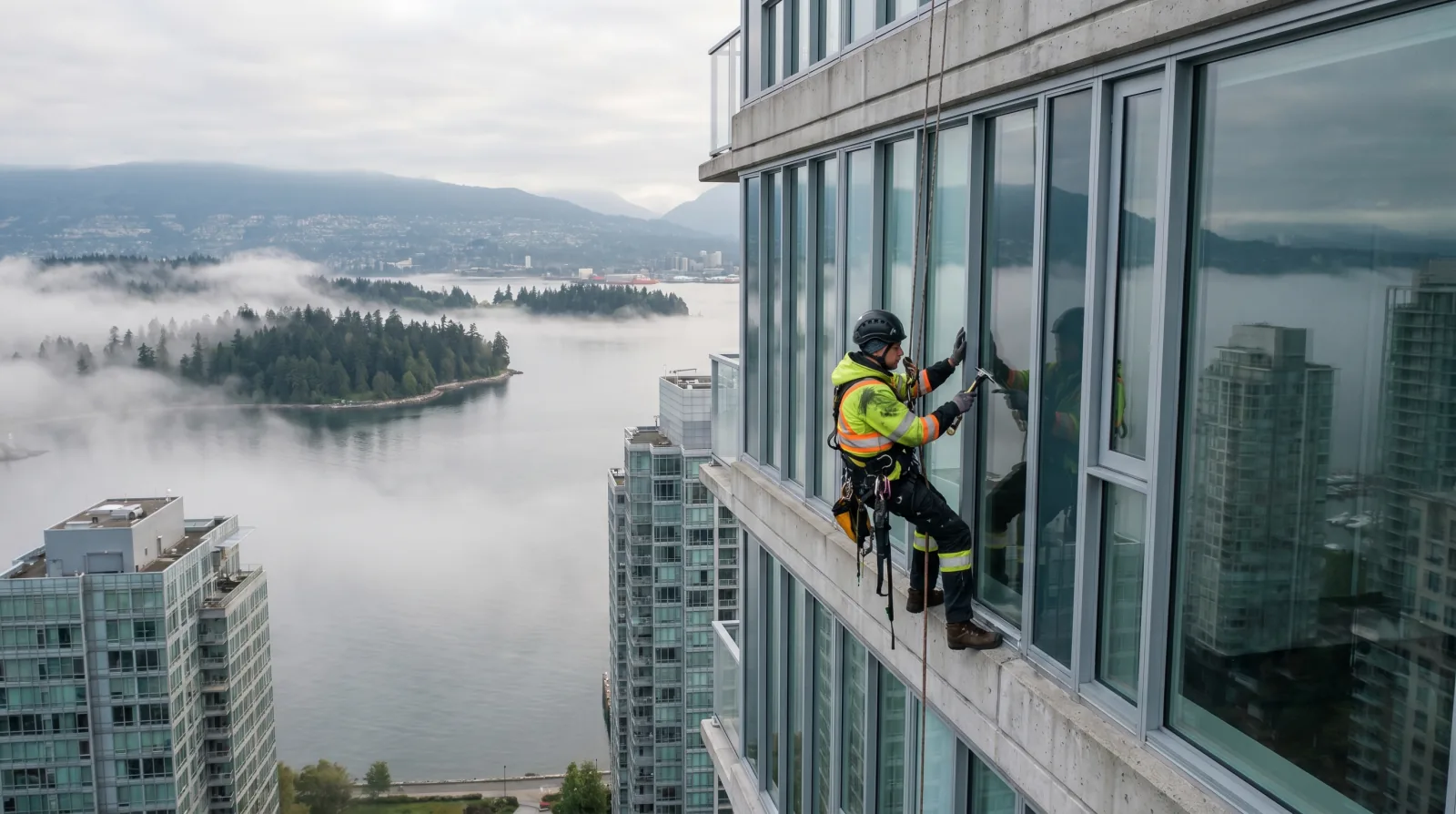
Coal Harbour's luxury high-rise strata towers — most built between 1994 and 2010 on former Canadian Pacific Railway lands — now face their first major sealant renewal cycles. Allweathercoating provides certified rope-access inspection, structural silicone replacement, and concrete restoration for the neighbourhood's waterfront and harbour-facing towers.
Property Types We Serve in Coal Harbour
Coal Harbour's residential development concentrated almost entirely between 1994 and 2010, when the former Canadian Pacific Railway freight yards along the north waterfront were redeveloped into a high-density condominium community. This compressed development window means that Coal Harbour has an unusually homogeneous building stock: most towers are 20 to 40 storeys of post-tensioned concrete with full-height glazed curtain walls, aluminum balcony railings, and structural silicone-sealed window systems. The towers nearest to Burrard Inlet — along Harbour Green Park, West Hastings Street, and Cordova Street — are the most exposed to marine conditions and the ones that strata councils most frequently contact us about for envelope inspection programs.
The density and prestige of Coal Harbour strata properties creates high standards for maintenance quality and documentation. Strata councils in this neighbourhood typically work with professional strata management companies and often require formal written inspection reports with elevation-by-elevation deficiency records, high-resolution photographs, and contractor certification documents before approving sealant work. Allweathercoating provides complete technical close-out packages including pre-work and post-work photographs, joint preparation logs, sealant product data sheets, and applied linear-metre records — the documentation standard that Coal Harbour strata councils and their property managers expect.
Several of Coal Harbour's towers include commercial podium levels occupied by retail tenants, private marinas, and hotel facilities. These mixed-use podium zones have complex envelope interfaces between the glazed residential tower above and the lower-floor commercial cladding systems below. Flashing transitions at the tower-podium interface are a priority inspection item on our Coal Harbour reviews: the step in facade geometry at these transitions concentrates water runoff and is a common origin point for water ingress into commercial tenant spaces. We perform detailed inspections of cap flashings, horizontal ledge drips, and cladding-to-window joints at podium levels during every building inspection program.
The rooftop amenity decks on Coal Harbour towers — many featuring pools, hot tubs, and planters installed by strata councils upgrading common amenities — represent a growing waterproofing maintenance challenge as these buildings mature. The original rooftop waterproofing membranes installed during construction in the 1990s and 2000s are reaching or approaching the end of their design life. We perform rooftop membrane condition assessments as part of comprehensive envelope programs, checking the membrane at all penetrations, drains, parapet interfaces, and structural movement joints. Early identification of membrane delamination or blister formation allows strata councils to budget for membrane replacement before leaks develop into suite-level water damage.
Local Coastal Climate Demands
Coal Harbour's position directly on Burrard Inlet exposes every waterfront-facing tower to a marine environment that is among the most aggressive in Metro Vancouver for building envelope deterioration. Salt spray carried off the inlet by prevailing southwest winds deposits chloride films on glass, concrete, and aluminum surfaces year-round. On the upper floors of harbour-facing towers — typically above the 15th floor where nearby buildings no longer provide wind shelter — salt loading increases significantly. We schedule high-rise window cleaning for Coal Harbour waterfront towers at minimum twice annually, with the spring cleaning targeted specifically at removing the mineral scale that winter storm activity deposits on glass surfaces. Allowing this mineral film to remain and be baked under summer UV light leads to permanent glass etching that cannot be removed by cleaning.
The Vancouver Harbour Water Aerodrome and the open water of Burrard Inlet to the north mean that Coal Harbour towers have no natural wind shelter from the north and northwest. Outflow wind events — high-velocity cold-air drainage events off the North Shore mountains that accelerate over the inlet — create sudden, extreme wind loads on harbour-facing facades. These events put maximum stress on structural silicone joints and curtain wall gaskets in a short period, and repeated cycles can initiate fatigue cracking in sealants that appear intact under normal conditions. Our close-up rope-access inspection protocol specifically addresses this: we probe silicone joints under direct hand pressure to detect internal softening or adhesion loss that is not visible to a distant inspection from the ground.
Deadman's Island — the HMCS Discovery naval base just off the Coal Harbour waterfront — sits directly in the western approach to Burrard Inlet and acts as a focal point for wave-generated spray during storm events. Towers along the western end of Coal Harbour, particularly those between Cardero Street and the Convention Centre, receive the highest direct salt spray loading in the neighbourhood. We recommend that strata councils for buildings in this western section adopt annual close-up sealant inspections as a standard maintenance practice, recognizing that the marine loading they face is comparable to oceanfront exposure rather than typical urban downtown conditions. We also secure City of Vancouver street use permits for rope drops over Harbour Green Park paths and the Coal Harbour seawall.
Jack Poole Plaza, the Olympic cauldron site adjacent to the Vancouver Convention Centre, creates a wind exposure corridor that directs southwesterly harbour breezes along the northern edge of the Coal Harbour residential towers. Buildings fronting Canada Place Way or the Seawall path are in direct exposure to this corridor. We factor directional rain load analysis into our repair prioritization recommendations for buildings along this corridor, focusing initial sealant replacement effort on the southwest and west elevations where cumulative water penetration risk is highest. This targeted approach helps strata councils allocate limited maintenance budgets to the facade sections where envelope failure would be most damaging.
"Allweathercoating cleaned our 22-storey strata tower in Coal Harbour with zero disruption to residents. The digital condition report they submitted after the job flagged two sealant failures we didn't know about — saved us from a costly leak investigation."
Services Available in Coal Harbour
High-Rise Window Cleaning
Allweathercoating provides safe, efficient high-rise window cleaning for strata towers, commercial buildings, office towers, and mixed-use properties across Vancouver, North Vancouver, West Vancouver, and Burnaby.
Local DetailsCommercial Window Cleaning
Allweathercoating provides professional commercial window cleaning for office plazas, retail complexes, institutional buildings, and low-to-mid rise properties in Vancouver, Burnaby, and the North Shore.
Local DetailsGlass Canopy and Awning Cleaning
Allweathercoating cleans and maintains glass entrance canopies, awnings, and overhead glazing for restaurants, retail storefronts, office lobbies, and strata entrances across Vancouver, Burnaby, and the North Shore.
Local DetailsWaterproofing Contractor
Allweathercoating provides specialized commercial and strata waterproofing services designed to protect properties from the challenging Pacific Northwest climate.
Local DetailsBuilding Envelope Repair
Allweathercoating provides targeted, localized building envelope repairs — rope-access concrete spall patching, sealant replacement, and stucco repair — for high-rise and commercial buildings across Vancouver, North Vancouver, West Vancouver, and Burnaby.
Local DetailsRope Access Building Maintenance
Allweathercoating uses certified industrial rope access (SPRAT/IRATA) to perform repairs, washing, and envelope maintenance on tall towers, reducing cost and tenant disruption.
Local DetailsExterior Coatings
Allweathercoating applies advanced exterior wall coatings and elastomeric painting to seal building facades against wind-driven coastal moisture.
Local DetailsSealant & Caulking
Allweathercoating replaces failed joints, window perimeter caulking, and structural expansion sealants to keep coastal rainwater out of strata and commercial properties.
Local DetailsBalcony Waterproofing
Allweathercoating installs high-durability balcony waterproofing membranes and liquid deck coatings to protect concrete decks and underlying framing from water ingress.
Local DetailsParkade Waterproofing
Allweathercoating applies heavy-duty vehicular traffic deck coatings and waterproofing membranes to protect parkade concrete structures from water ingress and salt corrosion.
Local DetailsStucco Repair
Allweathercoating repairs cracked, water-damaged, and deteriorating stucco on strata and multifamily buildings across Vancouver, North Vancouver, West Vancouver, and Burnaby, with texture-matched patching and a moisture assessment before any crack gets sealed over.
Local DetailsRainscreen Installation & Repair
Allweathercoating installs and repairs rainscreen wall assemblies for Vancouver, North Vancouver, West Vancouver, and Burnaby strata and multifamily buildings, converting older face-sealed walls into drained, vented systems that manage wind-driven rain the way the BC Building Code now requires.
Local DetailsConcrete Sealing
Allweathercoating seals structural concrete on Vancouver strata and commercial buildings: parkade slabs, balconies, and exterior concrete walls exposed to wind-driven rain and de-icing salt.
Local DetailsLeak Repair & Water Ingress
Allweathercoating diagnoses, traces, and repairs complex water ingress issues and building envelope leaks in Vancouver, Burnaby, and the North Shore.
Local DetailsBuilding Restoration
Allweathercoating delivers engineer-coordinated, full-scope building restoration for strata and commercial properties — structural concrete repair, brick masonry repointing, cladding renewal, and multi-system envelope rehabilitation across Vancouver, North Vancouver, West Vancouver, and Burnaby.
Local DetailsFrequently Asked Questions
When do Coal Harbour strata towers built in the 1990s need their first full sealant replacement?
Coal Harbour towers constructed between 1994 and 2002 are now 23 to 32 years old — within or past the typical 20-to-25-year service life for structural silicone glazing joints in a marine-influenced environment. The first signs of sealant fatigue we look for during rope inspections are cohesive tearing in the joint mid-section, adhesion loss at the glass-to-sealant interface, and surface chalking that indicates UV degradation. Active water ingress around window perimeters is a lagging indicator — by the time suites are reporting leaks, the sealant has been compromised for some time. We recommend that strata councils for towers built before 2000 commission a formal rope-access sealant condition assessment if one has not been completed in the last five years.
How often should high-rise window cleaning be scheduled for Coal Harbour waterfront towers?
We recommend twice-annual window cleaning for Coal Harbour towers facing directly onto Burrard Inlet: a spring cleaning to remove winter mineral salt and storm deposits, and a fall cleaning before the wet season reduces opportunities for outdoor work. The marine salt film deposited on harbour-facing glass during winter storms bonds to the glass surface over the dry summer months and becomes increasingly difficult to remove without risk of scratching if left untreated. Towers that are sheltered from the direct waterfront by other buildings can typically maintain acceptable glass condition with an annual cleaning. Combining window cleaning drops with close-up sealant inspection allows strata councils to capture two maintenance deliverables from a single rope mobilization, reducing overall maintenance cost.
Can you provide technical documentation suitable for a Coal Harbour strata depreciation report?
Yes. Under BC regulations, strata corporations must update their depreciation reports every three years, and the building envelope section requires verified component condition assessments and estimated remaining service lives. Our rope-access inspection programs produce elevation-by-elevation deficiency logs with GPS-referenced photographs, sealant joint condition ratings, membrane service life estimates, and ranked repair priority lists. We can structure this documentation specifically to support your depreciation report consultant, providing the component condition inputs they need to project maintenance reserve requirements for sealant joint renewal, balcony membrane replacement, and concrete restoration over the 30-year planning horizon.
Do you work on commercial podium levels and marina-facing facades in Coal Harbour?
Yes. We regularly inspect and repair the complex envelope interfaces at tower-podium transitions on Coal Harbour mixed-use buildings. These transition zones — where the residential curtain wall above meets the commercial cladding system below — concentrate water runoff at horizontal ledges and are a common origin point for leaks into commercial tenant spaces. Access to podium-level facades often requires boom lift equipment rather than rope descent because of restricted roof anchor geometry above lower-floor commercial sections. We carry the equipment and WorkSafeBC-compliant rigging expertise to handle these mixed-access situations on a single contract, providing strata councils with one point of accountability for the full building height.
What permits are required for rope access work on Coal Harbour towers over the seawall?
Rope drops that pass over the Coal Harbour seawall or Harbour Green Park pathways require a City of Vancouver street use permit, which we manage from initial application through site setup. These permits establish a barricaded exclusion zone beneath the active work area, protecting seawall cyclists and pedestrians walking beneath the tower facades. For marina-facing elevations where work areas extend over the water, we coordinate with the marina operator and Vancouver Port Authority regarding any marine access restrictions. We schedule seawall drops around peak pedestrian and cycling hours in summer, typically working this section in morning hours before recreational traffic peaks on the seawall.
Protect Your Strata or Commercial Building Today
Contact Vancouver’s commercial exterior maintenance specialists. Get fully insured high-rise window cleaning, waterproofing, and building envelope repair.