Balcony Waterproofing in Vancouver
A balcony deck is the most weather-loaded flat surface on the building, and the membrane on top of it is the only thing between the rain and the structure underneath. When that membrane fails, water doesn't just stain a ceiling — it corrodes rebar in a concrete slab or rots the joists in a wood-framed deck. This is the working reference we hand strata councils and property managers across Vancouver, North Vancouver, West Vancouver, and Burnaby when the leaks start.
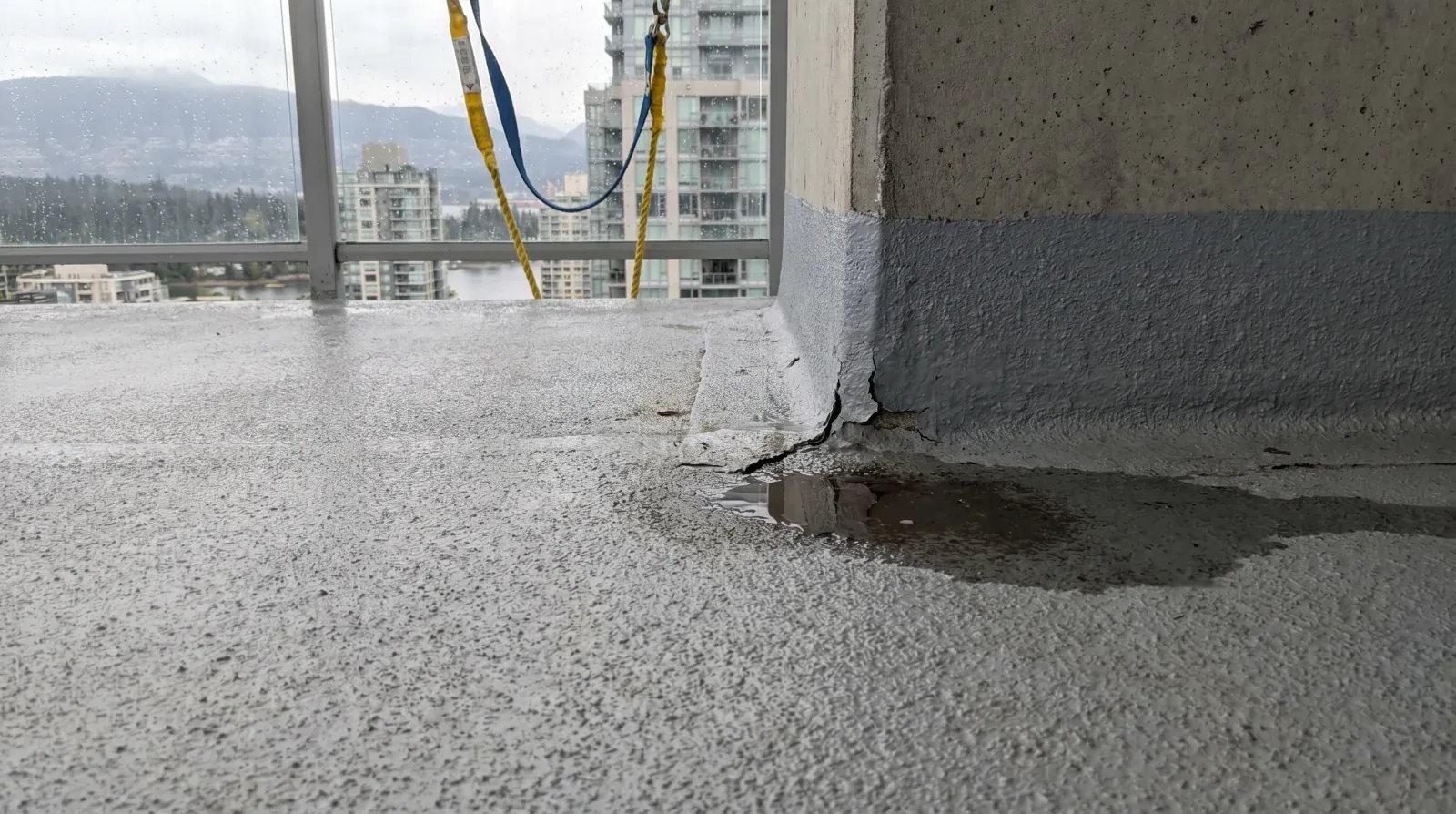
Why balconies leak first on the coast
Average annual precipitation at Vancouver International Airport (1991–2020) — most of it landing on horizontal balcony decks.
Damage from the "leaky condo" crisis across 900+ Lower Mainland buildings — failed balconies and decks were a leading entry point for the water.
The depreciation-report cycle now required of BC strata corporations of 5+ lots under the Strata Property Act, where balcony membranes get tracked as a funded component.
Three questions, in the right order
Most balcony waterproofing decisions go sideways because they're taken out of order — picking a membrane before anyone has diagnosed why the last one failed, or approving a cheap overlay over rotten framing. Work through these three in sequence.
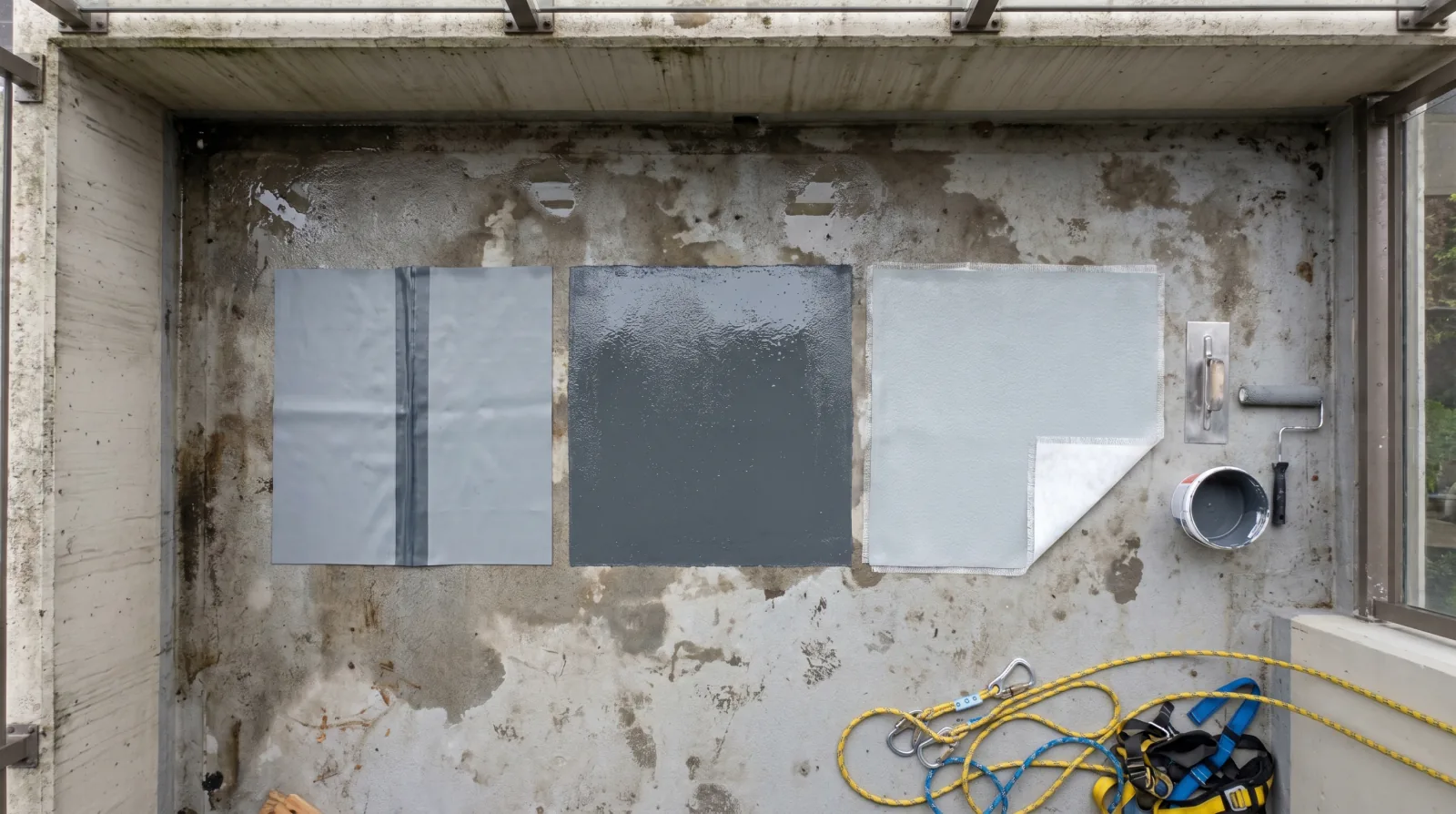 Compare
 Balcony membrane systems compared
Sheet-applied vinyl, liquid polyurethane, and PMMA — what each one is good at, where each one fails on the BC coast, and how to read a manufacturer warranty before it goes on your deck.
Read the guide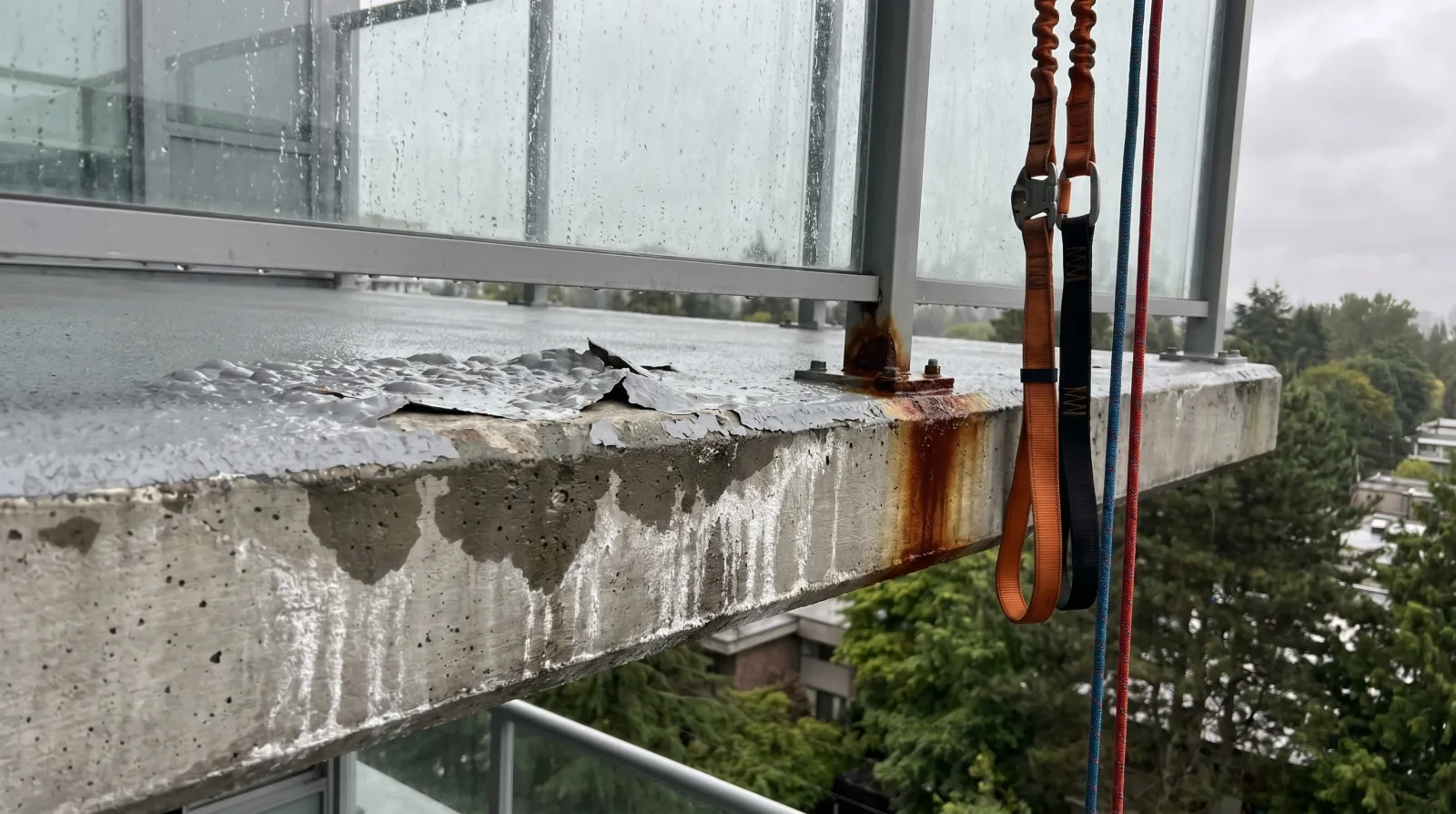 Diagnose
 How to tell a balcony membrane is failing
Ponding, blistering, lifted edges, stains on the soffit below, rust bleeding from the slab edge — the field signs that say the membrane is done, ranked by how urgent they are.
Read the guide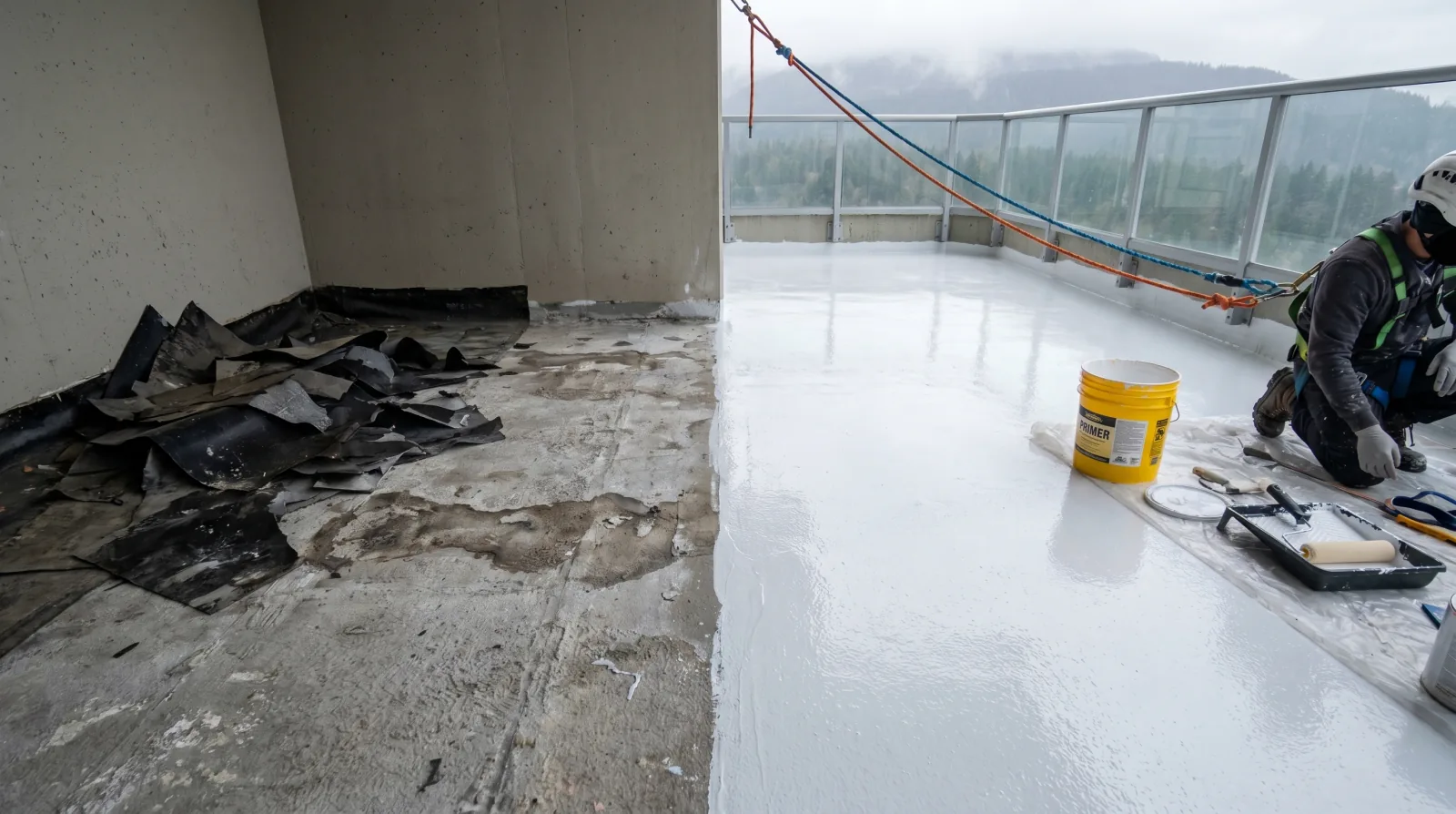 Decide
 Balcony waterproofing: repair, overlay, or replace
When a localized repair is honest, when an overlay buys real time, and when the only defensible move is a full tear-off back to the slab — plus the framing-rot check most owners skip.
Read the guide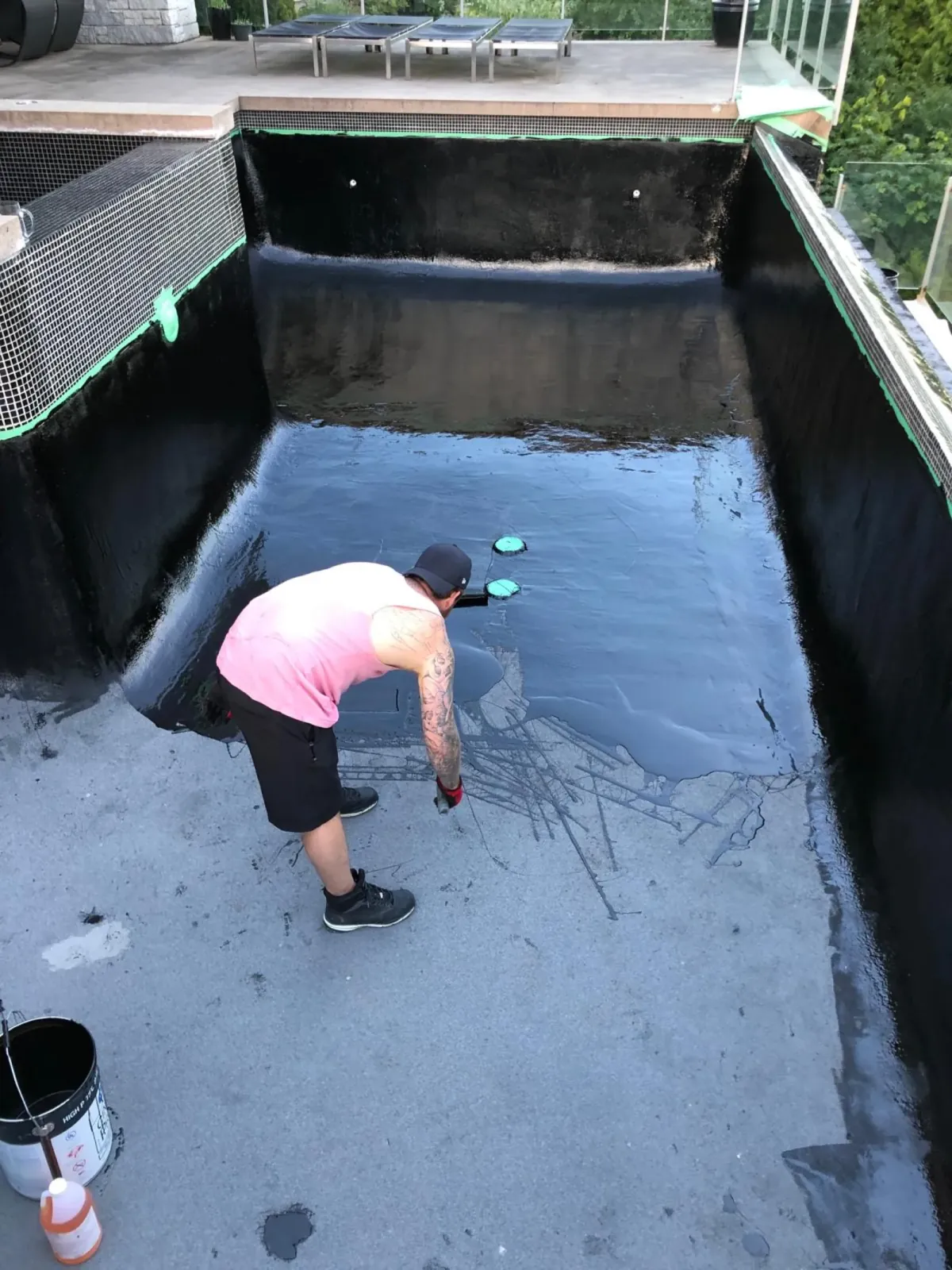 Compare
 Liquid-applied vs. sheet membrane on decks
Seamless cold liquid and PMMA that self-flash the drains and upturns, versus welded sheet and torch-on with factory thickness but field seams, and why hot work is a problem over occupied suites.
Read the guide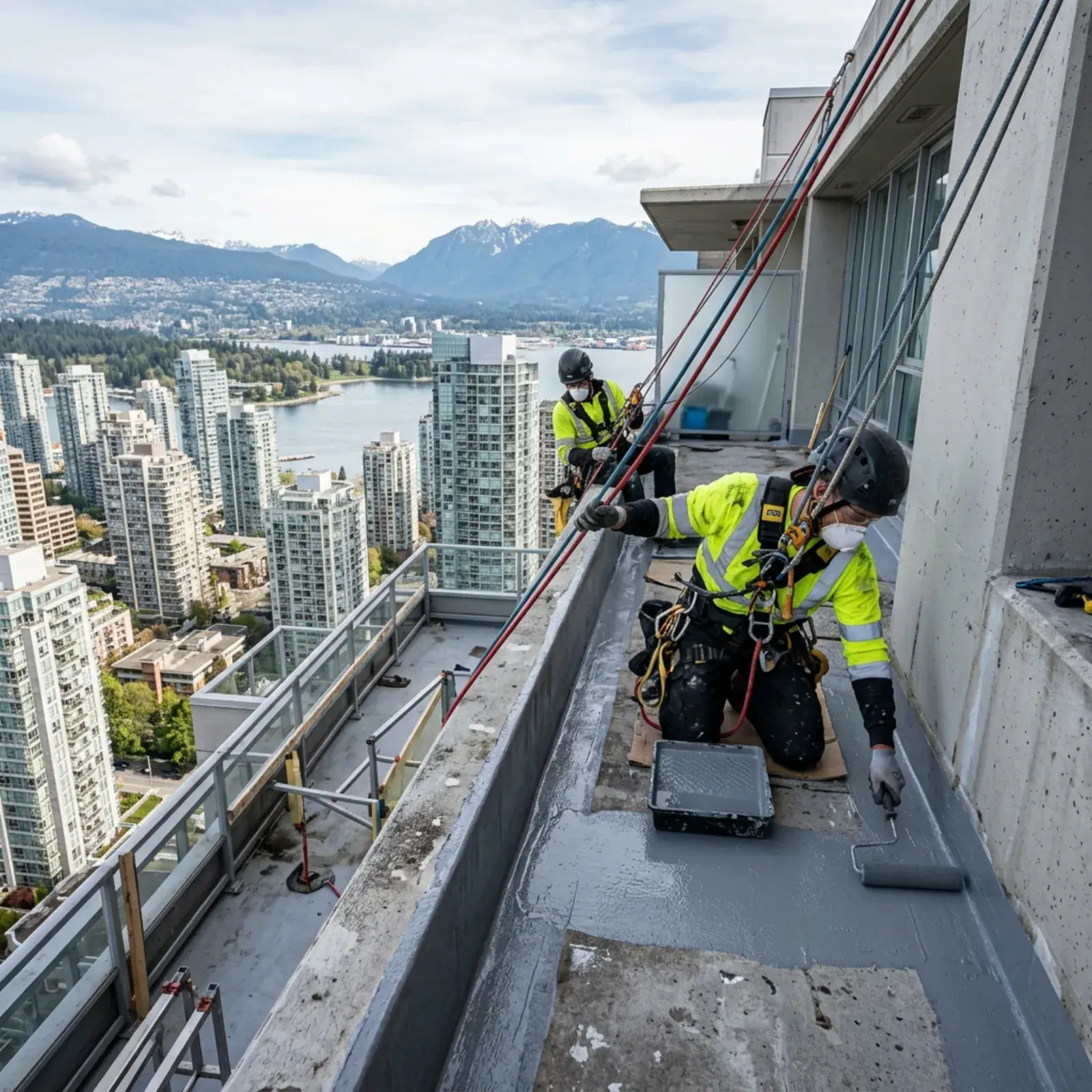 Compare
 Traffic coating vs. waterproof membrane
The wear-and-UV top layer versus the barrier that actually keeps water out, what each one does, why a traffic coat is not a substitute for a membrane, and how to set the recoat cycle.
Read the guide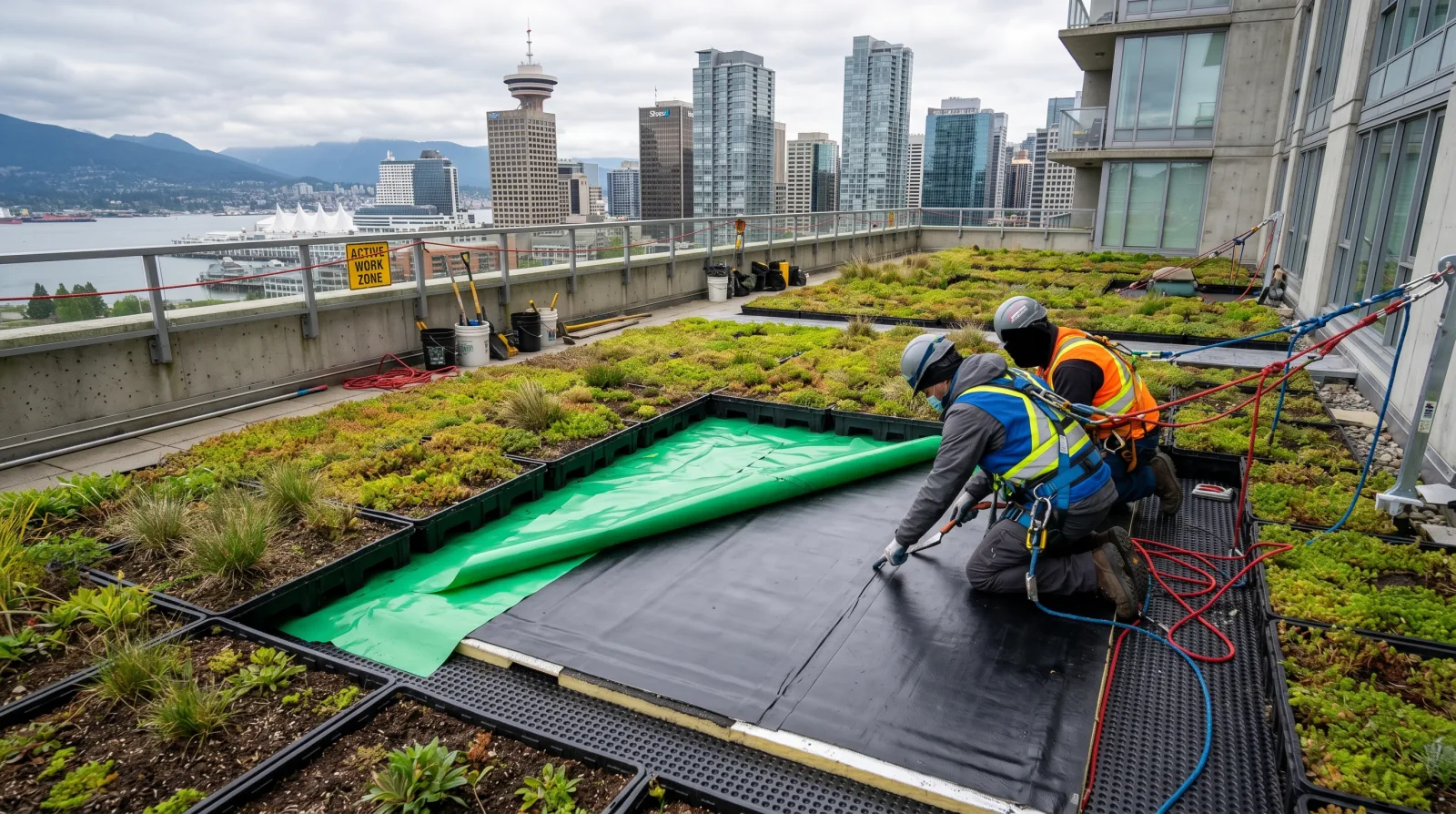 Compare
 Pedestal pavers vs. adhered tile over a membrane
Floating pavers that drain freely and lift out for membrane inspection, versus bonded tile that traps water, heaves in freeze-thaw, and buries the membrane, with the real repair-cost gap on the BC coast.
Read the guideWhat a balcony membrane actually does
A balcony slab is built to carry people and furniture, not to shed water on its own. Concrete is porous, and the joint where the deck meets the wall — the upturn — is exactly where water wants to track inside. The waterproofing membrane is a continuous, flexible skin laid over the deck and turned up the wall a few inches, sealed around drains and the railing posts, that gives the rain a path to the drain instead of into the structure. On a wood-framed balcony there's no margin: the membrane is the only barrier between the weather and joists that rot.
On a concrete balcony the stakes are different but no smaller. When the membrane lets go, water and the chloride it carries off the Strait reach the reinforcing steel in the slab edge. The steel rusts, the rust expands, and the cover concrete cracks off — the brown-stained spalling that connects this hub directly to our concrete restoration guide. A failed balcony membrane and a spalling balcony edge are usually the same problem caught at two different stages.
So a balcony repair is never just "recoat the floor." It's a system: the right membrane for the exposure and traffic, a drain that actually drains, an upturn detail sealed against wind-driven rain, and — where the slab edge has already started to go — concrete repair underneath before anything new goes on top. Skip the detailing and you've spent a special levy on a deck that leaks again next winter.
Where it goes wrong first
The failure almost always starts at a detail, not in the open field of the deck. Drains clog and back up, so water ponds instead of draining and finds the weakest seam. The wall-to-floor upturn opens up where the membrane was never turned up high enough or the sealant has aged out. Railing posts that penetrate the membrane work loose and let water in around the base. And the slab edge — the most exposed concrete on the whole building — is where membrane failure and concrete spalling meet.
None of that is guesswork on a specific deck. A proper assessment looks at the drainage, probes the soft spots, checks the framing on wood-framed balconies, and tests the concrete edge where there's staining before anyone scopes a membrane. The three guides below walk through choosing the system, reading the signs of failure, and making the repair-or-replace call.
Quick answers
What is balcony waterproofing and why does every strata balcony need it?
Balcony waterproofing is the membrane system applied over a concrete or wood-framed balcony deck that keeps water out of the structure underneath. The slab or framing itself is not waterproof — on a concrete balcony the membrane stops water and coastal chloride reaching the reinforcing steel, and on a wood-framed balcony it is the only thing keeping the joists and the suite below dry. Every exposed balcony needs a functioning membrane because the deck is the most weather-loaded horizontal surface on a Metro Vancouver building.
Why do balcony membranes fail so often in Metro Vancouver?
Three coastal factors stack up. Vancouver gets heavy wind-driven rain — the airport averages over 1,180 mm of precipitation a year — so balconies sit wet for long stretches. Sea-salt chloride in the air near the water and freeze-thaw cycling on higher-elevation North Shore buildings both attack the membrane and the concrete edge. And much of the building stock dates from the "leaky condo" decades, when balcony drainage and membrane detailing were often wrong from the start. Add the simple fact that every membrane has a finite service life, and failures are common.
How long does a balcony waterproofing membrane last?
The system, the installation quality, and the deck's exposure decide the lifespan, not a fixed number. A properly installed, professionally maintained membrane on a sheltered deck lasts much longer than a thin coating applied over a poorly prepared substrate on a wind-blasted North Shore corner unit. Rather than trust a single number, a strata should track each deck against its depreciation report and have the membranes inspected on a regular cycle so failures are caught before water reaches the structure. We do not quote a fixed lifespan for a membrane we have not inspected.
From the resources library
Vinyl Deck Membrane vs Liquid-Applied Membrane for BC Balconies
When BC strata balconies need new waterproofing, the choice between vinyl deck membrane and liquid-applied polyurethane membrane drives both upfront cost and long-term maintenance. A side-by-side comparison covering lifespan, repair, walking surface, and where each system makes sense.
Read article ArticleUnderstanding Strata Balcony Membrane Maintenance & Water Ingress in Vancouver
Strata balcony membranes bear the brunt of Vancouver's intense rain. We review the lifespan of vinyl, liquid polyurethane, and PMMA waterproofing systems, outline maintenance duties under the Strata Property Act, and explain how to prevent moisture damage.
Read article ArticleWhat Causes Water Ingress in High-Rise Buildings?
Water ingress can cause major structural damage. We break down the top causes of leaks in concrete structures, from wind-driven rain bypassing failed window perimeters to structural expansion joint tears and cracked stucco.
Read articleServices this guide connects to
Balcony waterproofing questions
What is balcony waterproofing and why does every strata balcony need it?
Balcony waterproofing is the membrane system applied over a concrete or wood-framed balcony deck that keeps water out of the structure underneath. The slab or framing itself is not waterproof — on a concrete balcony the membrane stops water and coastal chloride reaching the reinforcing steel, and on a wood-framed balcony it is the only thing keeping the joists and the suite below dry. Every exposed balcony needs a functioning membrane because the deck is the most weather-loaded horizontal surface on a Metro Vancouver building.
Why do balcony membranes fail so often in Metro Vancouver?
Three coastal factors stack up. Vancouver gets heavy wind-driven rain — the airport averages over 1,180 mm of precipitation a year — so balconies sit wet for long stretches. Sea-salt chloride in the air near the water and freeze-thaw cycling on higher-elevation North Shore buildings both attack the membrane and the concrete edge. And much of the building stock dates from the "leaky condo" decades, when balcony drainage and membrane detailing were often wrong from the start. Add the simple fact that every membrane has a finite service life, and failures are common.
How long does a balcony waterproofing membrane last?
The system, the installation quality, and the deck's exposure decide the lifespan, not a fixed number. A properly installed, professionally maintained membrane on a sheltered deck lasts much longer than a thin coating applied over a poorly prepared substrate on a wind-blasted North Shore corner unit. Rather than trust a single number, a strata should track each deck against its depreciation report and have the membranes inspected on a regular cycle so failures are caught before water reaches the structure. We do not quote a fixed lifespan for a membrane we have not inspected.
Can a balcony be waterproofed while the building stays occupied?
Yes — most strata and commercial balcony work runs on occupied buildings. The work is sequenced by stack or elevation, residents get written notice before crews are on their balcony, grinding and prep noise is confined to agreed daytime windows, and balconies are returned to use as each deck cures. Fast-cure systems like PMMA are sometimes chosen specifically because they let a deck be back in service the same day in cool, wet weather.
Does a depreciation report cover balcony waterproofing?
A depreciation report identifies balcony membranes as a funded future maintenance component and estimates their remaining service life and reserve cost — it flags and helps fund the work, but it is not an installation specification. Under the Strata Property Act, BC strata corporations of five or more lots must obtain a depreciation report on a five-year cycle, with a July 1, 2026 deadline for Metro Vancouver stratas that do not have a current one. When the report flags the membranes, the next step is a condition review to scope the actual waterproofing.
How do crews waterproof balconies on a high-rise without scaffolding the whole building?
The deck itself is worked from the balcony, but the edge details, drips, and any facade tie-in are reached by IRATA or SPRAT certified rope-access technicians rigging from engineered roof anchors on two independent lines under WorkSafeBC Part 11 fall-protection rules. Rope access keeps sidewalks and resident access open with small barricaded zones instead of a full scaffold or swing-stage wrap, which is why it suits phased, stack-by-stack balcony programs.
Water coming through a balcony?
We assess balcony membranes and slab edges on strata and commercial buildings across Vancouver, North Vancouver, West Vancouver, and Burnaby — and scope the waterproofing so it actually solves the leak instead of hiding it.