Balcony membrane systems compared
Three families of waterproofing system cover almost every Metro Vancouver balcony: sheet-applied vinyl, liquid polyurethane, and PMMA resin. None of them is "best" in the abstract — they're best for different decks. Here's what each one is actually good at, where each one fails on the coast, and how to read the warranty before it goes down.
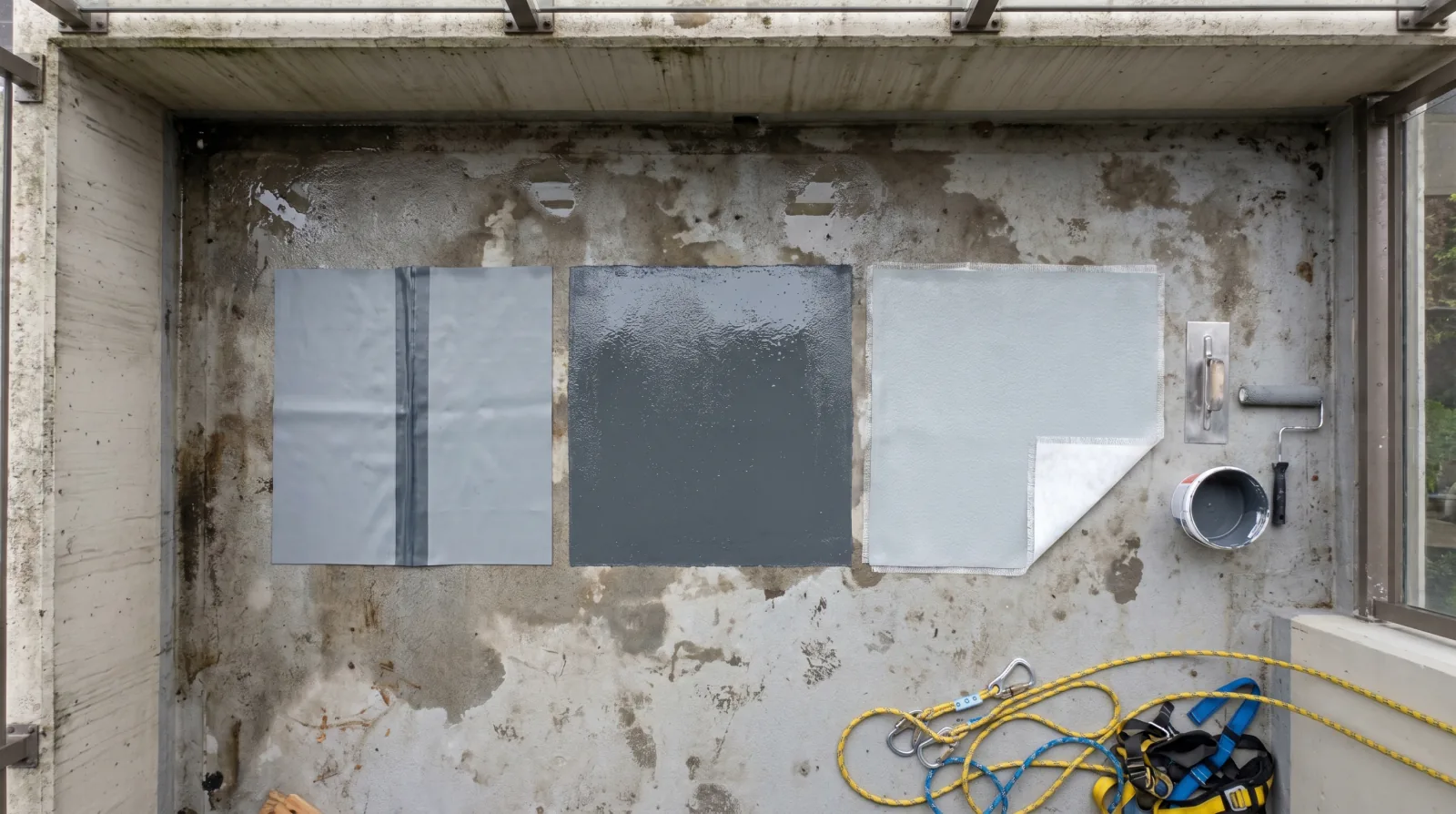
The detail decides the system
Before comparing products, understand where balconies actually leak. It's almost never the open middle of the deck — it's the drain, the wall upturn, and the railing posts that puncture the membrane. That's why the seam count and the detailing behaviour of a system matter more than any single performance number. A seamless liquid that self-flashes around a post will beat a stronger sheet that has to be welded around the same post by hand. Keep that in mind as you read the three.
The three systems, side by side
Sheet-applied vinyl (PVC)
Factory-made vinyl sheet rolled out over the deck and heat-welded at the seams, finished with a walkable textured surface.
Consistent factory thickness, walkable straight away, well understood on older strata decks where it has been the default for decades.
Every seam and every detail around a post or drain is a field weld that can fail; once water gets under the sheet it tracks sideways and the leak shows up far from the breach.
Straightforward rectangular decks with simple details, and like-for-like replacement where the building already runs vinyl.
Liquid polyurethane
A flexible liquid coating rolled or sprayed on in coats over a primer, curing into one continuous seamless membrane with no welded joints.
Seamless — it self-flashes around drains, posts, and the wall upturn with no seams to fail, and it bridges hairline movement in the deck. Strong fit for irregular decks and detail-heavy balconies.
Performance lives and dies on surface prep and film thickness; applied thin or over a damp or dirty substrate it blisters and peels. It also needs dry-enough, warm-enough conditions to cure, which is a real constraint in a Vancouver winter.
Irregular decks, lots of penetrations, and buildings that want a seamless system and can give the substrate proper prep and a weather window.
PMMA / PUMA resin
A reactive liquid resin, usually applied with a fleece reinforcement layer, that cures by chemical reaction rather than by drying.
Cures fast and in cold, damp conditions where other liquids stall — a deck can be back in use the same day. Tough, abrasion-resistant, and excellent for the wall upturn and detail work.
Material cost is higher, it has a strong odour during application that needs managing on an occupied building, and the fast cure leaves a short working window that demands an experienced crew.
High-traffic decks, tight occupied-building schedules, cold or wet-season work, and detailing where a fast, tough, fully-bonded system earns its premium.
Reading the warranty before you trust it
A long manufacturer warranty number sells a system, but it describes the material in a lab, not your deck in February. The performance you actually get depends on three things the warranty assumes and rarely guarantees: that the substrate was prepared and dry, that the membrane was applied at its specified film thickness, and that the detailing at drains and upturns was done to the manufacturer's instructions. A liquid polyurethane sprayed thin over a damp deck carries the same paper warranty as one applied properly — and fails years sooner.
So the question to a contractor isn't "what's the warranty," it's "how will you verify the prep and the thickness, and who inspects the detailing." On a strata, that's exactly what the engineer's specification exists to lock down. The product matters; the install matters more.
Where the concrete comes into it
One thing no membrane fixes: a slab edge that's already spalling. If the balcony edge is staining brown and sounding hollow, the reinforcing steel underneath is corroding, and laying a new membrane over it just buries an active problem. The concrete repair has to come first — chip back to sound material, treat the steel, rebuild the profile — and then the new waterproofing goes on. That sequence is covered in our concrete repair-or-replace guide, and it's why a real balcony scope often includes both trades.
Quick answers
What is the best balcony waterproofing membrane for a Vancouver strata?
There is no single best system — it depends on the deck. Irregular decks with lots of penetrations favour a seamless liquid polyurethane or PMMA system because there are no welded seams to fail. Simple rectangular decks, or a building already running sheet vinyl, may be best served by like-for-like vinyl replacement. High-traffic or tight-schedule decks lean toward fast-cure PMMA. The right call comes from a deck assessment and, on a strata, the engineer's specification — not from a product brochure.
Is liquid waterproofing better than a sheet membrane?
Each beats the other in different situations. Liquid systems are seamless, so they self-flash around drains, posts, and the wall upturn with nothing to weld — a real advantage on detail-heavy or irregular decks. Sheet vinyl gives a consistent factory thickness and is walkable immediately, but every seam is a field weld and water under the sheet travels sideways before it shows. Liquid systems are only as good as the surface prep and film build behind them, so a poorly applied liquid coating can underperform a well-welded sheet.
Why is PMMA used on balconies if it costs more?
PMMA cures by chemical reaction in roughly an hour and tolerates cold, damp conditions, so a balcony can be back in service the same day — which matters on an occupied strata where you cannot close a stack of balconies for a week. It is also tough and abrasion-resistant and excellent at the wall upturn and around penetrations. The trade-offs are higher material cost, a strong application odour to manage, and a short working window that needs an experienced crew.
Membrane system questions
What is the best balcony waterproofing membrane for a Vancouver strata?
There is no single best system — it depends on the deck. Irregular decks with lots of penetrations favour a seamless liquid polyurethane or PMMA system because there are no welded seams to fail. Simple rectangular decks, or a building already running sheet vinyl, may be best served by like-for-like vinyl replacement. High-traffic or tight-schedule decks lean toward fast-cure PMMA. The right call comes from a deck assessment and, on a strata, the engineer's specification — not from a product brochure.
Is liquid waterproofing better than a sheet membrane?
Each beats the other in different situations. Liquid systems are seamless, so they self-flash around drains, posts, and the wall upturn with nothing to weld — a real advantage on detail-heavy or irregular decks. Sheet vinyl gives a consistent factory thickness and is walkable immediately, but every seam is a field weld and water under the sheet travels sideways before it shows. Liquid systems are only as good as the surface prep and film build behind them, so a poorly applied liquid coating can underperform a well-welded sheet.
Why is PMMA used on balconies if it costs more?
PMMA cures by chemical reaction in roughly an hour and tolerates cold, damp conditions, so a balcony can be back in service the same day — which matters on an occupied strata where you cannot close a stack of balconies for a week. It is also tough and abrasion-resistant and excellent at the wall upturn and around penetrations. The trade-offs are higher material cost, a strong application odour to manage, and a short working window that needs an experienced crew.
How thick should a balcony waterproofing membrane be?
Thickness is set by the manufacturer's specification for the chosen system and the expected traffic, and it is one of the most common places a job is cut short. A liquid membrane applied below its specified dry-film thickness will not deliver its rated performance no matter what the warranty says, which is why a reputable installer documents coverage rates and wet-film readings as the work goes on. Ask how thickness will be verified before you award the job.
Does the membrane choice affect how long the balcony stays out of use?
Yes, and on an occupied building it can be the deciding factor. Sheet vinyl is walkable as soon as it is welded. Liquid polyurethane needs cure time between coats and is weather-dependent, so it can take a balcony out of service for longer in wet conditions. PMMA cures fast even in the cold and gets a deck back the same day. When a stack of residents loses balcony access during the work, the faster-curing system is often worth its premium.
Not sure which membrane your deck needs?
We assess balcony decks across Vancouver, North Vancouver, West Vancouver, and Burnaby and match the system to the exposure, the traffic, and the schedule — not to whatever's on the truck.