Understanding Strata Balcony Membrane Maintenance & Water Ingress in Vancouver
How Long Do Strata Balcony Membranes Last in Vancouver?
Strata balcony membranes in Vancouver last 15 to 20 years for properly installed liquid polyurethane systems and 10 to 15 years for PVC sheet vinyl membranes, depending on UV exposure, foot traffic, and quality of original installation. Early warning signs of membrane failure include bubbling near railing post penetrations, water staining on the underside of the balcony slab below, and soft spots in the plywood substrate when pressed. Annual inspections are recommended for buildings over 15 years old.
The Reality of Balcony Waterproofing in the Pacific Northwest
Strata buildings in the Lower Mainland exist in a challenging climate. According to Environment and Climate Change Canada data, Vancouver International Airport averages 1,189 mm of precipitation a year, with the vast majority falling during the wind-driven storm season from October to March. In locations closer to the mountains, such as North Vancouver or Coquitlam, annual rainfall easily exceeds 1,600 mm. For a building envelope, this means months of continuous saturation, placing extreme hydrostatic pressure on every exterior deck and balcony membrane.
Too often, strata councils treat balcony surfaces as simple walking decks. In reality, they are horizontal roof structures that protect the living spaces directly below them. A single breach in a balcony membrane can lead to extensive water ingress, structural wood rot in low-rise framing, or structural concrete deterioration in high-rise towers. Understanding the components of these systems, the legal framework surrounding their upkeep, and the specific material behaviors is what saves strata corporations from seven-figure envelope failures.
Sheet Vinyl vs. Liquid Polyurethane vs. PMMA: Waterproofing Technologies Compared
When planning a membrane replacement project, strata councils must evaluate different material options. The three most common waterproofing systems installed on Metro Vancouver balconies have distinct characteristics, installation demands, and performance lifecycles. For a side-by-side breakdown of where each one wins and fails, see the balcony membrane systems comparison in our balcony waterproofing hub.
1. Pre-Manufactured Sheet Vinyl (PVC)
Often referred to by brand names like Duradek, PVC sheet vinyl is a popular choice for low-to-mid-rise wood-frame buildings. Typically 60 mils (1.5 mm) thick and meeting CAN/CGSB 37.54-92 standards, vinyl sheets are rolled out over a plywood substrate, glued down, and hot-air welded at the seams.
- The Shop Perspective: Vinyl is highly effective for simple, rectangular decks with straight runs. Because it serves as both the waterproofing layer and the slip-resistant walking surface in a single application, it minimizes installation steps.
- The Practical Limitation: Vinyl relies entirely on the integrity of its welded seams and detailing around railing posts. In complex geometries—such as balconies with multiple corners, structural columns, or complex drainage penetrations—welding sheet vinyl becomes difficult. If a seam fails or a barbecue leg punctures the sheet, water gets trapped underneath, rotting the plywood deck before a leak becomes visible inside.
2. Liquid-Applied Polyurethane Membranes
Polyurethane coatings (often sourced from manufacturers like Sika, Tremco, or BASF) are liquid resins applied in multiple coats with rollers or squeegees. They cure to form an elastic rubber membrane with no seams, bonded directly to concrete or plywood.
- The Shop Perspective: This system is ideal for high-rise concrete balconies with complex shapes, cast-in-place railing posts, and tight clearances. Because there are no seams, there is no seam to fail. It easily conforms to vertical turn-ups at wall transitions and seals tight around floor drains.
- The Practical Limitation: Application is highly sensitive to site conditions. Concrete moisture content must register below 5% (typically verified using a moisture meter or ASTM D4263 plastic sheet test) before priming. If applied on a damp balcony slab during a typical Vancouver spring window, vapor transmission will cause the membrane to blister, debond, and peel within months.
3. Polymethyl Methacrylate (PMMA)
PMMA is a high-performance, rapid-curing liquid resin. It is reinforced with a polyester fleece during installation, forming a tough, monolithic barrier.
- The Shop Perspective: PMMA is a premium option, favored for high-traffic walkways, plaza decks, and complex strata balcony rehabilitations. Its curing time is remarkably fast—often dry to the touch in under an hour. This allows crews to apply primers, base coats, reinforcement, and wear coats in a single day, minimizing access restrictions for residents.
- The Practical Limitation: The material costs are significantly higher than polyurethane or PVC sheets. Installation requires specialized equipment and certified applicators who understand the fast chemistry. For stratas with a long-term view, however, the 25+ year service life of PMMA often offsets the initial expense.
Common Failure Modes: How Vancouver Balconies Let Water In
In our decades of inspecting exterior envelopes across Burnaby, Surrey, and Vancouver, we see the same failure patterns repeat. Water ingress rarely starts in the middle of a clear deck. It begins at the transitions, penetrations, and perimeter detailing — the signs-of-failure guide ranks these by urgency, and where the slab edge is already rusting, that’s where this connects to concrete restoration.
Railing Post Penetrations
Older strata buildings often feature aluminum railings bolted directly through the top of the balcony slab. When the sealant around these bolt penetrations dries out and cracks, water runs down the bolt threads directly into the concrete. Once inside, the water meets the steel reinforcing bars (rebar). As the steel corrodes, it expands up to ten times its original volume, splitting the concrete apart—a process known as concrete spalling. Modern designs avoid this by using fascia-mounted railings bolted to the outer vertical face of the slab.
Inadequate Door Threshold Heights
The BC Building Code Division B Section 9.27 sets strict standards for exterior door sill heights. Balcony door thresholds must step up at least 150 mm (6 inches) from the finished deck surface to the interior floor. On older buildings, or on balconies where owners have laid heavy wood tiles directly over the membrane, this height is compromised. During heavy winter rains, wind-driven water pools against the door sill and overflows the flashing, rotting the subfloor beneath the living room carpet.
Clogged Drains and Lack of Slope
Balconies must slope toward drains at a minimum 2% grade to ensure positive drainage. Over time, building settlement or poor initial concrete placement can create “low spots” where water ponds. When debris like leaves, pine needles, or moss blocks the small floor drains, a balcony can fill with several inches of water. Under standing water, minor micro-cracks in the membrane are forced open by hydrostatic pressure, initiating leaks into the concrete structure.
Who Pays for What? Balcony Maintenance Under the BC Strata Property Act
Strata councils in British Columbia frequently debate whether balconies are the responsibility of the individual unit owner or the strata corporation. The answer lies in the BC Strata Property Act Section 72 and the specific registered strata plan.
In almost all residential strata towers in Burnaby, North Vancouver, and Vancouver, the structural concrete slab and the waterproofing membrane are classified as common property (or limited common property). Under the Strata Property Act, the strata corporation has a statutory obligation to repair and maintain common property. Even if a balcony is designated as Limited Common Property (LCP) for the exclusive use of a single resident, the corporation remains responsible for the envelope barrier.
Individual unit owners are typically responsible for basic, surface-level maintenance. This includes sweeping debris, keeping the drain grate clear of leaves, and washing the walking surface using non-abrasive tools. Owners should never use high-pressure washers, lay heavy ceramic tiles, or place sharp-legged furniture directly on the membrane. If an owner’s neglect—such as letting a clogged drain overflow into their suite—causes damage, the strata may seek to recover the costs, but the physical repair of the envelope remains the strata’s responsibility to coordinate and execute.
The Strata Maintenance Blueprint: Protecting Your Investment
Preventative maintenance is the only way to avoid the premature failure of balcony membranes. The Condominium Home Owners Association of BC (CHOA) states directly that proactive building envelope management protects the strata’s contingency reserve fund (CRF).
Strata councils should establish a structured maintenance routine:
- Biennial Professional Inspections: Strata corporations should engage a qualified building envelope engineer to perform visual inspections of all balcony membranes, flashings, sealants, and railing connections every two years. This aligns with BC Housing’s Maintenance Matters Bulletin No. 6.
- Annual Sealant Reviews: The sealant joints around door thresholds, sliding track assemblies, and wall penetrations should be checked every fall. Polyurethane and silicone sealants exposed to coastal UV and wind-driven rain have a typical service life of 5 to 7 years and must be cut out and replaced before they fail.
- Owner Education: Strata councils should issue clear balcony guidelines to residents every spring and fall. These guidelines should outline rules against power-washing, using heavy planters without drainage saucers, or blocking floor drains with outdoor rugs.
High-Rise Access: Rope Access vs. Swing Stages
For high-rise concrete structures, accessing exterior balconies to perform inspections, sealant replacements, or localized membrane repairs is a major cost driver. Traditional swing stages require heavy roof rigging, building permits, and days of setup time.
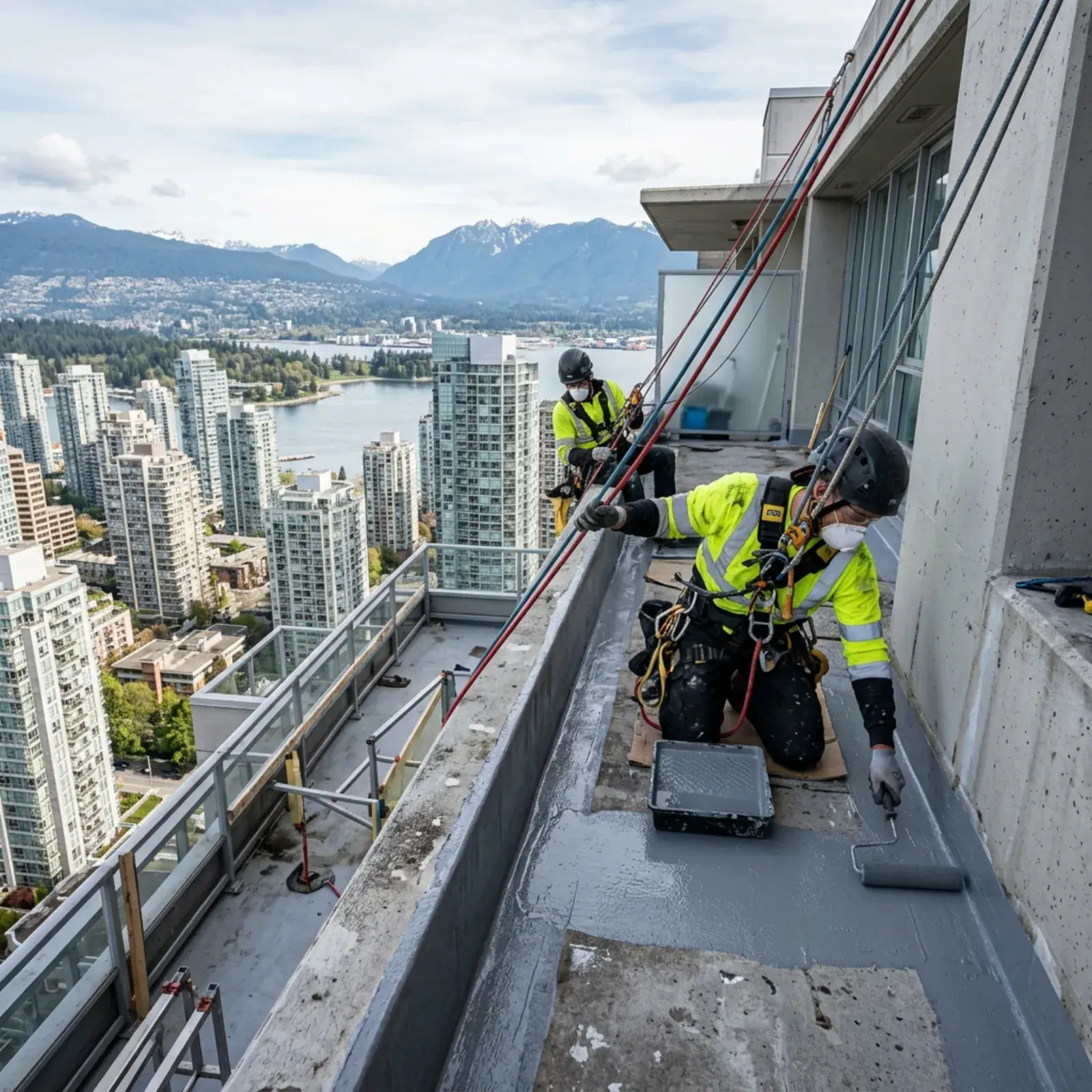
Industrial rope access (utilizing certified IRATA or SPRAT technicians) has become the preferred choice for strata buildings in Vancouver. Technicians descend directly from certified roof anchor points on two independent safety lines under compliance with WorkSafeBC Part 11 regulations. Rope access minimizes resident disturbance, eliminates the safety hazards of heavy overhead scaffolding, and significantly reduces mobilization costs. This makes small, localized waterproofing repairs financially viable before water damage spreads across the building facade.
Maintaining balcony membranes protects more than the concrete underneath. Regular inspections, prompt response to ponding, and certified access professionals together extend the life of the building envelope and protect the structural safety and resale value of the whole strata community, helping councils avoid unexpected, high-cost special levies.
What we see on assessment: the pattern that keeps repeating
In assessments across Metro Vancouver strata buildings — low-rise wood-frame in Surrey, mid-rise concrete in Burnaby, and high-rise towers along Vancouver’s waterfront — one pattern holds across almost every membrane failure we find. The failure is not in the open field of the deck. It is at a detail: a railing post penetration where the original sealant was never tooled properly, or a wall upturn that was turned up 50 mm instead of the code-required 150 mm, leaving barely enough material to seal against wind-driven rain. By the time the strata calls us, there is already water in the wall or moisture in the plywood subfloor, and the project scope has grown from a simple reseal to a full membrane tear-off with structural framing repair underneath.
The call we want to receive is the early one. A strata that books a balcony membrane condition inspection when the membrane is showing its first signs — minor bubbling at a post base, a drain collar that is pulling away slightly, a hairline crack at the wall transition — almost always avoids the structural work. The membrane can be dried, prepped, and resealed over the detail before water reaches what is below it. That same condition, left to one more wet season, turns into a replacement project with rot remediation added to the scope.
linkedinShare: | Deferred balcony membrane maintenance is one of the more reliably expensive mistakes a strata council makes.
Not because membranes are inherently difficult to maintain — they’re not. Vinyl, liquid polyurethane, and PMMA systems all have published service lives and maintenance requirements. The problem is that membranes fail gradually, and the damage they allow accumulates underneath where it isn’t visible until it’s significant.
In BC, under the Strata Property Act, the strata corporation is responsible for maintaining common property — which includes balcony membranes in most strata plans. Individual owners don’t get to defer the work, and the strata can’t assign the liability elsewhere when the membrane fails and the unit below is damaged.
Vancouver and Burnaby strata councils dealing with older towers face a particular version of this: buildings where the original membrane was installed 15 to 20 years ago, has had spot repairs but no full replacement, and is now at the point where the spot repairs are outnumbering the intact sections.
At that stage, the question isn’t whether to replace — it’s whether the substrate is still sound enough to accept a new membrane directly, or whether remediation is needed first.
Vinyl systems and liquid-applied polyurethane both have legitimate roles depending on the substrate condition and traffic load. PMMA makes sense when downtime is a constraint. The membrane choice should come after the substrate assessment, not before.
The post breaks down what a proper membrane assessment looks like and how to compare system options.
#BalconyWaterproofing #StrataMaintenance #BuildingEnvelope #PMMA #Vancouver
The July 1, 2026 depreciation report deadline and balcony membranes
BC strata corporations of five or more lots in the Metro Vancouver, Fraser Valley, and Capital Regional District areas are required to have a current depreciation report in place by July 1, 2026, under the 2024 amendments to the Strata Property Act Regulation. Reports must be renewed on a five-year cycle with no deferral option.
Balcony waterproofing membranes are funded components in every depreciation report — they are tracked by type, estimated service life, and replacement cost. If your strata’s current or incoming depreciation report flags the membranes as “Fair,” “Poor,” or past estimated service life, that is the trigger to book a physical condition assessment before the next wet season. The report tells you what is in the lifecycle model; a condition assessment tells you what is actually happening on the deck.
For stratas that do not yet have a compliant report, the July 1 deadline also means this is the season when balcony membrane condition assessments are most useful: they give the assessor current, accurate lifecycle and condition data to build a defensible reserve fund model around, rather than using database averages that may not reflect the specific condition of your building’s decks. The strata guide on depreciation reports covers how to read the building envelope section and what to do when it flags your membranes.
Frequently Asked Questions
More from Balcony Waterproofing Guide
Vinyl Deck Membrane vs Liquid-Applied Membrane for BC Balconies
When BC strata balconies need new waterproofing, the choice between vinyl deck membrane and liquid-applied polyurethane membrane drives both upfront cost and long-term maintenance. A side-by-side comparison covering lifespan, repair, walking surface, and where each system makes sense.
Read article →What Causes Water Ingress in High-Rise Buildings?
Water ingress can cause major structural damage. We break down the top causes of leaks in concrete structures, from wind-driven rain bypassing failed window perimeters to structural expansion joint tears and cracked stucco.
Read article →