Traffic coating vs. waterproof membrane: two layers, two jobs
These are not two options you pick between. On a properly built balcony they are two layers of one system, stacked. The waterproof membrane is the barrier bonded to the deck that keeps water out of the structure. The pedestrian traffic coating is the wear-and-UV surface on top that protects the membrane and gives a slip-resistant floor to walk on. The traffic coat is meant to wear out and be refreshed on a schedule, often every several years depending on traffic and exposure; the membrane is meant to last for many years. The costly mistake, made on Metro Vancouver strata decks every season, is treating a fresh traffic coat as if it were waterproofing.
Get the distinction right and the money goes where it belongs. A dull, thinning surface with a dry structure below is a routine wear-layer refresh, cheap and scheduled. Stains or drips in the suite below, rust bleeding from a slab edge, or soft spots on a wood-framed deck mean water has already passed the membrane, and that is a repair no top-coat can fix. This guide explains the stack from the concrete up, the recoat cycle, how to tell a worn surface from a breached membrane, and the warranty language that decides whether you are actually protected.
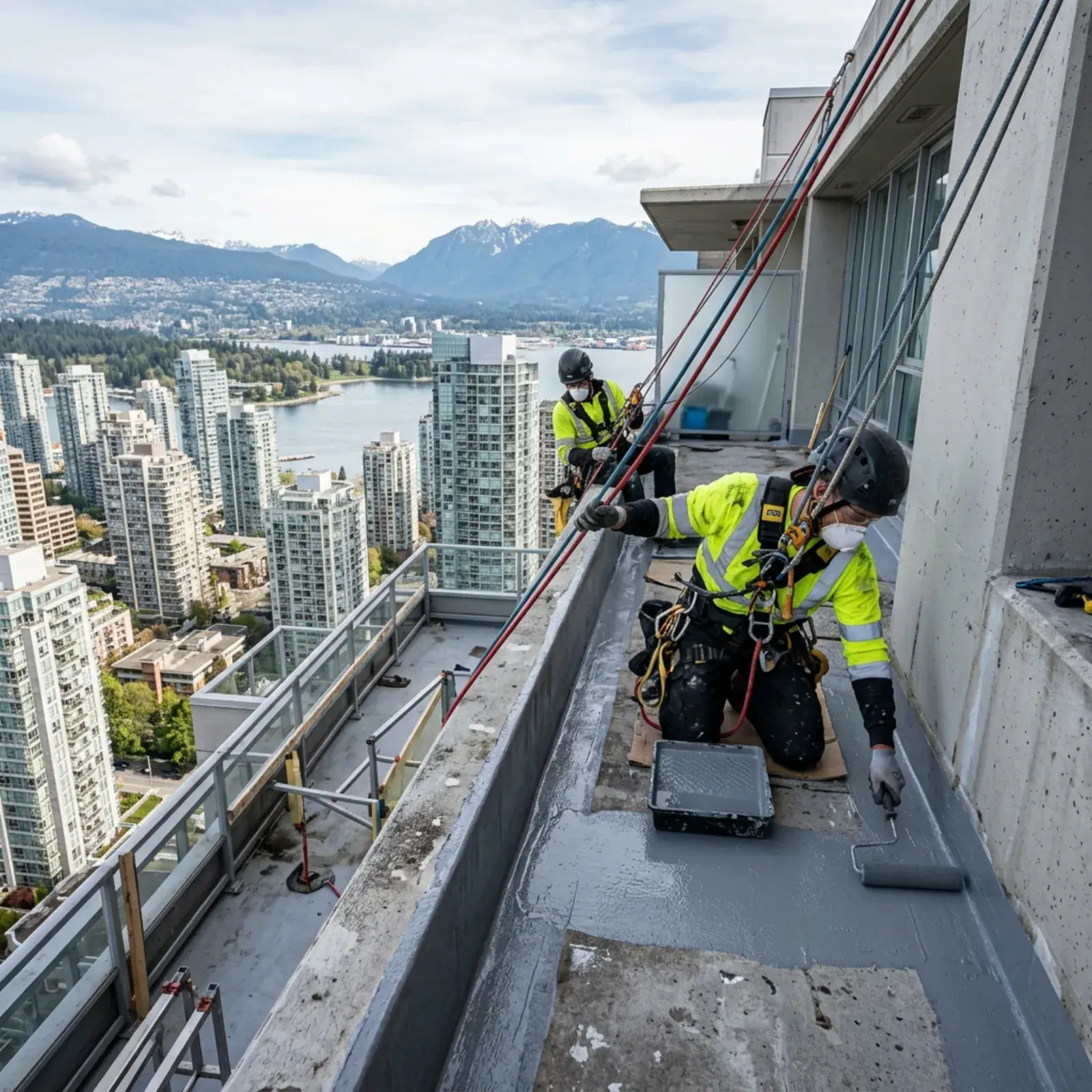
The stack, from the concrete up
Picture a cross-section of a balcony floor. At the bottom is the deck, a concrete slab or a wood-framed platform. Bonded to it is the waterproof membrane, turned up the wall a few inches and sealed around the drain and every railing post. On top of the membrane sits the traffic coating: usually a top-coat with aggregate broadcast into it for grip, finished with a UV-stable sealer. When you walk on the balcony, you are walking on the traffic coat. The membrane, the part doing the waterproofing, never sees your shoe. That is the whole idea. The wear layer takes the abuse so the waterproofing does not.
In a cold liquid-applied system the two layers are often part of one specification. The base coat is the membrane, bonded to the primed deck, and the top-coat with its aggregate is the wearing surface, exactly what ASTM C957/C957M describes as a cold liquid-applied elastomeric membrane with an integral wearing surface. The base coat carries the waterproofing; the top-coat resists wear and weather. That is why refreshing the surface and repairing the membrane are two different events even on the same assembly: you recoat the wearing surface on a schedule, and you only touch the base coat when the waterproofing itself has actually failed.
What each layer is actually for
Waterproof membrane
The continuous barrier bonded to the deck that actually keeps water out of the structure. On a balcony this is a liquid polyurethane, a PMMA resin, or a welded sheet, turned up the wall and sealed at drains and posts.
Pedestrian traffic coating
The wear-and-UV surface applied over the membrane: a top-coat, often with broadcast aggregate for grip, plus a UV-stable sealer. It takes the abuse the membrane cannot.
Decision framework: which layer are you actually dealing with
| Situation | Points to | Reason |
|---|---|---|
| Someone says "just recoat the balcony floor"? | Clarify which layer | Recoating the traffic surface is routine maintenance. Recoating because the membrane failed is a repair. Those are different jobs with different costs, and the words get used loosely. |
| Surface looks worn but there are no leaks below? | Likely a traffic-coat refresh | A dull, thinning walking surface over a sound, bonded membrane is exactly what the traffic coat is meant to do. Clean, prep, and recoat the wear layer before it reaches the membrane. |
| Stains or drips in the suite below? | Membrane problem, assess | Water in the structure means the waterproofing has been breached. A new traffic coat over a failed membrane hides the symptom and lets the damage keep going. |
| Traffic coat has worn through to the base layer? | Recoat now, before it spreads | Once the wear layer is gone, the membrane takes the traffic and UV directly. A prompt recoat is cheap; a membrane worn out early is not. |
| Buying a warranty on "the coating"? | Confirm what it covers | A warranty on the top-coat is not a warranty on the waterproofing. Ask specifically whether the membrane, the detailing, and the traffic layer are each covered, and for how long. |
| High-traffic deck (amenity roof, shared terrace)? | Shorter recoat interval | A busy shared deck wears its traffic coat faster than a lightly used private balcony. Set the recoat schedule to the actual traffic, not a generic number. |
| Bare concrete or bare plywood deck with no membrane at all? | Membrane first, always | A traffic coating on a bare deck is a walking surface, not waterproofing. On wood framing especially, a surface-only coat over plywood is one wet winter from rot. Install a real membrane first. |
| Ponding water sitting on the surface after rain? | Fix the slope before any coating | Standing water is a drainage problem no top-coat solves. Codes call for positive slope to the drain, typically about 2%. Correct the slope, then recoat, or the water just keeps working at the deck. |
Why a traffic coating is not a substitute for a membrane
A traffic coating protects against water to a degree, but its primary function is to bear pedestrian traffic and shed UV, not to keep water out of the building. Put a traffic layer on a bare deck with no membrane under it, and you have a walking surface that will let water through as soon as it wears, cracks at a detail, or fails at the upturn. The building owner thinks the deck is waterproofed. It is not. This shortcut shows up most often on quick "refresh the balcony" jobs where the crew coats what is there without confirming a real membrane exists underneath. On a wood-framed deck that gap is dangerous: the framing has no second line of defence, so a surface-only coating over bare plywood is one wet winter away from rot.
Metro Vancouver has an expensive history with exactly this kind of shortcut. The leaky-condo era of the 1990s and 2000s was, in large part, a lesson in what happens when water gets into wood-frame assemblies and stays there, and decks were a frequent entry point. That history is why a real waterproofing membrane, not just a surface finish, is the standard of care on any deck over occupied or wood-framed space, and why confirming the membrane exists and is sound is the first question, not an afterthought.
The recoat cycle: maintenance, not repair
The traffic coat is designed to be sacrificial. It thins first at the places you would expect, the door threshold, the spot where people turn, the corner where a chair drags, and it dulls under UV across the whole deck. That is the layer doing its job. The maintenance is straightforward: inspect the deck once a year, and when the wear surface starts thinning toward the base coat, clean it, prep it, and recoat it. How often that comes around depends on traffic and exposure, not a fixed calendar. A quiet private balcony might go years between recoats; a shared amenity roof over a lobby wears far faster. Set the schedule to the actual traffic. The point is to always refresh the wear layer before it is gone, so the membrane never takes the abuse directly.
Miss that window for long enough and the economics flip hard. A recoat of the wear surface is cheap, routine work. A membrane worn out early because it spent years taking traffic and sun with no protection is a repair or replacement, with the crew, the resident notices, and the special levy that come with it. The recoat schedule exists precisely so you never get there. It is the cheapest insurance a strata can buy on its decks, and the one most often skipped because the surface still "looks okay" from a distance.
Reading a leak: which layer is the problem
When a balcony develops a problem, the first question is which layer failed, because the answer decides the whole scope. A dull, thinning, scuffed surface with no water reaching the structure is a traffic-coat issue: refresh the wear layer and move on. Stains or drips in the suite below, brown rust bleeding from a concrete slab edge, or soft spots on a wood-framed deck mean water has already breached the membrane, and no amount of new top-coat will stop it. You tell them apart by checking below the deck, not by looking at the floor, because the floor can look identical either way. A recoat decided from the top of the deck alone is a guess, and on a leaking deck it is an expensive one.
There is a related trap worth naming: the fresh-looking recoat over a deck that is already leaking. Someone coats the surface, it looks new for a season, and the water keeps tracking into the structure the whole time, now hidden. The framing keeps getting wet, the damage keeps spreading, and the visible "fix" has only delayed the real repair. This is why a proper assessment looks under the deck before anyone decides to recoat, and why the honest contractor checks the soffit and the suite below, not just the floor.
Three Metro Vancouver decks, three calls
West End concrete high-rise, private balconies, dull grey floors, no leaks reported
Situation: A 1980s concrete tower in the West End. The balcony floors look tired and grey, the surface grit has worn smooth at the doorways, and residents are asking for the decks to be "redone." No one has reported a leak, and there are no stains on the soffits below.
The call: A traffic-coat refresh, not a membrane replacement.
Why: This is exactly what a wear layer is supposed to do, wear. A dull, smoothed surface over a membrane that is still keeping water out is a maintenance item, not a repair. The right move is to confirm the membrane below is sound and bonded, then clean, prep, and recoat the wear layer with fresh aggregate and top-coat. Selling this as a full membrane replacement would be overcharging for a routine refresh, and the honest answer is the cheaper one.
North Shore wood-frame strata, one deck with a stain on the ceiling below
Situation: A wood-frame four-storey on the North Shore. Most balconies look fine, but one unit reports a brown stain spreading on the bedroom ceiling directly under the deck above, and the deck surface up top looks recently recoated.
The call: Stop, this is a membrane failure, not a surface job.
Why: A fresh-looking top-coat over a deck that is leaking into the suite below is the classic trap: someone recoated the surface and the water kept coming, because the breach is in the membrane or a detail, not the wear layer. On wood framing this is urgent, because trapped water rots the structure and the framing has no second line of defence. The scope here is to open up, find the breach at the membrane or a detail, repair the waterproofing properly, and only then rebuild the surface. No amount of new traffic coating stops water that is already past the membrane.
Downtown amenity roof terrace over a lobby, heavy shared use
Situation: A shared roof terrace over a building lobby and suites, used daily, with furniture dragged around and steady foot traffic. The surface is wearing fast at the main walking routes and the strata is on a fixed recoat calendar set years ago.
The call: Shorten the recoat interval and set it to the actual traffic.
Why: A busy amenity deck wears its traffic coat far faster than a quiet private balcony, so a fixed calendar set for an average deck lets this one wear through before the next scheduled recoat. The fix is to inspect it more often, watch the high-traffic routes and the turning points, and recoat when the wear layer starts thinning toward the base coat, not when the calendar says. Refreshing the wear surface on time here is cheap insurance over a lobby and suites, the most expensive place in the building for water to get in.
Cost drivers and lifecycle: paying for the right thing
The single biggest cost lever on a deck over its life is whether the wear layer gets refreshed on time. A scheduled recoat is a small, planned expense: clean, prep, and re-apply the wearing surface, usually with limited disruption. Letting the wear layer run to failure moves the deck into a different cost bracket entirely, because now the membrane has taken years of traffic and UV and may need repair or full replacement, which means access, prep, detailing, resident notices, and often a special levy. What actually moves the price on either job is access to the deck, how much prep and slope correction is needed, and the detail count at drains and posts, not the coating material itself. The lesson for a reserve fund is plain: budget the recoat cycle as ongoing maintenance, because it is far cheaper than the membrane replacement it prevents.
Warranty reality: what "coating warranty" leaves out
A warranty is only as good as what it names. A warranty on "the coating" very often means the wear layer only, and says nothing about the membrane, the detailing at drains and upstands, or the labour to find and fix a leak. On a strata deck the parts that fail in a way that damages the building are the membrane and its details, not the surface, so a long headline number on the top-coat can give a false sense of security. Before you sign, get plain answers to four questions: is the waterproof membrane itself warranted and for how long, does the warranty cover the detailing at drains and posts, does it cover the labour to repair a leak or only the material, and who honours it if the installer is gone. A warranty that excludes the membrane, the details, and the labour is protecting the cheapest, most easily replaced part of the deck.
How this fits the rest of the deck decision
Knowing the difference between the wear layer and the membrane is the foundation, and it connects to every other deck decision. For the full field guide to what membrane failure looks like from below, see how to tell a balcony membrane is failing. When the surface issue turns out to be a bigger problem, balcony repair vs. replace walks through when a patch is enough and when the deck needs a full rebuild. For how the membrane systems themselves compare, see the balcony membrane systems guide and the difference between liquid and sheet membranes. When the membrane is the problem, our balcony waterproofing team scopes the repair so the fix addresses the leak, not just the look of the floor, and our waterproofing contractor crew handles leaks that have already reached the structure.
Questions to ask before you approve the scope
Because a worn surface and a failing membrane look the same from the top of the deck, the risk is paying for the wrong job. These are the questions to put to any contractor bidding a balcony recoat or repair, with the answers that should make you pause.
- Is there a real waterproof membrane under this deck, or just a surface coating? Red flag: If the contractor cannot say what membrane is down there, or proposes to "coat what is there" without confirming a membrane exists, stop. A traffic coat on a bare deck is not waterproofing, and on plywood it is dangerous.
- Is this a routine wear-layer recoat, or a repair because the membrane failed? Red flag: A quote that blurs the two is a warning sign. A refresh and a repair are different jobs at different prices. If they call a membrane failure a "recoat," you are being sold a cover-up.
- Have you checked the soffit and the suite below for signs of water? Red flag: A contractor who only looks at the floor and never checks below the deck has skipped the one test that tells apart a worn surface from a breached membrane. The floor looks the same either way.
- What does the warranty cover: the wear coat, the membrane, or both? Red flag: A long number on "the coating" that turns out to mean the top layer only, with nothing on the membrane, the detailing, or the repair labour, is close to meaningless. The parts that fail catastrophically are the membrane and the details.
- How will you set the recoat schedule for this deck? Red flag: A generic "every X years" with no reference to the actual traffic or exposure is a guess. A busy amenity deck and a quiet private balcony do not wear at the same rate, and the schedule should say so.
- Does the surface pond after rain, and if so, what is the plan for the slope? Red flag: If they plan to recoat over standing water without touching the slope, the water just keeps working at the deck. Positive drainage comes first; a top-coat does not fix a flat deck.
- What surface prep are you doing before the recoat, and is the existing coating compatible? Red flag: A recoat rolled over a dirty, chalking, or incompatible surface delaminates fast. If prep and compatibility are not part of the answer, the fresh coat is going to peel.
Quick answers
What is the difference between a traffic coating and a waterproofing membrane?
The waterproofing membrane is the continuous barrier bonded to the deck that keeps water out of the structure. The pedestrian traffic coating is the wear-and-UV layer applied over that membrane to protect it from foot traffic, grit, and sunlight and to give a slip-resistant walking surface. They are two parts of one system with two different jobs: the membrane does the waterproofing, and the traffic coat protects the membrane so it lasts. The traffic coat is meant to wear and be refreshed on a schedule; the membrane is meant to stay intact for many years. Confusing the two is how a routine surface refresh gets sold as a repair, or worse, how a failed membrane gets papered over with a new top-coat.
Is a traffic coating the same as waterproofing a balcony?
No, and treating it that way is a common and expensive mistake. A traffic coating on its own is a wear surface, not a waterproofing system. Its main function is to bear pedestrian traffic and shed UV, not to keep water out of the structure. On a properly built deck the traffic coat sits on top of a dedicated waterproof membrane that does the actual sealing. If someone coats a bare deck with a traffic layer alone and calls it waterproofed, the deck is not protected the way the owner thinks it is. When you scope balcony work, confirm there is a real membrane underneath, not just a surface coating.
How often should a pedestrian traffic coating be recoated?
The system, the film thickness, the traffic the deck sees, and its sun and weather exposure set the recoat interval, so there is no single number that fits every deck. A private balcony that gets light use wears its traffic coat far slower than a shared amenity roof or a terrace over a lobby. The reliable approach is to inspect the surface annually and recoat when you see the wear layer thinning toward the base coat or primer, especially at door thresholds and turning points, rather than waiting for a fixed calendar date. Recoating on time is cheap insurance; the whole point of the wear layer is to be refreshed before the membrane underneath is ever at risk.
Traffic coating vs. membrane questions
What is the difference between a traffic coating and a waterproofing membrane?
The waterproofing membrane is the continuous barrier bonded to the deck that keeps water out of the structure. The pedestrian traffic coating is the wear-and-UV layer applied over that membrane to protect it from foot traffic, grit, and sunlight and to give a slip-resistant walking surface. They are two parts of one system with two different jobs: the membrane does the waterproofing, and the traffic coat protects the membrane so it lasts. The traffic coat is meant to wear and be refreshed on a schedule; the membrane is meant to stay intact for many years. Confusing the two is how a routine surface refresh gets sold as a repair, or worse, how a failed membrane gets papered over with a new top-coat.
Is a traffic coating the same as waterproofing a balcony?
No, and treating it that way is a common and expensive mistake. A traffic coating on its own is a wear surface, not a waterproofing system. Its main function is to bear pedestrian traffic and shed UV, not to keep water out of the structure. On a properly built deck the traffic coat sits on top of a dedicated waterproof membrane that does the actual sealing. If someone coats a bare deck with a traffic layer alone and calls it waterproofed, the deck is not protected the way the owner thinks it is. When you scope balcony work, confirm there is a real membrane underneath, not just a surface coating.
How often should a pedestrian traffic coating be recoated?
The system, the film thickness, the traffic the deck sees, and its sun and weather exposure set the recoat interval, so there is no single number that fits every deck. A private balcony that gets light use wears its traffic coat far slower than a shared amenity roof or a terrace over a lobby. The reliable approach is to inspect the surface annually and recoat when you see the wear layer thinning toward the base coat or primer, especially at door thresholds and turning points, rather than waiting for a fixed calendar date. Recoating on time is cheap insurance; the whole point of the wear layer is to be refreshed before the membrane underneath is ever at risk.
Can I just recoat my balcony instead of replacing the membrane?
If the membrane underneath is still sound and bonded and there are no leaks reaching the structure, then yes, recoating the traffic surface is exactly the right, routine maintenance, and it extends the life of the whole system. The problem is when "just recoat it" is used to avoid dealing with a membrane that has actually failed. A fresh traffic coat over a breached membrane looks new for a season and does nothing to stop water already tracking into the slab or the suite below. The honest answer for a specific deck comes from checking whether water has reached the structure, not from how the surface looks. If there are stains or drips below, that is a membrane issue, and a top-coat will not fix it.
Why does a traffic coating need UV protection on the BC coast?
Sunlight breaks down many coating resins over time, causing them to discolour, chalk, and lose their properties, which is why exterior deck systems carry a UV-stable top layer. Even in Metro Vancouver, where we get long grey stretches, the summer sun on a south-facing or west-facing deck is enough to degrade an unprotected coating. The UV-stable wear layer takes that exposure so the waterproofing resin below it does not. When that top layer dulls and thins, refreshing it restores the UV protection. Let it wear away completely and the sun starts working on the membrane directly, which shortens the life of the part you actually cannot afford to lose.
What happens if the traffic coat wears through but the membrane is fine?
You have a short window to fix it cheaply before it becomes a real problem. Once the wear layer is gone, the exposed membrane starts taking foot traffic, grit, and UV directly, abuse it was never meant to carry alone, and its service life starts dropping. Caught early, at annual inspection, the fix is to clean, prep, and recoat the wear layer, which is routine and inexpensive. Left for a few more years, the membrane itself thins and can start to fail, at which point you are looking at membrane repair or replacement instead of a surface recoat. This is the whole argument for inspecting decks yearly and keeping the traffic coat current.
Does a warranty on the coating cover the waterproofing membrane?
Not necessarily, and this is worth pinning down before you sign. A warranty on "the coating" can mean the top wear layer only, and say nothing about the membrane, the detailing at drains and upstands, or the labour to fix a leak. On a strata deck the parts that fail catastrophically are the membrane and the detailing, not the surface. So the questions to ask are specific: is the waterproof membrane warranted, for how many years, does the warranty cover the detailing at drains and posts, and does it cover labour or just material. A long headline number on the wear layer means little if the waterproofing underneath carries a shorter, narrower warranty or none at all.
Is a traffic coating the same thing as an integral wearing surface on a liquid membrane?
They are closely related and often part of the same specification. A cold liquid-applied elastomeric membrane with an integral wearing surface, the kind covered by ASTM C957/C957M, is a layered system: a base coat that carries the waterproofing and a top-coat, often with aggregate, that resists wear and weather. In that system the "traffic coating" is the wearing surface built into the membrane assembly, and it is the part you recoat over time while the base coat keeps waterproofing. The point to hold onto is the same one: the wear surface is meant to be refreshed on a schedule, and the base coat underneath is the part that must stay intact. Recoating the wearing surface is maintenance; if the base coat has failed, that is a repair.
How do I tell if a leak is coming from the surface or the membrane?
You cannot tell from the top of the deck, because a worn surface and a breached membrane can look identical up there. The test is to check below and around the deck. Stains or drips on the soffit or the ceiling of the suite below, brown rust bleeding from a concrete slab edge, soft or spongy spots on a wood-framed deck, or efflorescence tracking out of the underside all point to water that has already passed the membrane. A surface that is only dull, smooth, and thinning, with a clean, dry structure below, is a wear-layer issue. When in doubt, the sound approach is a proper assessment that looks under the deck, not a recoat based on how the floor looks.
Does adding a traffic coating fix a deck that is already leaking?
No. A traffic coating shed on top of a deck that is already letting water into the structure does not reach the breach, which is usually in the membrane or a detail below the wear layer. The new coat looks fresh for a season while the water keeps tracking in, the framing keeps getting wet, and the damage keeps spreading, now hidden under a surface that looks fine. This is one of the more expensive mistakes on strata decks, because the visible fix delays the real repair and lets the structure deteriorate in the meantime. If a deck is leaking, the membrane and the detailing get assessed and repaired first, and the surface is rebuilt afterward.
Can any contractor recoat a balcony, or does it need a waterproofing specialist?
A simple wear-layer refresh over a sound membrane is straightforward work, but the judgment call of whether that is actually all the deck needs is where a specialist earns their fee. The risk is a general trade recoating the surface without checking below the deck and missing a membrane that is already failing, which turns a cheap refresh into a hidden, growing leak. A waterproofing specialist confirms the membrane is sound before recoating, uses a compatible system, prepares the surface properly, and details the drains and upturns if any of that is disturbed. On an occupied strata deck over suites, that judgment is worth more than the coating itself.
Why does slope and drainage matter for the traffic coating, not just the membrane?
Because standing water wears the surface and the system faster than water that drains away. Codes and manufacturers call for positive drainage on a deck, typically a 2% slope (about 1/4 inch per foot) toward the drains, so water clears instead of ponding. A traffic coat sitting under a pool after every rain is worked on constantly, and the water finds its way to any thin spot or detail. If a deck ponds, no recoat fixes that, the slope has to be corrected first. On a Vancouver deck taking heavy, sustained wind-driven rain, a deck that drains properly keeps both the wear layer and the membrane below it lasting the way they were designed to.
Worn surface, or a failing membrane? Find out before you recoat
We assess balcony decks across Vancouver, North Vancouver, West Vancouver, and Burnaby: checking whether the problem is a tired traffic coat that needs a refresh or a breached membrane letting water into the structure, so the money goes where it actually solves the problem.