Migrating corrosion inhibitors vs. galvanic anodes: what actually extends a repair
For most Metro Vancouver concrete repairs, the embedded galvanic anode is the dependable choice and the migrating corrosion inhibitor is at best a supplement. The reason is a single hard number. One study found a surface-applied inhibitor reached about 55 percent efficiency when it went on before the concrete saw any chloride, then collapsed to about 3 percent when it was applied after corrosion had already started and the concrete had been through repeated wet and dry cycles. By the time a coastal building is spalling, you are firmly in that second case, and that is where the inhibitor has almost nothing left to give.
So the split is about timing and proof. An inhibitor is a preventive chemical for sound, low-chloride concrete that has not started to corrode, and its main weakness is that you cannot confirm on site that enough of it ever reached the steel. A galvanic anode is a piece of zinc wired to the reinforcing bar that supplies a small protective current, works with chloride present, can be checked with a potential reading, and is the standard way to stop corrosion jumping to the edge of a patch. If your concrete is already corroding and salted, you want the anode. If it is sound and clean and you want cheap early insurance, the inhibitor has a real but limited place.
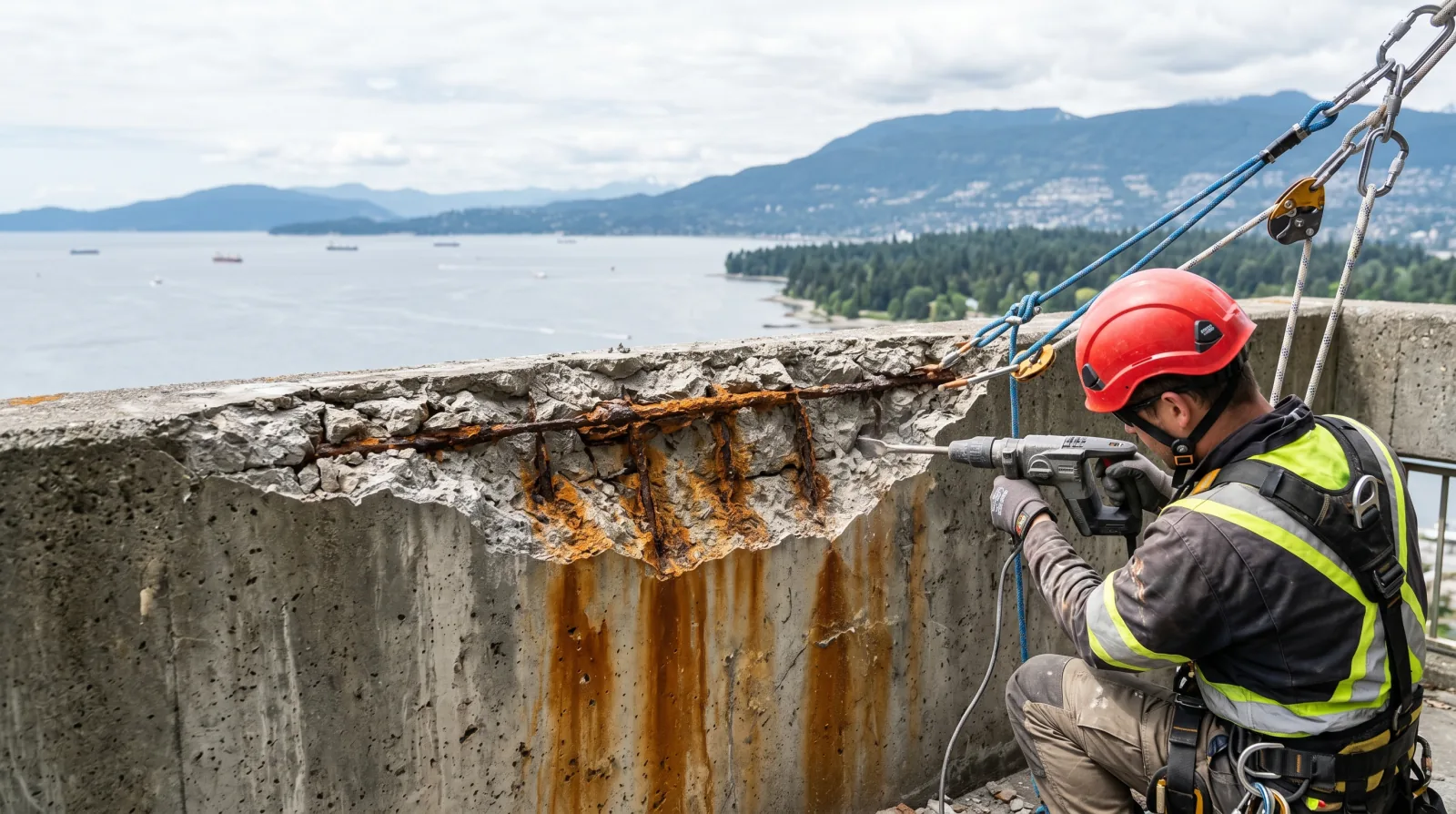
Two tools that promise the same thing by very different routes
Both of these get sold as a way to buy a concrete repair more years before the next round of corrosion. That shared promise is why they end up on the same line of a quote. But they reach it by completely different routes, and the route is the whole story. Get the route wrong and you pay for a treatment that does nothing for your actual problem.
A migrating corrosion inhibitor is chemistry. It is usually an amino-alcohol liquid, brushed or sprayed onto the concrete surface or mixed into the repair mortar. The idea is that it moves through the pores of the concrete, as a vapour and in the pore water, until it reaches the steel and forms a thin film on the bar that slows the corrosion reaction. Nothing is embedded. There is no wire, no device, no current. You are betting that enough of a chemical travelled far enough to do its job on a surface you cannot see.
A galvanic anode is physics. A small zinc anode, a real object with tie wires, is fixed to the reinforcing bar and cast into the repair mortar. Zinc is a less noble metal than steel, so in the moist concrete the two form a small battery. The zinc gives up electrons and slowly dissolves, and that current flows to the steel and holds it at a potential where it does not rust. The steel is protected because the zinc is being sacrificed in its place. This is galvanic cathodic protection, and it changes the electrical condition of the steel directly rather than depending on a chemical arriving.
How a migrating corrosion inhibitor actually works, and where it breaks down
Walk through the steps the inhibitor has to complete and the weaknesses show up on their own. First it has to get into the concrete. Then it has to travel to the depth of the steel through a pore structure that may be dense, wet, or already carbonated, all of which slow it down. Then it has to adsorb onto the bar and stay there long enough to matter. Every one of those steps happens out of sight, and none of them can be confirmed with a simple field test on your building.
Now put numbers on it. Lab studies of amino-alcohol inhibitors report effectiveness that swings widely with dosage and cover, roughly 45 percent at a low dosage up to about 88 percent at a higher dosage in one study. That range alone should tell you the result depends heavily on getting enough product to the right place. But the number that settles the argument is about timing. The same body of work found roughly 55 percent efficiency when the inhibitor was applied before the concrete was exposed to chloride, and about 3 percent efficiency when it was applied after corrosion had already started and the concrete had cycled wet and dry. Three percent is, for practical purposes, nothing.
So the inhibitor is a preventive tool. It has a fair chance of slowing corrosion that has not begun, on concrete that is not yet salted. It has almost nothing to offer a bar that is already rusting in chloride-laden concrete. And because you cannot verify penetration on site, even in the good case you are trusting a datasheet rather than reading a measurement. None of that makes the product a fraud. It makes it a supplement with a narrow window and a service life you cannot confirm, which is a very different thing from a corrosion-control system you can stand behind.
How a galvanic anode works, and why it is dependable on the BC coast
The anode works because of a difference in metals, not a chemical journey. Wire zinc to steel in damp concrete and you have built a cell where the zinc is the anode and the steel is the cathode. The zinc corrodes and feeds a small protective current to the steel, and while that current flows the steel is held at a safe potential. The concrete does not need to be dry or clean for this to work. In fact the anode needs the concrete to be moist enough to conduct, which the Metro Vancouver climate supplies for most of the year.
That is the core reason it fits the coast. By the time a downtown parkade soffit or a West Vancouver balcony is spalling, the steel is already corroding and the chloride is already at the bar. That condition is where the inhibitor is weakest and the anode is strongest, because the anode does not care that chloride is present. It changes the steel's potential either way. Discrete embedded galvanic anodes, for example the Sika FerroGard-670, have been used at patch repairs since the mid-1990s and are referenced to EN ISO 12696:2022, Cathodic protection of steel in concrete. And you can check the work: a potential reading on the steel tells you whether the protection is real, at install and years later.
One technical note worth keeping straight. ISO 12696 includes a 100 mV depolarization criterion for judging cathodic protection systems, but that criterion is not applied to galvanic anodes embedded at patch repairs. Those anodes are used for local, unmanaged protection to suppress reversed corrosion at the repair edges, not as a fully monitored building-wide system. So do not let a proposal wave the ISO number around as if it guarantees a performance level it was never meant to certify for a handful of patch anodes.
The ring anode effect, explained plainly
This is the single problem galvanic anodes were made to solve, so it is worth understanding well. Say a crew patches only the spots where the concrete has already spalled in a chloride-loaded slab. The fresh repair mortar is alkaline and clean, so the steel inside the patch is re-protected and stops corroding. But the steel just outside the patch is still sitting in old, salted, contaminated concrete. Now you have a sharp contrast: passive steel in the patch, active steel right next to it.
That contrast drives current. The steel at the edge of the repair becomes the anode of a new corrosion cell, and it corrodes faster than before. Within a few years a ring of fresh spalling appears around the perimeter of the patch you just paid for. This is the incipient anode effect, also called the ring or halo effect, and it is why patch-only repairs in salted concrete so often fail at their own edges. A galvanic anode tied around that perimeter supplies protective current to the surrounding steel, so instead of corroding, the edge steel is held at a safe potential and the zinc is consumed instead. That is the standard, documented way to stop the ring anode effect, and it is why a properly designed patch in salted concrete has anodes built into it. Our partial versus full-depth repair guide covers how the removal depth ties into all of this.
The failure modes owners never budget for
The most common and most expensive failure is the ring anode effect above, showing up as a new ring of spalls around last year's patches because no anodes were used. The strata pays twice: once for the original repair and again to chase the new damage.
The second is the invisible inhibitor. An inhibitor gets applied to an already-corroding structure, everyone assumes the corrosion is handled, and nobody measures anything because there is no easy way to measure it. The corrosion carries on under the surface. By the time it shows again, more section is lost and the repair is bigger. The failure was baked in the day a preventive product was used as an active cure.
The third is the spent anode that nobody planned for. Sacrificial zinc is consumed, commonly over 10 to 20 years depending on the chloride load. When it runs out, the protection ends, quietly. If the reserve plan treated the anodes as permanent, the building is now unprotected and no one flagged the date. The fourth is broken continuity: anodes tied to reinforcing steel that turns out not to be electrically continuous protect only the isolated bit they touch. The rest keeps corroding while the paperwork says the job is protected.
The two approaches compared
Migrating corrosion inhibitor (MCI)
A liquid treatment, usually an amino-alcohol chemistry, applied to the concrete surface or mixed into the repair mortar. It is meant to diffuse through the concrete to the steel and slow the corrosion reaction.
Embedded galvanic (sacrificial) anode
A small zinc anode tied to the reinforcing steel and cast into the repair mortar, usually around the perimeter of a patch. The zinc corrodes in place of the steel.
What a correct specification includes
Before anyone names a product, the condition of the steel has to be measured. That starts with a half-cell potential survey under ASTM C876, using a copper/copper-sulphate reference electrode across the slab. Readings more negative than -350 mV point to about a 90 percent probability of corrosion in that area. Readings more positive than -200 mV point to about a 90 percent probability of no corrosion. The band between is uncertain, and none of it should be read alone.
So the potential map is combined with two more things: chloride content sampled at the depth of the reinforcing steel, and a delamination survey where a crew sounds the concrete for hollow, drummy areas. Those three data sets together tell you where the steel is corroding, why, and how far the damage has spread. Only then does a product choice make sense. The removal and repair itself is scoped to CSA S448.1, the standard for repair of reinforced concrete in buildings and parking structures, which covers investigation, design, and execution. Surface preparation follows ICRI Guideline 310.2R for concrete surface profile and ACI PRC-546 for repair practice, and the finished bond can be checked with tensile pull-off testing under ICRI 210.3 and ASTM C1583. Skip the testing and you are specifying corrosion control blind.
Standards and testing that let you verify the work
The value of naming standards is that they turn opinions into checks. CSA S448.1 sets how the repair is investigated, designed, and carried out, though note it does not cover prestressed or post-tensioned concrete or non-structural slabs-on-grade, so those need their own engineering path. ASTM C876 gives the half-cell survey its numbers, which is why a proposal that quotes potential readings is on firmer ground than one that does not. ISO 12696 frames the cathodic protection side, with the caveat above about the depolarization criterion not applying to patch anodes.
On the workmanship side, ICRI 310.2R defines the surface profile the repair mortar needs to bond to, and ASTM C1583 pull-off testing gives you a real tensile number on the finished repair rather than a visual guess. A contractor who works to these can show you data at each stage: the potential map before, the profile during, the pull-off result after. That is the difference between a repair you can audit and one you have to take on faith.
What actually drives the cost
Neither product is expensive by the unit, so unit price is the wrong thing to focus on. For the inhibitor, the material is cheap and the labour is light. The cost risk is not the product, it is paying for a preventive step on an active problem and then funding the real repair anyway when the corrosion continues. For anodes, the per-anode price is modest and the drivers are how many the design calls for, the labour to tie them to clean continuous steel and encase them in mortar, and the access method.
Access is often the biggest single line on a Metro Vancouver job and it has nothing to do with which corrosion product you pick. Reaching a parkade soffit, a mid-height balcony, or a tower face means either scaffold, swing stage, or rope access. Rope access is governed by WorkSafeBC: fall protection is required at 3 m (10 ft) or more, work is carried out under Part 34 with Part 11 fall protection, and technicians hold IRATA or SPRAT certification. The same crew and access serve the repair regardless of the corrosion-control method, which is another reason the choice should be made on evidence rather than on the small difference in product cost.
Lifecycle cost, not sticker price
The honest way to compare these is by cost per protected year, not by what the tin costs. An inhibitor that reads cheap but delivers about 3 percent efficiency on an active structure costs infinite dollars per year of real protection, because it bought almost none. Anodes that add a line to the repair but suppress the ring anode effect for 10 to 20 years spread their cost across all those years and, more to the point, prevent the repeat mobilization that a ring of new spalls would force.
That repeat mobilization is where the money actually goes. Bringing an access crew back to a coastal tower to chase edge spalls that anodes would have prevented can cost more than the anodes several times over. So the reserve-fund question is not "which product is cheaper today" but "which choice avoids paying for access twice." On an active, salted structure that answer is almost always the anode. Our repair versus replace guide works through the same logic at the level of the whole element.
Warranty reality
Read warranties on corrosion products with a clear head. A product warranty from a manufacturer covers the product against defects, not the outcome on your building, and it usually depends on the material being applied exactly to the datasheet. For an inhibitor, that is a promise about a chemical you cannot verify reached the steel, so the warranty is thin comfort in practice. For anodes, the manufacturer stands behind the anode, but the protection still ends when the zinc is consumed, and no warranty extends past the sacrificial life of the metal.
What matters more than the product warranty is the workmanship warranty from the contractor and the fact that the corrosion control sat inside a properly engineered, tested repair. A ten-year paper warranty on an inhibitor used as a cure on active corrosion is close to meaningless. A shorter warranty backed by half-cell data, documented prep, and pull-off tests is worth far more, because the work behind it can actually be verified.
What neither product can do
Here is the part that gets lost when either of these is sold as a shortcut. Neither an inhibitor nor a galvanic anode removes concrete that has already delaminated or lost its bond to the steel. Once the cover has cracked off or gone drummy, that material has to come out and the section has to be rebuilt, because no surface treatment restores concrete that has separated from the bar. The rebar corrosion and spalling guide covers why that separation happens in the first place. These products control the corrosion of the steel that remains after the repair. They live inside a proper scope under CSA S448.1, not instead of one.
They also do nothing about the water and salt getting in. On a coastal building that source is usually a failed membrane or open sealant joints, and if it is not fixed the chloride keeps arriving and no corrosion method lasts. So the corrosion-control choice always sits next to a waterproofing scope, coordinated through our building restoration and parkade waterproofing work. On a heavily contaminated structure where you need protection for the full life of the building rather than the life of one repair, the conversation shifts again, to full cathodic protection, which our cathodic protection versus patch repair guide works through.
How to read a contractor proposal for corrosion control
A good proposal reads like a diagnosis followed by a matching treatment. It tells you what testing was done, a half-cell survey under ASTM C876, chloride sampling at bar depth, and a delamination survey, and it uses that data to justify the method. It scopes the concrete removal and surface prep to CSA S448.1 and ICRI 310.2R. For anodes it states the spacing and count and says how rebar continuity will be confirmed. For any inhibitor it is honest that the product is a supplement and that penetration cannot be field-verified.
The warning signs are the mirror of that. A branded inhibitor named as the main corrosion defence on a structure that is actively spalling. A promise of corrosion control with no chloride or potential data behind it. A lifetime claim on a sacrificial anode. Silence on the water and salt source. Any of those means the proposal is selling a product instead of solving the problem, and it is fair to send it back and ask for the evidence.
Four Metro Vancouver scenarios
1980s concrete high-rise parkade soffit, downtown Vancouver
Active spalling on the underside of a suspended slab, rust staining, and hollow-sounding concrete. Cores and chloride sampling show chloride sitting right at the reinforcing steel from years of road salt tracked in on tires. A half-cell survey reads well past -350 mV across the affected bays.
Recommended call: Galvanic anodes inside a CSA S448.1 repair
This is the textbook case for anodes. The concrete is already corroding and full of chloride, which is exactly where an inhibitor is at its weakest. Chip out the delaminated concrete, clean the steel, tie sacrificial anodes around each patch perimeter, and rebuild. The anodes suppress the ring anode effect that would otherwise start new spalls at every patch edge. An inhibitor here would be paying for a treatment you cannot verify while the corrosion continues.
West Vancouver coastal balcony, sea-salt aerosol exposure
Spalling at the balcony slab edges and drip line, the classic spot where wind-driven salt collects. The membrane has failed and water has been getting in for years. Chloride is at the bar and the steel is actively corroding along the exposed edges.
Recommended call: Galvanic anodes, and fix the membrane
Same logic as the parkade: active corrosion with chloride present points to anodes at the patch edges, not a surface chemical. But the corrosion-control choice is only half the job. If the failed balcony membrane is not replaced, salt water keeps arriving and no method lasts. The anode handles the steel; the waterproofing handles the source. An inhibitor could be brushed onto adjacent sound concrete as a minor preventive step, but it is not the defence for the corroding edge.
Newer Burnaby building, sound concrete, low chloride, cheap preventive add-on wanted
A well-built structure with no spalling, no delamination, and chloride testing that comes back low. The owner is doing a coating campaign anyway and asks whether a corrosion inhibitor is worth adding as cheap insurance before any problem starts.
Recommended call: Inhibitor is a reasonable supplement here
This is the one case where the inhibitor honestly earns its place. The published efficiency numbers that are worth anything, around 55 percent, apply when the treatment goes on before chloride exposure and before corrosion starts. That is this building. Used as a preventive add-on inside a coating campaign on sound, low-chloride concrete, it can slow the onset of corrosion. Just call it what it is: a supplement with a hard-to-verify service life, not a structural corrosion-control system.
Heavily contaminated older structure needing full-life protection
A large concrete structure with high chloride throughout, widespread corrosion, and an owner who wants protection for the remaining decades of the building rather than the life of one patch campaign. Patch-and-anode work would mean chasing new spalls for years.
Recommended call: Look past both to impressed-current cathodic protection
When contamination is this widespread and the horizon is decades, sacrificial anodes are the wrong tool because the zinc is consumed in 10 to 20 years and an inhibitor is only a supplement. An impressed-current cathodic protection system drives protective current from a powered, monitored anode system for the life of the building and can be tuned as conditions change. It costs more up front and needs a power feed, but it is the method matched to full-life protection of a badly salted structure.
Decision framework: ten questions
| Question | Points to | Reason |
|---|---|---|
| Is the concrete already spalling with active corrosion? | Galvanic anode | Inhibitors work best as a preventive treatment and lose most of their effect once corrosion has started. A galvanic anode arrests active corrosion electrochemically, which is what a spalling area needs. |
| Is chloride at the bar already high? | Galvanic anode | Study evidence shows inhibitors give little benefit at high chloride levels. Galvanic protection works even with chloride present, because it changes the steel's potential rather than relying on a chemical reaching the bar. |
| Do you need to prevent the ring anode effect at a patch edge? | Galvanic anode | This is the exact job galvanic anodes are designed for. Tied around the patch perimeter, they stop corrosion jumping to the steel just outside the repair. |
| Is the concrete sound and not yet corroding, and you want a low-cost preventive add-on? | Inhibitor may help | Applied early, before corrosion starts and while chloride is still low, an inhibitor can slow the onset. Treat it as supplementary, and do not rely on it as the only defence. |
| Can the result be verified on site? | Galvanic anode | Anode performance can be checked through steel potential readings. Inhibitor penetration to the bar is difficult to confirm in the field, so you are trusting the datasheet rather than a measurement. |
| Is this a structural element on a suspended slab? | Engineer decides | On a structural balcony or parkade slab the corrosion-control method is part of the repair design under CSA S448.1. Neither product substitutes for removing delaminated concrete and treating the steel. |
| Do you need protection for the full life of the building, not just one repair? | Look past both | Sacrificial anodes are consumed in 10 to 20 years and an inhibitor is a supplement. For decades of protection on a heavily salted structure, impressed-current cathodic protection is the system built for that horizon. |
| Has a half-cell survey and chloride test been done yet? | Test first | Under ASTM C876 a half-cell reading more negative than -350 mV points to about a 90 percent chance of corrosion. Without that data plus chloride depth, any product choice is a guess. Measure the steel before you specify the fix. |
| Is the repair a small isolated patch in otherwise sound concrete? | Galvanic anode | A patch in salted concrete creates the ring anode effect at its own edge. A few anodes tied around that perimeter suppress the reversed corrosion and protect the fresh repair from being undermined. |
| Is the reinforcing steel electrically continuous? | Confirm before anodes | A galvanic anode only protects steel it is wired to. If the bars are broken or isolated, continuity has to be established first, or the anode protects nothing. An inhibitor does not need continuity but also cannot be verified. |
Questions to ask before you approve the scope
Put these to any contractor bidding corrosion control on your building. The red-flag answer beside each one tells you when to slow down and ask for evidence.
What testing did you base the corrosion-control choice on?
Red flag: No half-cell survey and no chloride sampling. If they cannot show ASTM C876 potential data and chloride at bar depth, they are guessing.
Are you removing all the delaminated and drummy concrete first?
Red flag: Any answer that treats the product as a way to skip demolition. Contaminated, debonded concrete has to come out under CSA S448.1 before anything else.
For anodes, what is the spacing and count, and how did you set them?
Red flag: A vague "we put some in." Anode layout should come from the patch size and chloride load, with a stated spacing around each perimeter.
How will you confirm the reinforcing steel is electrically continuous?
Red flag: They have not thought about it. A galvanic anode only protects steel it is wired to, so continuity has to be checked before the anodes go in.
If you are proposing an inhibitor, how will you verify it reached the steel?
Red flag: A confident promise that it works, with no verification method. There is no simple field test for inhibitor penetration, so honesty here is the tell.
How will you prepare and check the repair bond?
Red flag: No mention of surface profile or pull-off testing. Prep should follow ICRI 310.2R and the bond can be checked with ASTM C1583 pull-off tests.
What is the expected service life of the corrosion protection?
Red flag: A lifetime claim for a sacrificial anode. Zinc is consumed, commonly over 10 to 20 years depending on chloride, and then protection ends.
What is the water or salt source, and how are you fixing it?
Red flag: Silence on the membrane or sealant. If the source of the chloride and water is not addressed, the corrosion comes back no matter which method is used.
Is an engineer designing the corrosion control on this structural element?
Red flag: A contractor picking the method alone on a suspended structural slab. On structural elements the method is part of an engineered repair design.
Quick answers
What is the difference between a migrating corrosion inhibitor and a galvanic anode?
They control rebar corrosion by completely different routes. A migrating corrosion inhibitor is a chemical, usually an amino-alcohol liquid, applied to the concrete surface or mixed into the repair mortar, meant to diffuse through the concrete and form a protective layer on the steel that slows the corrosion reaction. A galvanic anode is a piece of zinc tied to the reinforcing steel and cast into the repair; the zinc corrodes in place of the steel and supplies a small protective electric current that holds the bar at a potential where it will not rust. The inhibitor is a chemical treatment with uncertain field verification, while the galvanic anode is a form of cathodic protection with a measurable, well-documented mechanism.
Do migrating corrosion inhibitors actually work on concrete?
The honest answer is that they work in some conditions and not in others, and the evidence has real limits. Laboratory studies of amino-alcohol surface-applied inhibitors report effectiveness roughly in the 48 to 87 percent range when they are used as a preventive treatment on concrete that is not yet badly contaminated. The effect drops sharply once corrosion has already started, and studies show little to no benefit when the chloride at the bar is already high. There is also a practical problem: it is hard to confirm in the field how much inhibitor actually reached the steel, so you are largely trusting the product datasheet rather than a site measurement. That is why a careful engineer treats an inhibitor as a supplementary, preventive measure, not as the primary corrosion control on an actively corroding structure.
When should you use a galvanic anode instead of a corrosion inhibitor?
Use a galvanic anode when the concrete is already corroding, when chloride at the bar is high, or when you need to stop the ring anode effect at the edge of a patch repair. Galvanic protection works by changing the electrical potential of the steel, so it arrests corrosion even with chloride present, which is exactly the situation on most Metro Vancouver parkades and coastal balconies by the time repair is needed. An inhibitor, by contrast, is at its best applied early as a preventive treatment on concrete that has not started corroding and where chloride is still low. On an active, chloride-contaminated repair, the galvanic anode is the reliable choice.
Corrosion control questions
What is the difference between a migrating corrosion inhibitor and a galvanic anode?
They control rebar corrosion by completely different routes. A migrating corrosion inhibitor is a chemical, usually an amino-alcohol liquid, applied to the concrete surface or mixed into the repair mortar, meant to diffuse through the concrete and form a protective layer on the steel that slows the corrosion reaction. A galvanic anode is a piece of zinc tied to the reinforcing steel and cast into the repair; the zinc corrodes in place of the steel and supplies a small protective electric current that holds the bar at a potential where it will not rust. The inhibitor is a chemical treatment with uncertain field verification, while the galvanic anode is a form of cathodic protection with a measurable, well-documented mechanism.
Do migrating corrosion inhibitors actually work on concrete?
The honest answer is that they work in some conditions and not in others, and the evidence has real limits. Laboratory studies of amino-alcohol surface-applied inhibitors report effectiveness roughly in the 48 to 87 percent range when they are used as a preventive treatment on concrete that is not yet badly contaminated. The effect drops sharply once corrosion has already started, and studies show little to no benefit when the chloride at the bar is already high. There is also a practical problem: it is hard to confirm in the field how much inhibitor actually reached the steel, so you are largely trusting the product datasheet rather than a site measurement. That is why a careful engineer treats an inhibitor as a supplementary, preventive measure, not as the primary corrosion control on an actively corroding structure.
When should you use a galvanic anode instead of a corrosion inhibitor?
Use a galvanic anode when the concrete is already corroding, when chloride at the bar is high, or when you need to stop the ring anode effect at the edge of a patch repair. Galvanic protection works by changing the electrical potential of the steel, so it arrests corrosion even with chloride present, which is exactly the situation on most Metro Vancouver parkades and coastal balconies by the time repair is needed. An inhibitor, by contrast, is at its best applied early as a preventive treatment on concrete that has not started corroding and where chloride is still low. On an active, chloride-contaminated repair, the galvanic anode is the reliable choice.
What is the ring anode effect, and how does a galvanic anode prevent it?
When you patch only the corroding spots in chloride-contaminated concrete, the fresh alkaline mortar re-protects the steel inside the patch while the steel just outside stays contaminated. That contrast drives corrosion onto the steel at the edge of the repair, so the patch perimeter becomes the next spall. This is the incipient or ring anode effect. A galvanic anode tied around the perimeter of the patch supplies a protective current to that surrounding steel, so instead of corroding, the edge steel is held at a safe potential and the zinc anode is consumed instead. This is the documented, standard way of stopping the ring anode effect, and it is why a properly designed patch in salted concrete often has sacrificial anodes built into it.
How long do embedded galvanic anodes last in concrete?
A galvanic anode has a finite life because it works by being consumed: the zinc corrodes in place of the steel until the zinc is used up. How long that takes depends mainly on the chloride load and how hard the anode has to work, and it commonly falls in the range of 10 to 20 years. That is a genuine advantage over the life of a repair, because it protects the surrounding steel through the years when the ring anode effect would otherwise be forming new spalls. The limitation is that when the anode is spent, the protection ends, and there is no simple way to recharge it. On a heavily contaminated structure where you need protection for the full life of the building, an impressed-current cathodic protection system is designed for that longer horizon.
Can a corrosion inhibitor replace removing the damaged concrete?
No. Neither an inhibitor nor a galvanic anode removes the need to take out concrete that has already delaminated or lost its bond to the steel. Once the cover has cracked off or gone drummy, that material has to come out and the section has to be rebuilt, because no surface treatment restores concrete that has separated from the bar. What these products do is control the corrosion of the steel that remains, to slow the next round of deterioration. An inhibitor is a supplementary preventive layer; a galvanic anode is active protection at the patch edges. Both sit inside a proper repair scoped under CSA S448.1, not as a substitute for it.
Which is better for a Vancouver coastal balcony repair?
On a coastal balcony in West Vancouver or on the downtown waterfront, the steel is usually already corroding and the chloride from sea-salt aerosol is already at the bar by the time you see spalling. In that situation a galvanic anode at the patch perimeter is the dependable choice, because it stops the ring anode effect and works with chloride present. A migrating corrosion inhibitor might be added as a supplementary measure, or applied to adjacent sound concrete as a preventive step, but it should not be the primary defence on an already-corroding balcony. As with any structural repair, the corrosion-control method is part of the engineer's repair design, and it is paired with fixing the failed balcony membrane that let the water and salt in to begin with.
How do I know if my concrete is actually corroding before I choose a method?
You test the steel, you do not guess from the surface. A half-cell potential survey under ASTM C876 uses a copper/copper-sulphate reference electrode to map the electrical potential of the reinforcing steel across the slab. Readings more negative than -350 millivolts point to about a 90 percent chance that corrosion is active in that area, while readings more positive than -200 millivolts point to about a 90 percent chance the steel is passive, with the middle band uncertain. That survey is combined with chloride content taken at bar depth and a delamination survey where a crew sounds the concrete for hollow areas. Only with those three pieces of data does the corrosion picture become real enough to specify the right control method. Reading any one of them alone can send you to the wrong fix.
Can I put galvanic anodes in without removing the spalled concrete first?
No, and any proposal that suggests it should worry you. The anodes go into fresh repair mortar around cleaned steel, so the delaminated and drummy concrete has to come out first as part of a repair scoped under CSA S448.1. The surface prep matters too. Bond faces should be prepared to a defined concrete surface profile following ICRI Guideline 310.2R, and the repair can be checked with tensile pull-off testing under ICRI 210.3 and ASTM C1583 to confirm the new material actually bonded. The anode is one part of a proper repair, not a shortcut that lets you skip the demolition and rebuild.
What is impressed-current cathodic protection, and when does it beat a galvanic anode?
A galvanic anode runs on the natural voltage difference between zinc and steel, so its output is fixed and its zinc is slowly used up, commonly over 10 to 20 years depending on chloride load. An impressed-current cathodic protection system instead uses a permanent power supply to drive protective current through a durable anode mesh or ribbon, and it can be tuned and monitored for the life of the building. On a heavily contaminated structure where you need protection for decades rather than for the life of one patch, impressed-current is the system designed for that horizon. It costs more up front and needs a power feed and ongoing monitoring, so it fits large, badly salted structures more than a single small balcony repair. Our cathodic protection versus patch repair guide walks through where that line sits.
Does rain and the Vancouver climate change which method I should use?
Yes, wet-dry cycling is part of the problem here, and it hurts inhibitors more than anodes. Vancouver receives about 1,189 millimetres of precipitation a year, and roughly 74 percent of it falls between October and March, so exposed concrete goes through long stretches of wetting and drying. The inhibitor study that showed effectiveness collapsing to about 3 percent measured that drop after repeated wet-dry cycles once corrosion had started, which is exactly the exposure our climate delivers. A galvanic anode, by contrast, actually needs the concrete to be moist to conduct, so the damp coastal environment keeps it working. On the coast the practical read is that the anode suits the climate and the inhibitor is fighting it.
Are galvanic anodes only for parkades, or do they work on balconies and planters too?
They work anywhere you are patching chloride-contaminated reinforced concrete and want to stop the ring anode effect at the repair edge. Parkade slabs and soffits are the most common case because road salt tracks in on vehicles, but coastal balconies, planter walls, retaining walls, and pool decks all see chloride from sea-salt aerosol or de-icing and all get the same edge-corrosion problem after a patch. The deciding factor is the condition of the concrete and the steel, not the name of the element. Wherever chloride is in the concrete and you are cutting a patch, anodes around that patch perimeter are the standard way to keep the repair from failing at its own edges.
Deciding how to extend a concrete repair?
We assess corrosion and chloride condition on strata and commercial buildings across Vancouver, North Vancouver, West Vancouver, and Burnaby, and work to the engineer's corrosion-control design, so the choice between inhibitors and galvanic anodes rests on evidence.