The strata concrete restoration process, step by step
A concrete restoration project on a BC strata building isn't mostly about chipping concrete — it's about getting the right work scoped, funded, and approved before a single crew shows up. Skip the order and you get failed votes, surprise costs, and repairs that don't hold. Here's how a Metro Vancouver strata runs it properly.
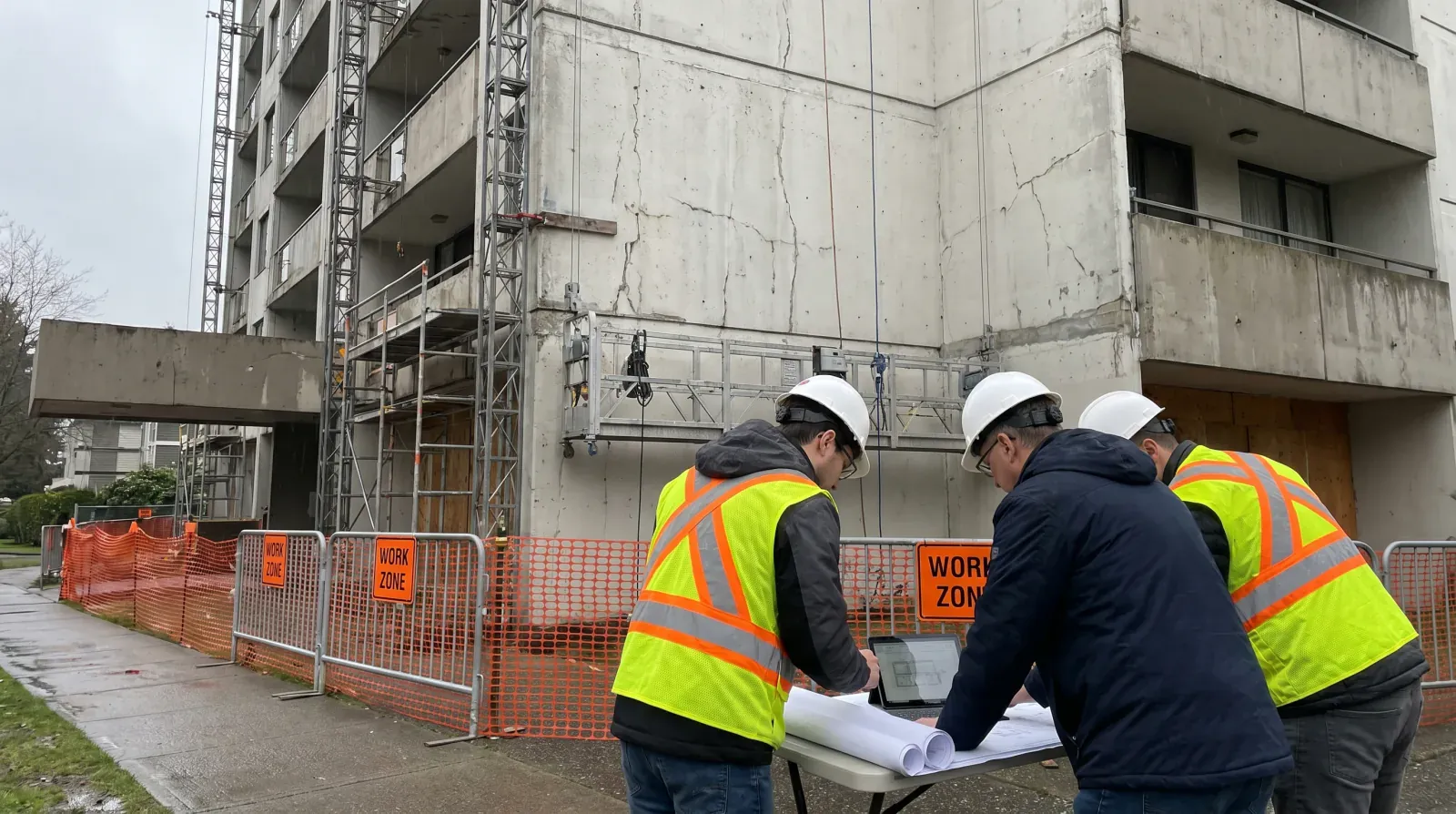
Why the order matters
The most expensive mistakes in strata restoration aren't technical — they're procedural. A council that solicits contractor quotes before an engineer has scoped the work gets bids that can't be compared, because each contractor is pricing a different guess. A council that brings a number to owners without a defensible engineered scope tends to get the special levy voted down. And a building that patches before it tests ends up patching again. Run the steps in order and most of those problems never appear.
The flag
The problem surfaces — a falling spall, a leak into a unit, or a line item in the depreciation report. Under the Strata Property Act, strata corporations of five or more lots must obtain a depreciation report on a five-year cycle, and that report is usually where concrete deterioration first gets named as a funded future cost.
Condition assessment
A building-envelope or structural engineer is retained to investigate: sounding survey, half-cell potential mapping, chloride sampling, carbonation depth. This produces the diagnosis and the repair-or-replace decision — the technical basis for everything that follows.
Engineered scope & specification
The engineer writes the repair design to CSA S448.1: how much concrete comes out, how the steel is treated, which repair mortar and coatings are specified, and how the work is to be tendered. The strata now has a defined scope instead of a vague worry.
Funding approval
The council brings the cost to the owners. Most restoration is funded by a special levy, which requires a 3/4 vote at a general meeting, or drawn from the contingency reserve fund (CRF) under the rules in the Strata Property Act. The engineer's scope is what makes the number defensible to owners.
Tender & contractor selection
The engineered specification goes to qualified restoration contractors for competitive pricing on the same scope. Apples-to-apples bids are only possible because the engineer defined the work — this is why the assessment comes before the quote, not after.
Permits & access setup
City building and street-use / sidewalk permits are arranged where required, engineered roof anchors are verified or installed, and access is set up — rope access for localized facade work, swing stage or scaffold for full-elevation campaigns. Resident notices go out before crews are on any face or balcony.
Execution under engineering review
Crews chip back to sound concrete, the engineer reviews the prepared substrate and exposed steel before anything is closed up (a hold point), repair mortar is placed, and protective coatings or membranes go on. Occupied buildings are sequenced by elevation with agreed noise windows.
Sign-off & warranty
The engineer issues field reviews and a completion letter confirming the work matches the design. The strata files the documentation with the building records and the depreciation report is updated so the next reserve cycle reflects the renewed component.
The funding piece, in plain terms
This is where projects stall, so it's worth being concrete. Restoration money comes from two places under the Strata Property Act: the contingency reserve fund, and a special levy approved by a 3/4 vote of owners. A depreciation report that actually planned for the concrete work makes the reserve route realistic and shrinks the levy owners have to swallow. That's the practical reason the five-year depreciation report cycle — now mandatory with a July 1, 2026 deadline for Metro Vancouver stratas — matters beyond compliance: a building that's been planning for its concrete isn't scrambling to levy for it.
Access and the resident experience
How crews reach the work shapes both cost and disruption. For spot repairs and facade campaigns, IRATA or SPRAT certified rope access under WorkSafeBC Part 11 keeps the footprint small — no full scaffold wrapping the building, sidewalks stay mostly open, and resident privacy is less affected than with a swing stage parked outside a window for weeks. Larger full-elevation programs may still call for swing stage or scaffold. Either way, the resident-facing details — advance notice, noise windows, barricaded drop zones, balconies returned as they cure — are what a council should expect a contractor to put in writing.
What good looks like at the end
A restoration project closes properly when the engineer's field reviews and completion letter confirm the work matches the design, the warranty paperwork is in the strata's records, and the depreciation report is updated to reflect the renewed component. That last step is easy to skip and worth insisting on — it's what tells the next council, and the next reserve study, that this concrete has been dealt with. If you're still working out whether your damage even needs full restoration, start with the repair vs. replace guide.
Quick answers
How does a BC strata pay for concrete restoration?
Two routes under the Strata Property Act: a special levy approved by a 3/4 vote of owners at a general meeting, or a draw from the contingency reserve fund (CRF). Larger restoration projects are commonly a mix — some from the reserve, the balance levied. A well-funded depreciation report that anticipated the concrete work makes the reserve route more viable and softens the levy. We do not quote restoration dollar figures without an engineer's scope; the cost depends on the extent of deterioration, access, and the specification.
Do we need a depreciation report before doing concrete repairs?
You do not need one to do an emergency repair, but you are required to have one as a strata corporation of five or more lots. The report is now mandatory on a five-year cycle and can no longer be waived or deferred — Metro Vancouver, Fraser Valley, and Capital Regional District stratas without a current report have until July 1, 2026. The report identifies and funds the concrete work; the engineer's condition assessment then scopes the actual repair.
Who can prepare a strata depreciation report in BC?
As of July 1, 2025, only specified qualified professionals may prepare them — including professional engineers and licensee engineers, architects and architectural technologists, applied science technologists and certified technicians, accredited appraisers, certified reserve planners, and professional quantity surveyors. The provincial requirement narrowed the field to ensure reports carry real technical weight.
Strata restoration process questions
How does a BC strata pay for concrete restoration?
Two routes under the Strata Property Act: a special levy approved by a 3/4 vote of owners at a general meeting, or a draw from the contingency reserve fund (CRF). Larger restoration projects are commonly a mix — some from the reserve, the balance levied. A well-funded depreciation report that anticipated the concrete work makes the reserve route more viable and softens the levy. We do not quote restoration dollar figures without an engineer's scope; the cost depends on the extent of deterioration, access, and the specification.
Do we need a depreciation report before doing concrete repairs?
You do not need one to do an emergency repair, but you are required to have one as a strata corporation of five or more lots. The report is now mandatory on a five-year cycle and can no longer be waived or deferred — Metro Vancouver, Fraser Valley, and Capital Regional District stratas without a current report have until July 1, 2026. The report identifies and funds the concrete work; the engineer's condition assessment then scopes the actual repair.
Who can prepare a strata depreciation report in BC?
As of July 1, 2025, only specified qualified professionals may prepare them — including professional engineers and licensee engineers, architects and architectural technologists, applied science technologists and certified technicians, accredited appraisers, certified reserve planners, and professional quantity surveyors. The provincial requirement narrowed the field to ensure reports carry real technical weight.
How long does a strata concrete restoration project take?
The on-site work for a localized balcony or facade campaign can run a few weeks to a couple of months depending on access and weather windows; a full-building or parkade program runs longer and is often phased across a season. The bigger timeline is everything before the crews arrive — assessment, scope, the general meeting vote, tendering, and permits — which commonly takes several months. Starting the assessment early is the single biggest schedule lever a council controls.
Does the work have to stop for Vancouver winter weather?
Concrete repair mortars and coatings have temperature and moisture limits for placement and curing, so coastal winter storms and cold snaps do force scheduling around weather windows. Crews tent and heat work areas where practical, but applying repair materials to wet or freezing substrate is how repairs fail early. A realistic restoration schedule in Metro Vancouver builds in weather contingency rather than promising a fixed end date in February.
Can residents stay in the building during restoration?
Almost always, yes. Strata concrete restoration is routinely done on fully occupied buildings. Residents get written notice before crews are on their elevation or balcony, noisy chipping is confined to agreed daytime windows, ground-level barricades isolate the drop zone, and balconies are returned to use as each section is completed and cured. Coordination with the property manager and council is what keeps disruption manageable.
Planning a restoration for your strata?
We work alongside strata councils, property managers, and engineers across Vancouver, North Vancouver, West Vancouver, and Burnaby — from condition assessment through CSA S448.1 repair and sign-off.