Rope access vs. scaffolding vs. swing stage: how the three access methods compare
For most high-rise maintenance work in Metro Vancouver — window cleaning, sealant replacement, coatings, and localized concrete repairs — rope access costs 30–60% less than scaffolding, starts in under an hour, and leaves no footprint on the street below. Swing stages and ground scaffolding still win for heavy payload and multi-trade campaigns. Here's how to read the scope and make the right call.
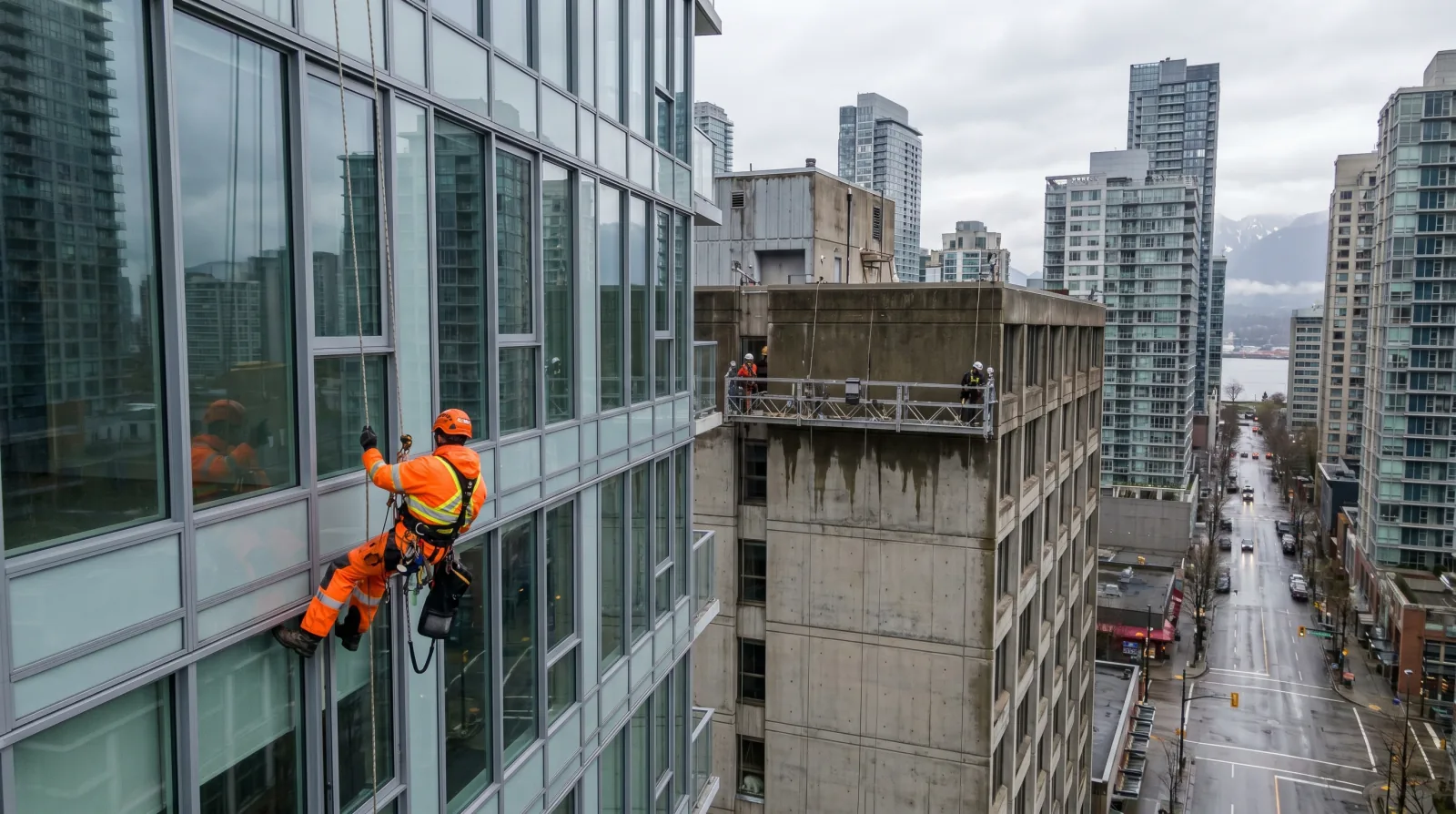
The three access methods
High-rise building maintenance in BC is governed by WorkSafeBC Part 11 and requires one of three access systems: industrial rope access, suspended swing stages, or erected scaffolding. Each works. None is universally best. The right choice comes from the weight of the materials, the complexity of the geometry, the project duration, and what the strata's budget and residents can absorb.
Full comparison: nine factors that actually matter
| Factor | Rope Access | Swing Stage | Ground Scaffolding |
|---|---|---|---|
| Setup & teardown time | Under 1 hour — rigged from certified roof anchors, removed at end of shift | 2–5 days — steel beams, counterweights, motor units, outrigger engineering | 1–3 weeks — ground-up erect, permit coordination, on-site storage |
| Mobilization cost | Low — crew carries all gear in packs, no crane, no transport of heavy steel | Moderate-to-high — heavy steel transport, certified rigger supervision required | High — labour, steel rental, crane lifts, site setup fees |
| Ground disruption | None — zero footprint, no sidewalk closures, no street permits | Low-moderate — some ground rigging, minimal sidewalk impact | High — closes sidewalks and lanes, requires city street-use permits and overhead protection |
| Material / payload capacity | Limited — hand tools and materials under ~25 kg per technician | High — 450–900 kg rated platforms for bulk mortar, glass units, masonry | High — unlimited tool and material staging across the full platform |
| Architectural access | Excellent — conforms to corners, curves, setbacks, and complex geometry | Limited — straight drops only, cannot follow irregular facades | Good — customizable but slow and expensive to adapt to complex shapes |
| Resident privacy | Excellent — technicians work quickly and ropes are removed daily | Poor — platform hangs outside windows for weeks, blocking light and views | Poor — structure blocks views and access points for the full project duration |
| Noise | Minimal — no motorized hoists | Moderate — electric hoist motors during raises and lowers | Significant — erect and strip operations generate sustained noise |
| WorkSafeBC certification | SPRAT or IRATA certified technicians; Part 11 two-rope redundancy mandatory | Suspended scaffold certification, annual hoist inspection, P.Eng. anchor sign-off | Scaffold erector certification, engineered drawings for structures over 6 m |
| Typical cost saving vs scaffolding | 30–60% less for maintenance, cleaning, sealant, coatings, and localized repairs | 15–30% less than scaffolding for single-facade campaigns | Baseline — highest cost, justified for multi-trade, multi-level simultaneous work |
WorkSafeBC and the two-rope rule
Every access method carries a distinct compliance burden. For rope access, WorkSafeBC Part 11 requires every technician to be on two independent lines — a working line and a separate fall-arrest backup — each anchored to a distinct P.Eng.-certified point. The roof anchors must be rated to 22.2 kN (5,000 lbs) per user, inspected annually, and recertified by a structural engineer every five years. For swing stages, hoist certification, outrigger engineering calculations, and platform inspections carry a comparable compliance load. Ground scaffolding over 6 m requires engineered drawings.
IRATA publishes annual injury statistics across its global member workforce. The most recently published rate for certified rope access technicians runs below 0.5 incidents per 100,000 worker-hours — lower than most ground-level construction trades. That figure reflects the structural safety advantage of the two-rope system and the mandatory companion-rescue training that every Level 3 supervisor must demonstrate, not just complete in a classroom.
The compliance burden is real for all three methods. What distinguishes rope access is that it adds no permit burden at street level — there's no sidewalk closure, no street use permit, and no municipal overhead protection structure to coordinate.
Technician certification: what to ask for
WorkSafeBC requires all rope access operations to follow SPRAT or IRATA standards. Both certifications require independent third-party assessment — not just attending a training course — and every operating crew must include a Level 3 supervisor capable of performing a companion rescue at height without waiting for outside emergency services. Level 1 is the entry credential; it still requires passing a rigorous assessment covering rigging, movement, and rescue. Ask any rope access contractor you're evaluating to name the SPRAT or IRATA numbers of the technicians assigned to your job, not just confirm that the company "uses certified techs."
Allweathercoating's rope access crews hold active SPRAT and IRATA certification at Levels 1 through 3. Before any project begins, we provide a crew list with each technician's certification body, level, and certificate number — not a general company assurance, but individual verifiable credentials. If a contractor can't produce that list on request, treat it as a red flag.
When to choose each method
Choose rope access when:
- High-rise window cleaning — Vancouver, North Vancouver, West Vancouver, Burnaby
- Sealant and caulking replacement along window perimeters and panel joints
- Localized concrete spall repairs and spot coating touch-ups
- Elastomeric coating applications on concrete shear walls
- Annual or pre-season building inspections and condition surveys
- Post-storm or insurance-driven damage assessments at height
- Any scope where the work is distributed across the facade rather than concentrated in one spot
Choose a swing stage when:
- Full window replacement requiring two or three workers and large glass units
- Deep concrete restoration with heavy equipment and bulk structural mortar
- Brick masonry repointing across wide facade sections
- Projects where one crew works a single continuous drop for an extended period
Choose ground scaffolding when:
- Multi-trade campaigns — cladding replacement while electrical, mechanical, and waterproofing crews work simultaneously
- Parkade and podium level work where the structure is at or near grade
- Sites without engineered roof anchors or with roof geometry that prevents straight rope drops
- Full-building envelope retrofits with heavy material staging requirements
A note on North Shore terrain
On the North Shore, the access method is often decided by the site before the scope is even reviewed. Steeply graded lots in North Vancouver and West Vancouver can drop four to six metres from one end of a building's base to the other, making a level scaffold base impossible without significant shoring and engineered temporary works. Ground-up scaffolding on these properties can cost more in site preparation alone than the entire rope access campaign. Rope access rigs from the roof regardless of what's happening at grade. For many North Shore stratas, it isn't a cost comparison — it's the only compliant access method available for upper-elevation facade work.
The Payload–Geometry–Duration test
Before cost enters any access method discussion, three questions determine the answer:
Payload: Does the scope require moving more than 25 kg of materials per technician per drop? If yes — bulk structural mortar, large double-glazed window units, heavy facade panels — rope access is out. Swing stage or scaffold wins on payload alone, full stop.
Geometry: Does the facade have corners, curves, setbacks, or sections without a direct vertical drop from a certified roof anchor? If yes, rope access wins. A swing stage platform needs a straight, unobstructed vertical run. Scaffolding can adapt to complex geometry, but slowly and expensively.
Duration: Is the work concentrated in one area for more than two weeks, requiring two or three workers coordinating simultaneously? If yes, the daily rigging and de-rigging overhead of rope access erodes the cost advantage. A swing stage that can be left in position overnight earns its setup cost when the work is dense and continuous.
If none of the three tests triggers, rope access is the default. It mobilizes in under an hour, leaves no street footprint, and returns the building to normal at the end of every shift.
How the choice plays out on a real North Shore job
On a concrete-frame strata in North Vancouver — 22 storeys, 1990s construction — we assessed both a swing stage and rope access for a full-perimeter sealant replacement. The north and east elevations were straightforward straight drops. The problem was the west face: a stepped setback at floors 14 and 19, with curved concrete shear walls at the corners. A swing stage platform cannot follow that geometry. We rigged rope access on all four faces and completed the sealant campaign in 11 days. A swing stage would have required separate platform configurations for each setback, adding days of re-rigging and crane time that the scope didn't justify. The curved sections would not have been reachable with a rigid platform at any price.
That kind of geometry is common in Metro Vancouver towers built between 1985 and 2005 — the leaky condo era produced a lot of architecturally complex facades, and those buildings are now hitting their first or second major sealant replacement cycle. Rope access handles them cleanly.
The resident disruption calculation
For a strata council, resident disruption is rarely the first line item in a tender comparison — but it's frequently the first complaint after the work starts. A swing stage platform suspended outside residential windows for three weeks generates security concerns, blocked views, and noise from hoist motors every morning. Ground scaffolding closes building entrances, blocks parking, and can trigger noise bylaws during erect and strip. Rope access leaves the building completely normal at the end of each day — the ropes come up, nothing hangs on the facade, and no street access is affected. For an occupied residential strata, that operating quietness is a real cost factor that rarely appears in the quote comparison.
The hybrid approach: when both are needed
Most building envelope campaigns use rope access as the primary method and bring in a swing stage for specific heavy lifts. A concrete restoration project might run rope access for sealant replacement, inspection, and localized patching across the full tower, while a swing stage handles the two or three bays where full facade panel replacement requires bulk mortar and two workers coordinating simultaneously. The access method follows the scope, not the other way around. A good contractor will tell you honestly where the payload limit of rope access is reached on your specific project — and price accordingly.
Quick answers
Is rope access safer than swing stages for high-rise work in BC?
By the data, yes. IRATA publishes annual safety statistics across millions of logged work hours globally, and the injury rate for certified rope access technicians consistently runs below 0.5 per 100,000 hours — lower than most ground-level construction trades. The safety foundation is the two-rope system: every technician is on an independent working line and a separate fall-arrest backup line anchored to distinct certified roof points. Under WorkSafeBC Part 11, both lines are mandatory and both anchors must be P.Eng. certified. Swing stages are safe when properly maintained and operated, but they introduce mechanical failure modes — cable drums, electric hoists, and outrigger loads — that rope access simply does not have.
How much cheaper is rope access than scaffolding?
For typical high-rise maintenance work — window cleaning, sealant replacement, coating touch-ups, localized concrete repairs — rope access generally costs 30–60% less than ground-up scaffolding. The gap closes for heavy restoration scopes where material weight or continuous multi-worker access justifies a swing stage or scaffold platform. For a Vancouver strata doing a building-wide sealant campaign, the rope access saving over scaffolding frequently runs to tens of thousands of dollars, primarily because mobilization, permits, and street protection are eliminated entirely.
Can rope access be used in cold or rainy weather in Vancouver?
Yes, with qualification. WorkSafeBC and IRATA standards address adverse conditions: work continues in light rain when the surface and ropes remain manageable, halts when ice, strong wind, or lightning creates unacceptable risk. Practically, Vancouver's mild coastal winters mean rope access rarely loses more than a few days per year to weather. Swing stages face similar wind restrictions and are more sensitive to high wind loading on their platform area. Neither system works in a true windstorm — that applies to both equally.
Rope access & access method questions
Is rope access safer than swing stages for high-rise work in BC?
By the data, yes. IRATA publishes annual safety statistics across millions of logged work hours globally, and the injury rate for certified rope access technicians consistently runs below 0.5 per 100,000 hours — lower than most ground-level construction trades. The safety foundation is the two-rope system: every technician is on an independent working line and a separate fall-arrest backup line anchored to distinct certified roof points. Under WorkSafeBC Part 11, both lines are mandatory and both anchors must be P.Eng. certified. Swing stages are safe when properly maintained and operated, but they introduce mechanical failure modes — cable drums, electric hoists, and outrigger loads — that rope access simply does not have.
How much cheaper is rope access than scaffolding?
For typical high-rise maintenance work — window cleaning, sealant replacement, coating touch-ups, localized concrete repairs — rope access generally costs 30–60% less than ground-up scaffolding. The gap closes for heavy restoration scopes where material weight or continuous multi-worker access justifies a swing stage or scaffold platform. For a Vancouver strata doing a building-wide sealant campaign, the rope access saving over scaffolding frequently runs to tens of thousands of dollars, primarily because mobilization, permits, and street protection are eliminated entirely.
Can rope access be used in cold or rainy weather in Vancouver?
Yes, with qualification. WorkSafeBC and IRATA standards address adverse conditions: work continues in light rain when the surface and ropes remain manageable, halts when ice, strong wind, or lightning creates unacceptable risk. Practically, Vancouver's mild coastal winters mean rope access rarely loses more than a few days per year to weather. Swing stages face similar wind restrictions and are more sensitive to high wind loading on their platform area. Neither system works in a true windstorm — that applies to both equally.
Do roof anchors need to be certified before rope access or swing stage work?
Yes, for both. Under WorkSafeBC OHS Section 11.2, every anchor point used for fall protection, rope access, or suspended staging must be certified by a professional engineer (P.Eng.) — rated to a minimum 22.2 kN (5,000 lbs) per user — and inspected by a qualified person at least annually. Anchors must be recertified by a structural engineer every five years. The strata corporation is legally responsible for maintaining anchor certification. If anchors are out of compliance, a reputable contractor will refuse to rig until they're brought current. We include anchor status in every initial assessment — it's not a surprise we want to deliver at mobilization.
What rope access certifications should a Vancouver contractor hold?
WorkSafeBC requires all rope access operations to follow either SPRAT (Society of Professional Rope Access Technicians) or IRATA (Industrial Rope Access Trade Association) standards. Both require technicians to hold a minimum Level 1 certification — passed by independent assessment, not just training attendance — and every crew must include a Level 3 supervisor qualified to execute companion rescues at height without waiting for emergency services. When vetting a contractor, ask for SPRAT or IRATA membership certificates for named technicians, not just a general company claim.
When does a building genuinely need a swing stage instead of rope access?
When the payload exceeds what rope access can carry. The hard limit for rope access is roughly 25 kg of tools and materials per technician — excellent for most maintenance and repair work, but not for replacing large double-glazed window units, carrying bulk bags of structural mortar, or coordinating three workers on one task. Swing stages carry 450–900 kg and provide a flat stable floor, which is genuinely necessary for heavy facade rehabilitation. Roof geometry also forces the choice: if the roof overhang prevents a straight rope drop or there are no engineered anchors above the work face, a swing stage rigged from parapet clamps may be the only compliant option.
How long does rope access mobilization take versus a swing stage?
Rope access can be rigged and on rope in under an hour from arrival on site — no permits, no crane, no heavy steel transport. At the end of the shift the ropes come up, locked inside the roof hatch or penthouse, and the building has nothing hanging on its exterior overnight. A swing stage setup runs two to five days: transport of steel beams, counterweights, and platform sections to the roof, outrigger engineering sign-off, hoist installation, and a test lift. For a strata that needs a two-day sealant inspection done with minimal notice and no permit application, rope access is not just cheaper — it's the only access method that can actually start this week.
Does ground scaffolding have any advantages over rope access?
Yes — for specific scopes. Ground-up scaffolding wins when multiple trades need simultaneous vertical access across the full facade, when material staging at height is continuous and heavy, or when a site has no viable roof anchor system. Scaffolding also works for low-rise and podium-level work where the vertical run is short enough that the economies of rope access don't materialise. For a full building envelope retrofit involving new cladding, window replacement, and mechanical upgrades all running in parallel, a scaffold frame is often the only system that keeps all three trades moving without getting in each other's way.
Can rope access be used for joint sealant replacement in Richmond or Burnaby?
Yes, rope access is highly efficient for joint sealant and caulking replacement on Richmond and Burnaby condo and office towers. Technicians can easily descend to seal window frames and concrete panels, completing the job much faster than staging setups. For Burnaby towers, rope access also leaves zero ground footprint, eliminates the noise of motorized hoists, and allows technicians to reach difficult architectural shapes and corners that a wide, rigid swing stage platform cannot reach.
Does using rope access reduce scaffolding costs for North Vancouver or West Vancouver stratas?
Yes — significantly. Rope access completely eliminates the need for expensive ground-up scaffolding or staging systems. For strata buildings on sloped terrain in North Vancouver or West Vancouver, this saves tens of thousands of dollars in mobilization and permit fees. The steeply graded lots common on the North Shore also make ground-supported scaffolding logistically complex, so rope access is often the only practical access method for upper-elevation facade work on these buildings.
Not sure which access method fits your project?
We scope building envelope work across Vancouver, North Vancouver, West Vancouver, and Burnaby and will tell you plainly when rope access is the right tool and when it isn't. No upselling the method — just the scope.