Polyurethane vs. hybrid MS sealant: which one belongs on your envelope joints
On a joint that gets painted or hides under a wall coating, paintable polyurethane at its lower cost still does the job and meets ASTM C920 Class 25. On an exposed joint that stays in the sun, bare polyurethane chalks and stiffens within a few years, and that is where hybrid MS (STPE) earns its premium: it keeps polyurethane's paintability and grip on concrete while adding silicone's UV resistance, typically at Class 25 to 35 movement. The choice comes down to two things, sun exposure and whether the joint gets painted.
Reach for polyurethane on porous-substrate joints that sit under a coating or get painted, where its lower material cost is a real saving and UV never reaches it. Reach for hybrid MS on exposed joints that stay in the weather, on exposed joints that also have to match the facade colour (the one case silicone cannot cover), on mixed-substrate transitions where two materials meet, and on damp coastal mornings where its primerless grip keeps a crew moving. Here is how to read your building joint by joint.
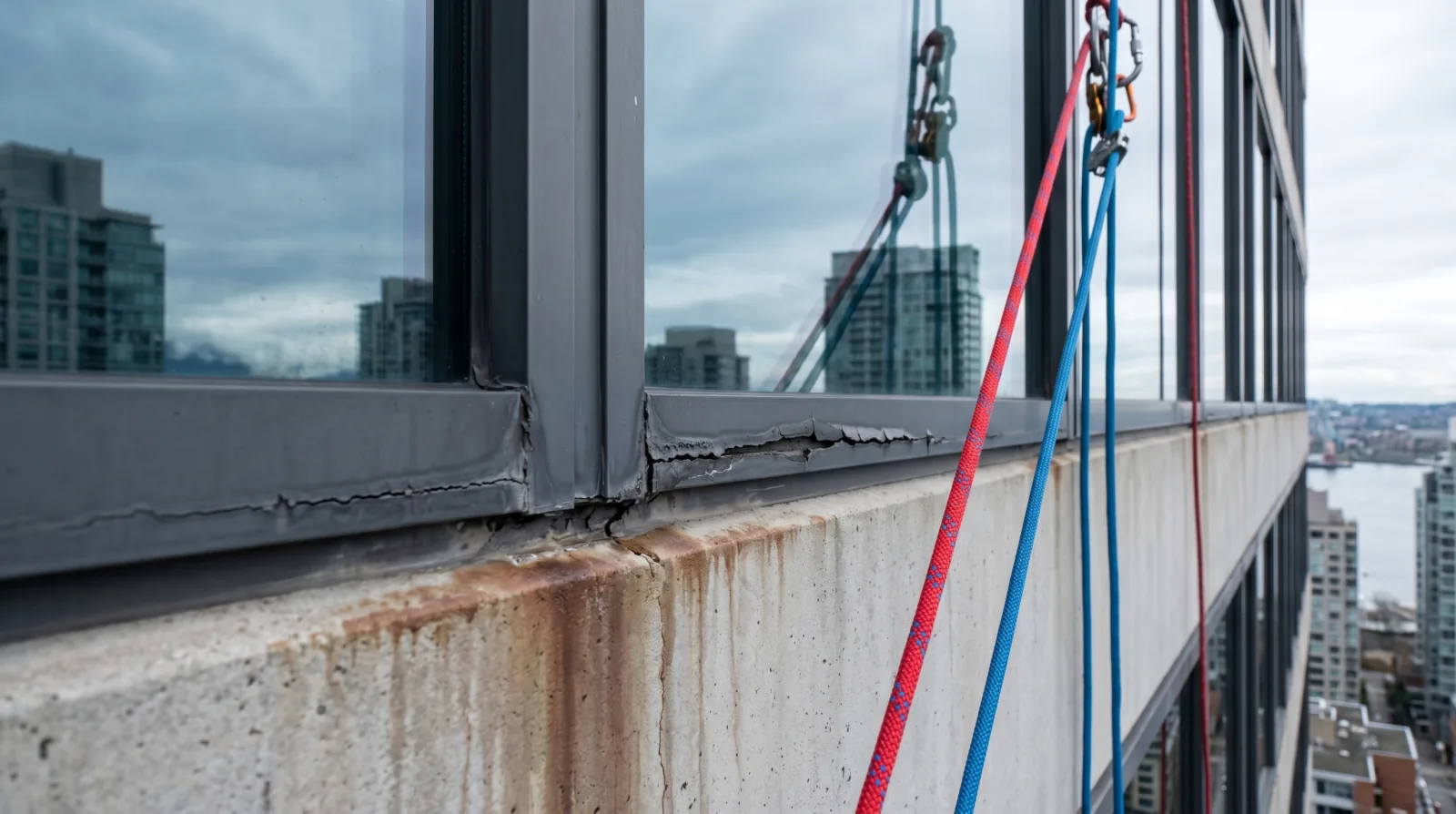
The one weakness that decides most of these joints
Polyurethane has been the standard sealant for concrete and masonry envelope joints for decades, and for good reason. It bonds strongly to porous substrates without a primer, it takes paint, and it handles the medium movement of a panel or expansion joint. But it has one clear weakness: it does not like sunlight. Unprotected polyurethane exposed to UV chalks on the surface, discolours, and slowly loses the elasticity it needs to keep flexing with the joint. On a south or west face of a Vancouver tower, that failure shows up in a few years, not fifteen.
Hybrid MS sealant was formulated to solve exactly that. It is a silyl-terminated polyether, and you will also see it called MS polymer or silane-modified polymer. It keeps the two things that make polyurethane useful on a building envelope, paintability and a strong bond to concrete and stucco, and it borrows silicone's UV stability. So an exposed hybrid MS joint stays flexible in the sun without needing a paint or coating over it.
Everything else on this page follows from that single tradeoff. If the joint is protected from sunlight, polyurethane is the value pick. If the joint lives in the sun, hybrid MS keeps its shape where polyurethane would not. The rest is detail: how each one cures, how it bonds, how much it can move, and how the Vancouver climate nudges the call one way or the other.
How polyurethane cures and why it grips porous joints
Most single-part polyurethane sealant cures by moisture. The bead reacts with water vapour in the air, skinning over from the outside first and then curing deeper over several days. That is why a very dry, cold day slows a one-part polyurethane and why the damp coastal air in Metro Vancouver can actually help it along once it is in the joint. Two-part polyurethane skips the wait on air moisture: a base and an activator mix at the nozzle and cure by chemical reaction, which sets faster and more predictably on large jobs. If you want the full breakdown of when each makes sense, we cover it in one-part versus two-part polyurethane.
The reason polyurethane took over concrete and masonry work is its grip on porous surfaces. As it cures it keys into the microscopic pores of concrete, block, brick, stucco, and fibre cement, so on a clean and sound porous face it often bonds well without a primer. That grip, plus its ability to take paint, is exactly what hybrid MS was designed to keep. Where polyurethane gets fussy is moisture and smoothness: a damp face or a very smooth, dense substrate can need a primer to bond, and a poorly cleaned joint face can fail no matter how good the product is.
How hybrid MS chemistry works
Hybrid MS starts with a polyether backbone, the flexible chain that gives it a body much like polyurethane. The ends of that chain are capped with silane (silyl) groups, the same kind of chemistry that gives silicone its resistance to sunlight. When the bead meets moisture, those silyl end groups react and cross-link the material into a cured rubber. So you get a polyether body that behaves like polyurethane, grips concrete, and takes paint, joined to silane end chemistry that shrugs off UV like silicone does.
Two other properties fall out of that build. It is isocyanate-free, so it does not carry the stronger fumes that polyurethane gives off during cure, which matters on an occupied tower where residents are on balconies or have windows open. And many grades bond to a wide range of substrates without a primer, porous and non-porous alike, including some damp surfaces. That last point is why hybrid MS is often the practical winner at a joint where metal meets concrete, or on a wet Vancouver morning when a polyurethane would need the face dried first.
Why Metro Vancouver changes the answer
The coast pushes the choice toward UV stability and moisture tolerance more than a dry inland climate would. Vancouver takes roughly 1,150 to 1,200 mm of rain a year, and wind-driven rain hits south and west high-rise faces hard. A joint that has stiffened and cracked does not just look bad, it lets that driven rain straight into the assembly. So on the exposed faces most at risk from rain, you also want the sealant that keeps its elasticity longest.
The wet reputation hides how much sun those same faces take in summer. UV on an exposed south or west elevation is strong enough to chalk bare polyurethane in a few years, which is the failure in the photo at the top of this page. On oceanfront faces in West Vancouver there is sea-salt exposure on top of the sun and rain. And the damp mornings that hang over the city for much of the year cut into the window when a moisture-sensitive polyurethane can bond, while a moisture-tolerant hybrid grade keeps a rope-access crew working. Put the strong summer sun on exposed joints together with the long wet season, and hybrid MS wins more exposed-joint calls here than it would in Kamloops.
There is a stock-condition angle too. A lot of the mid-rise and wood-frame stock across Vancouver, Burnaby, and the North Shore dates to the leaky-condo era of the 1980s and 90s, when envelope detailing was weaker and many buildings have since been rehabilitated. On those buildings the sealant joints are part of a repaired assembly, and the exposed architectural joints on the newer concrete faces are exactly where UV stability earns its keep.
Sealants compared
Polyurethane (PU)
A moisture-cure sealant that bonds by chemical reaction to porous substrates. The workhorse product for concrete and masonry joints for decades. Paintable and strong-bonding, but sensitive to sunlight on its own.
Hybrid MS / STPE
A silyl-terminated polyether, also called MS polymer, silane-modified polymer, or hybrid. It keeps polyurethane's paintability and porous-substrate grip while adding silicone-like UV resistance. Isocyanate-free and low-odour.
The failure modes to watch for
The most common polyurethane failure on the coast is UV degradation on an exposed joint. The surface chalks to a dull powder, the bead loses colour, and it stiffens until it can no longer flex with the joint. Once it is stiff it cracks, pulls away from one face, and water gets in. This is not a product defect, it is the wrong product for an exposed spot, or the right product left without the coating that was supposed to protect it.
The second failure is a bond problem, and it comes in two forms. Adhesive failure is when the bead peels cleanly off the joint face, which points to poor cleaning, a missed primer step, or a damp substrate the product could not handle. Cohesive failure is when the bead tears within itself, which points to a joint that moved more than the sealant was rated for, or a bead pulled too thin. Telling the two apart on site tells you whether to fix the prep or fix the joint design.
The third failure is self-inflicted: resealing over old caulk. Capping a new bead over a degraded old one saves the removal cost and fails at or before the old sealant does, because the new bead is only as good as what it is stuck to. It is one of the most common mistakes on strata recaulking, and it is why any honest scope starts with full removal. When water is already getting inside a suite, the joint is often only part of the path, which is why we scope leaks as a system in our leak and water ingress repair service.
Surface prep and correct specification
A sealant is only as good as the joint it sits in, and the joint geometry is set by ASTM C1193, the standard guide for using joint sealants. The minimum joint is about 1/4 inch wide by 1/4 inch deep. For joints from 1/2 inch to 1 inch wide, the sealant depth should be about half the width, roughly a 2 to 1 width-to-depth ratio. For joints wider than 1 inch, depth is held near 1/2 inch. Get the depth wrong and even the best chemistry fails early.
Backer rod is what makes that geometry work. Pushed into the joint to set the depth, it does two jobs: it controls how thick the bead is, and it stops the sealant from bonding to the back of the joint. You want the bead bonded to the two side faces only, so it can stretch and compress as the joint moves. If it also bonds to the back, that is three-sided adhesion, and the bead tears as soon as the joint works. The finished bead gets tooled to a concave hourglass profile, thinner in the middle than at the edges, which lets it flex without over-stressing the bond line.
Prep is the rest of it: cut and pull all the old sealant, clean the faces down to sound substrate, prime where the data sheet calls for it, and only then run the new bead. C1193 also recommends a safety factor of 1.25 to 1.5 on the calculated movement, so the joint is designed with margin, not right at the sealant's limit. Once the bead has cured, the honest check is ASTM C1521, a hand-pull adhesion test on the real joints on the building, described in the next section.
Standards worth naming, and what to verify
Four standards carry the weight on a sealant scope, and knowing them lets you read a proposal instead of trusting it. ASTM C920 is the specification for elastomeric joint sealants, and its movement classes (12.5, 25, 35, 50, 100) tell you how much of the joint width the sealant can take in stretch or squeeze. Class 25 means plus or minus 25% of the joint width. Commercial polyurethane usually meets Class 25; hybrid MS grades usually meet Class 25 to 35, some higher.
ASTM C1193 governs the joint design, the geometry and backer rod and safety factor above. For adhesion, keep two tests straight: ASTM C1521 is the field hand-pull test on installed weatherproofing joints, and ASTM C794 is the lab peel-adhesion test used to qualify a product before it ships. A contractor who runs C1521 spot checks on your building is verifying the bond on the actual substrate rather than assuming it. Last, ASTM C1401 is the structural sealant glazing guide, and it accepts only silicone products formulated for structural glazing, on walls no more than 15 degrees off vertical. Neither polyurethane nor hybrid MS is a structural glazing product, which is the clean line between joint sealing and glazing work.
What drives the cost, joint to joint
The sticker price of a tube tells you almost nothing about what a recaulk costs. On a Vancouver high-rise the biggest single cost is usually access: the swing stage or the rope-access rigging that gets a crew to the joints, run under WorkSafeBC Part 11 fall-protection rules. That cost is roughly the same whether the crew installs the cheaper or the pricier sealant, which is why the product premium is often a small slice of the total and why it rarely makes sense to under-spec the sealant to save a few dollars per joint.
After access, the drivers are substrate condition (a joint face that needs grinding or repair costs more to prep), the joint count and total linear metres, the number of primer steps the substrates demand, and the labour to fully remove old sealant rather than cap over it. The product premium for hybrid MS sits on top of all that. Where hybrid MS actually saves money is on damp coastal mornings and mixed substrates, because a primerless, moisture-tolerant grade cuts steps out of the sequence and keeps the crew productive during the hours the rigging is up.
Lifecycle cost, not tube cost
The number that matters to a strata is cost per year of service, not cost per tube. A cheaper polyurethane joint that fails in five years on an exposed south face is more expensive than a hybrid MS joint that lasts fifteen, once you count the second round of rigging and labour to redo it. The rigging cost gets paid again on the redo, which is what makes early failure so expensive on a tall building.
This is where the Strata Property Act depreciation report comes in. When the report sets the renewal budget for the envelope, matching the sealant to the exposure protects that budget: pay the hybrid premium where UV would otherwise force an early redo, and do not pay it on protected joints where polyurethane lasts just as long. Spending in the right place, not the most expensive place everywhere, is what keeps the reserve fund honest.
Warranty reality
There are two different warranties on a sealant job and they are easy to confuse. A product warranty comes from the sealant manufacturer and covers the material for a stated period, commonly 10 to 20 years, when the product is installed and used within its data-sheet conditions. A workmanship warranty comes from the contractor and covers the installation: prep, backer rod, bead profile, and adhesion. You want both, and you want to know which is which.
The traps are in the conditions. A product warranty on polyurethane usually assumes the joint is protected or painted, so an exposed unpainted joint can fall outside the warranted conditions and the manufacturer walks away when it chalks. Resealing over old caulk voids most warranties because it violates the installation the warranty assumes. And a warranty is only worth the company standing behind it in three years, so a long paper warranty from a crew that will not answer the phone is worth less than a shorter one from a contractor who will come back. Read what voids coverage as carefully as what it promises.
The wrong tool, in both directions
Hybrid MS is not a structural glazing product and it is not a substitute for silicone on a high-movement glazing joint. A curtain wall glazing joint that cycles near plus or minus 50% is engineered under ASTM C1401 and gets a silicone formulated for that duty. Putting a paintable hybrid bead there because it is on the truck tears the joint. If you are choosing between wet and dry sealing at glazing, that is a separate decision covered in wet glazing versus dry glazing, and for the broader silicone-versus-polyurethane tradeoff see polyurethane versus silicone.
Polyurethane, on the other side, is the wrong tool on an exposed unpainted joint in the sun. It is also poor where a damp substrate cannot be dried and no primer is planned. Reaching for the value product in those spots is a false saving, because the joint fails early and the rigging cost gets paid twice. The skill is matching each joint to the product that fits it, which is the whole point of walking a building before writing a scope. That walk is part of how we scope work in our building envelope repair service.
Reading a contractor's sealant proposal
A good proposal names the sealant chemistry and the ASTM C920 class for each joint type, not one product for the whole building. It states full removal of old sealant, backer rod at the correct depth, the primer steps each substrate needs, and a plan to run ASTM C1521 field adhesion checks once the beads have cured. It distinguishes exposed joints (UV-stable product or a coating) from protected joints (polyurethane is fine). And it separates the product warranty from the workmanship warranty and says plainly what voids each.
The warning signs are the mirror image. One sealant for everything with no reference to exposure. No backer rod in the scope. Any hint of capping over old caulk. No adhesion testing. Bare polyurethane on an exposed unpainted face. A single paper warranty presented as if it covers both product and workmanship. Any of those is a reason to ask the questions in the checklist further down before you approve the scope. If it comes down to a full reseal versus targeted repairs, the tradeoff is laid out in full recaulk versus spot repair, and the sealant category itself is mapped in our sealant and caulking resource hub.
Four Metro Vancouver joints and the honest call
1980s concrete panel high-rise, West End, being recoated
A concrete panel tower off Davie Street in the West End is due for a full elastomeric wall coating. The panel-to-panel joints and stucco expansion joints will all sit under the new coating once the work is done.
Polyurethane is the right call here.
The coating covers every joint, so the coating carries the UV load and protects the sealant from the one thing that hurts it. Paintable polyurethane at its lower cost will last as long as the coating cycle. Paying the hybrid MS premium on joints that never see the sun is money spent for no gain. The joints still get full removal of old sealant, fresh backer rod, and a tooled concave bead before the coating goes on.
Exposed unpainted concrete expansion joints, North Shore mid-rise south face
A North Vancouver mid-rise has vertical expansion joints running up an exposed south elevation. The concrete is left as bare architectural concrete, no coating, and the joints stay in full view and full sun through the summer.
Hybrid MS.
These joints get direct UV with no topcoat to protect them. Bare polyurethane would chalk and stiffen in a few years on this face, then crack and let wind-driven rain into the joint. Hybrid MS holds its elasticity in the same sun without a coating over it, and if the owner ever wants the joints tinted to match the concrete, it takes paint where silicone would not.
Mixed-substrate transition, Burnaby Metrotown tower, damp fall mornings
A Burnaby tower near Metrotown has a transition joint where a metal window frame meets a concrete surround, and the recaulk is scheduled for October when the concrete face rarely dries out before mid-morning.
Hybrid MS, primerless grade.
Two things point the same way. First, the joint bridges two different materials, metal and concrete, and a single primerless hybrid grips both without switching products mid-joint. Second, the damp fall substrate would force a drying wait or a primer step with polyurethane, while a moisture-tolerant hybrid grade bonds on the damp face and lets the crew keep moving between rain cells. Confirm the grade's substrate and moisture limits on the data sheet before skipping primer.
Curtain wall glazing joint, downtown Vancouver office tower
A downtown Vancouver office tower has a wet-sealed glazing joint at the curtain wall that has failed and is letting water past the glass line. The building engineer flags it as a high-movement glazing joint.
Neither. This is a silicone joint.
A glazing joint that cycles near plus or minus 50% is outside what polyurethane or hybrid MS can take, and structural sealant glazing is a silicone specification under ASTM C1401 set by the envelope engineer. Putting a hybrid MS bead in a joint that moves this much would tear it the same way polyurethane would. The honest answer is to defer to the engineer's silicone spec, not to reach for the paintable product because it is on the truck.
Decision framework: nine questions that point to the right sealant
| Question | Recommendation | Reason |
|---|---|---|
| Joint is exposed to direct sun and stays unpainted? | Hybrid MS | Bare polyurethane chalks and hardens under UV within a few years on a south or west Vancouver face. Hybrid MS holds its elasticity in the same exposure without a topcoat. |
| Joint will be overcoated with elastomeric or paint? | Polyurethane is fine | If the wall coating covers the joint, the coating carries the UV load. Paintable polyurethane at its lower cost is a sound choice for that concrete or stucco joint. |
| Exposed joint must also match the facade colour? | Hybrid MS | This is the case silicone cannot cover, because paint will not bond to cured silicone. Hybrid MS is UV-stable and paintable at the same time. |
| Substrate is damp or the weather window is short? | Hybrid MS | Many STPE grades tolerate a damp substrate and bond without a separate primer, which shortens the wet-morning application sequence common on the BC coast. |
| Two different materials meet at the joint? | Hybrid MS | A single primerless product that grips concrete, metal, and glass at a mixed-substrate transition beats juggling two primers and two chemistries at the same joint. |
| High-movement structural glazing joint? | Neither, use silicone | Glazing and curtain wall joints that cycle near plus or minus 50% are a silicone specification set by the envelope engineer. Neither polyurethane nor hybrid MS is rated for that movement. |
| Occupied building, residents near the work? | Hybrid MS | Isocyanate-free and low-odour, so it runs on occupied balconies and near open suite windows with fewer complaints than a solvent-heavy polyurethane. |
| Budget-driven, protected joint, no UV exposure? | Polyurethane | On a sheltered soffit or recessed joint out of the sun, polyurethane at lower cost performs as long as hybrid MS. Do not pay the premium where UV is not a factor. |
| Joint moves more than the product is rated for? | Redesign the joint first | No chemistry saves an undersized joint. Widen the joint or reset the backer rod so movement stays inside plus or minus 25 to 35% before you pick a sealant. |
Questions to ask before you approve the sealant scope
Put these to any contractor bidding sealant work on your building. The red-flag answer is noted under each one.
- Which sealant chemistry are you specifying for each joint type, and why? Red flag: one product for the whole building with no distinction between exposed and coated joints. That means the choice was made by what is on the truck, not by exposure.
- What ASTM C920 movement class is the sealant, and what movement does the joint actually see? Red flag: no class named, or a Class 25 product proposed for a high-movement glazing joint that needs silicone.
- Are you fully removing the old sealant, or resealing over it? Red flag: any mention of capping, skinning, or applying new bead over the old caulk. New sealant does not bond to old, degraded sealant.
- How are you setting joint depth and backer rod? Red flag: no backer rod in the scope, or a plan that lets the sealant bond to the back of the joint (three-sided adhesion), which tears the bead as the joint moves.
- Will you run field adhesion tests once the sealant has cured? Red flag: no ASTM C1521 hand-pull testing on the installed joints. Without it you are trusting the bond on faith across the whole elevation.
- What primer steps does each substrate need, and are they in the price? Red flag: primer skipped on marginal or smooth substrates to save time, with no data-sheet basis for going primerless there.
- How will damp coastal mornings affect your schedule and product choice? Red flag: no answer, or a moisture-sensitive polyurethane proposed for damp joints with no drying plan.
- For exposed joints, is the product UV-stable on its own or does it rely on a coating? Red flag: bare polyurethane specified for an exposed, unpainted joint with no topcoat in the scope.
- What does the workmanship warranty cover, and what voids it? Red flag: a product warranty passed off as a workmanship warranty, or terms that void coverage for the exact exposed conditions on your building.
- How will you protect residents from odour and fumes on an occupied building? Red flag: no plan for ventilation, scheduling, or resident notice on a tower where isocyanate odour from polyurethane will reach open windows and balconies.
Quick answers
What is hybrid MS sealant and how is it different from polyurethane?
Hybrid MS sealant, also called MS polymer, silyl-terminated polyether (STPE), or silane-modified polymer, is a sealant chemistry that combines the strengths of polyurethane and silicone. It keeps polyurethane's paintability and its strong bond to porous substrates like concrete and stucco, and it adds silicone's resistance to sunlight. Polyurethane on its own is sensitive to UV: on a fully exposed joint it chalks, discolours, and stiffens over a few years unless it is painted or coated over. Hybrid MS stays flexible in the same exposure without a topcoat. The chemistry is also isocyanate-free and lower-odour, which matters on occupied strata buildings where residents are near the work.
Is hybrid MS sealant worth the extra cost over polyurethane on a Vancouver building?
The joint itself decides it. On a concrete panel or stucco expansion joint that will be painted or covered by an elastomeric wall coating, the coating carries the UV load, so paintable polyurethane at its lower cost performs just as long. Paying the hybrid MS premium there is money spent for no gain. Where hybrid MS earns its cost is on an exposed joint that stays unpainted, or on an exposed joint that also has to match the facade colour, because that is the one case pure silicone cannot cover. On a mixed-substrate transition where a single primerless product saves labour on damp coastal mornings, the premium can also pay for itself in reduced application time.
Can hybrid MS sealant be painted like polyurethane?
Yes. That is one of its main advantages over silicone. Hybrid MS accepts both water-based and synthetic paints once it has cured, so it works on architectural joints that need to disappear into the wall colour. Pure silicone cannot be painted at all, because paint does not bond to a cured silicone surface. This makes hybrid MS the technically correct product for one specific problem: an exposed joint that needs both UV stability and a colour match to the cladding. As with any paintable sealant, confirm the paint system is compatible with the sealant manufacturer's specification and let the sealant cure before painting.
Sealant chemistry questions
What is hybrid MS sealant and how is it different from polyurethane?
Hybrid MS sealant, also called MS polymer, silyl-terminated polyether (STPE), or silane-modified polymer, is a sealant chemistry that combines the strengths of polyurethane and silicone. It keeps polyurethane's paintability and its strong bond to porous substrates like concrete and stucco, and it adds silicone's resistance to sunlight. Polyurethane on its own is sensitive to UV: on a fully exposed joint it chalks, discolours, and stiffens over a few years unless it is painted or coated over. Hybrid MS stays flexible in the same exposure without a topcoat. The chemistry is also isocyanate-free and lower-odour, which matters on occupied strata buildings where residents are near the work.
Is hybrid MS sealant worth the extra cost over polyurethane on a Vancouver building?
The joint itself decides it. On a concrete panel or stucco expansion joint that will be painted or covered by an elastomeric wall coating, the coating carries the UV load, so paintable polyurethane at its lower cost performs just as long. Paying the hybrid MS premium there is money spent for no gain. Where hybrid MS earns its cost is on an exposed joint that stays unpainted, or on an exposed joint that also has to match the facade colour, because that is the one case pure silicone cannot cover. On a mixed-substrate transition where a single primerless product saves labour on damp coastal mornings, the premium can also pay for itself in reduced application time.
Can hybrid MS sealant be painted like polyurethane?
Yes. That is one of its main advantages over silicone. Hybrid MS accepts both water-based and synthetic paints once it has cured, so it works on architectural joints that need to disappear into the wall colour. Pure silicone cannot be painted at all, because paint does not bond to a cured silicone surface. This makes hybrid MS the technically correct product for one specific problem: an exposed joint that needs both UV stability and a colour match to the cladding. As with any paintable sealant, confirm the paint system is compatible with the sealant manufacturer's specification and let the sealant cure before painting.
Does hybrid MS sealant bond to concrete without a primer?
In most cases, yes. Hybrid MS grades are formulated for primerless adhesion across a wide range of substrates, both porous like concrete, masonry, and stucco, and non-porous like glass and metal. Some grades also bond to a damp substrate, which is useful in Metro Vancouver where a concrete face is rarely bone-dry through the wet season. Polyurethane is also usually primerless on sound, clean, dry porous substrates, but it is less forgiving of moisture. The practical value of hybrid MS on the BC coast is fewer primer steps and more tolerance of a damp morning, which shortens the application sequence. Always confirm the specific grade's substrate and moisture limits on the manufacturer data sheet before skipping primer.
How much movement can polyurethane and hybrid MS sealants handle?
Commercial-grade polyurethane sealants typically handle about plus or minus 25% of the joint width and meet ASTM C920 Class 25. Hybrid MS grades typically reach plus or minus 25% to 35%, so they sit slightly above polyurethane and meet Class 25 or higher. Both are medium-movement products suited to concrete panel joints, stucco expansion joints, and window perimeter joints on masonry. Neither is rated for the high movement of a structural glazing or curtain wall joint, which cycles closer to plus or minus 50% and is a silicone specification set by the building envelope engineer. Matching the sealant's rated movement to the joint's actual movement is what keeps a joint from tearing, regardless of which chemistry you pick.
Why does polyurethane sealant fail on exposed joints in Vancouver?
The usual cause on an exposed joint is UV degradation. Metro Vancouver gets strong summer sun on south and west elevations even though the climate is wet, and unprotected polyurethane is sensitive to ultraviolet light. Over a few years the surface chalks, the bead discolours, and the sealant loses the elasticity it needs to keep flexing with the joint. Once it stiffens, it cracks and pulls away, and water finds the joint. This is why polyurethane on an exposed joint should be painted or coated over, or replaced with a UV-stable chemistry like hybrid MS or silicone. On a joint that sits under an elastomeric wall coating, the coating protects the polyurethane and the same product lasts far longer.
Can I use hybrid MS sealant over an old polyurethane joint?
No. As with any sealant reseal, new sealant does not bond reliably to old, cured, degraded sealant of any chemistry. The correct method is full removal: cut and pull the old polyurethane out of the joint, clean the joint faces of all residue, install fresh backer rod at the correct depth, and apply the new hybrid MS bead tooled to a concave profile. Capping a new bead over old caulk is a short-term visual fix that fails at or before the old sealant fails. This is the same rule that applies to switching between any two sealant chemistries, and it is one of the most common field mistakes on strata recaulking projects.
What joint size and backer rod do these sealants need?
ASTM C1193, the guide for using joint sealants, sets the geometry. The minimum joint is about 1/4 inch wide by 1/4 inch deep. For joints from 1/2 inch to 1 inch wide, the sealant depth should be roughly half the width, about a 2 to 1 width-to-depth ratio. For joints wider than 1 inch, depth is held near 1/2 inch. Backer rod is what sets that depth. It also stops the sealant from bonding to the back of the joint, so the bead bonds only to the two side faces and can stretch and compress as the joint moves. Without backer rod you get three-sided adhesion, which tears the bead. The finished bead should be tooled to a concave hourglass shape, thinner in the middle than at the edges.
How do you verify a sealant joint actually bonded?
The field check is ASTM C1521, a hand-pull adhesion test done on the installed and cured joint on the building. A short length of bead is cut free and pulled by hand to see whether it stays bonded to the substrate or peels off. If the sealant tears within itself (cohesive failure) the bond is good. If it peels cleanly off the substrate (adhesive failure) the bond failed and the prep or primer needs fixing before the rest of the elevation goes ahead. There is also a lab test, ASTM C794, which measures peel adhesion of elastomeric sealants under controlled conditions before a product is approved. Use C1521 in the field and C794 in the lab. A contractor who runs C1521 spot checks on the real joints is testing the bond instead of trusting it.
Is hybrid MS or polyurethane used for structural glazing?
Neither. Structural sealant glazing, where the sealant holds glass to the frame, is governed by ASTM C1401, and only silicone products chemically formulated for structural glazing are acceptable. That guide applies to walls no more than 15 degrees off vertical. Polyurethane and hybrid MS are weatherproofing and joint sealants, not structural glazing products, and they are not rated to hold glass or to take the high movement of a curtain wall glazing joint. If a proposal suggests a paintable sealant for a glazing joint, that is a signal to bring in the building envelope engineer. For the wet-seal versus dry-seal question at glazing, see our comparison of wet glazing versus dry glazing.
Should I do a full recaulk or spot-repair the failed joints?
The age and condition of the sealant across the elevation decide it, not just the joints that are visibly leaking. If the beads are all the same age and the failures are spreading, spot repair buys a season and then you are back on the swing stage. If most joints are sound and a few localised spots failed early, targeted repair can be the honest call. The trap is resealing over old caulk to save the removal cost, which fails fast. We walk through how to make that call on a high-rise in our guide to full recaulk versus spot repair. On a Vancouver tower the access rigging is often the biggest single cost, so it usually makes sense to do all the joints on an elevation once the crew is hanging there.
How does Vancouver weather change the sealant choice?
The coast pushes the answer toward UV stability and moisture tolerance. Vancouver gets around 1,150 to 1,200 mm of rain a year, and wind-driven rain drives hard against south and west high-rise faces, so a joint that stiffens and cracks lets water in fast. Summer UV on those same exposed faces is strong enough to chalk bare polyurethane in a few years despite the wet reputation. On oceanfront faces in West Vancouver there is also sea-salt exposure. Damp mornings shorten the window when a moisture-sensitive polyurethane can bond, while many hybrid MS grades tolerate a damp substrate and skip the primer step. Add the strong summer sun on exposed joints and the wet season on the rest, and hybrid MS wins more of the exposed-joint calls on the coast than it would in a dry climate.
Not sure which sealant your building's joints need?
We assess joint exposure, substrate, movement, and coating status across Vancouver, North Vancouver, West Vancouver, Burnaby, and Richmond, then specify the right sealant for each joint type so you are not paying a premium where it does no good or saving money where it fails early.