Cold-Weather Exterior Restoration in Coastal BC: What Works in Winter
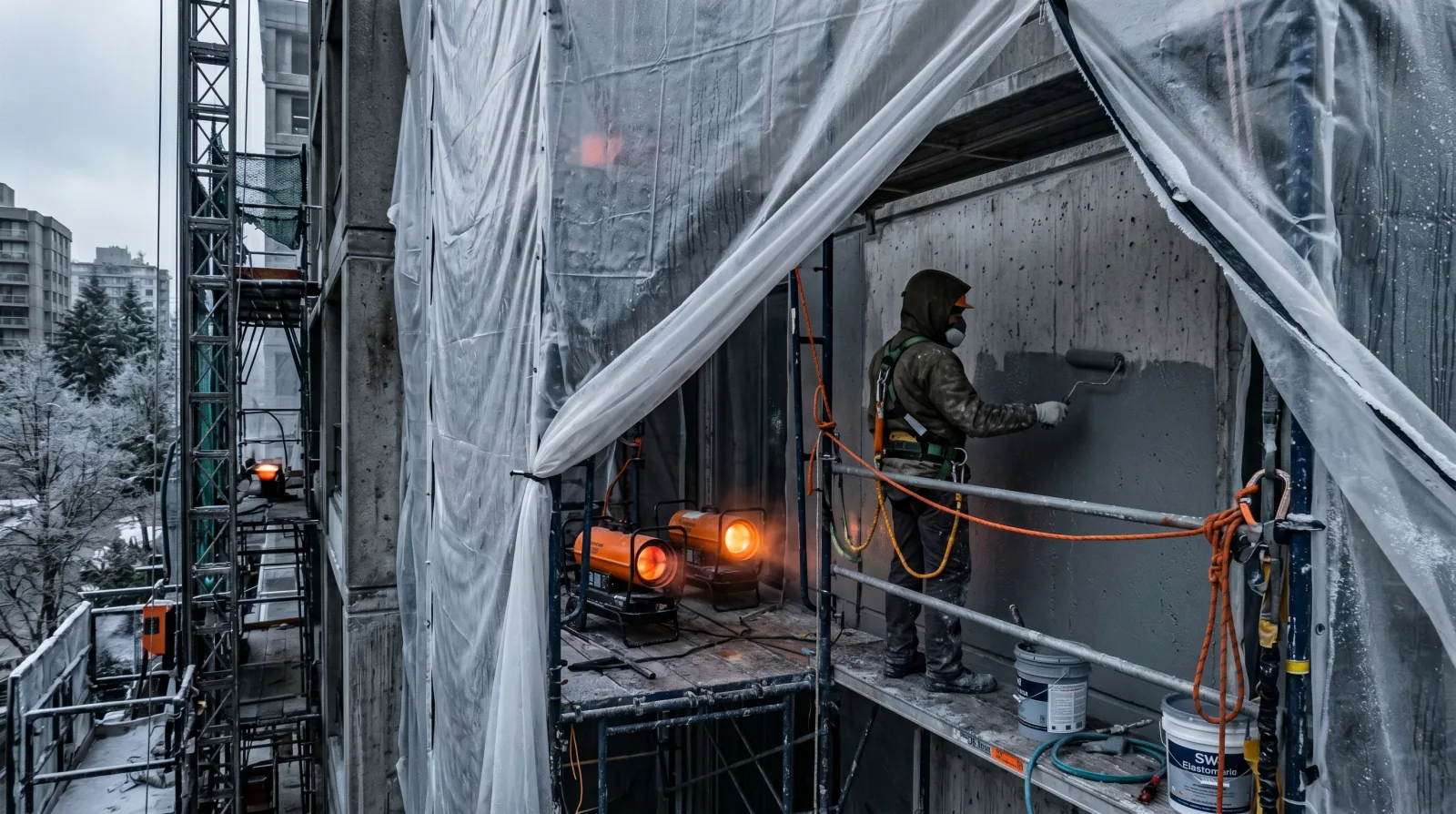
“Let’s wait until spring.” It is the most common instinct a strata council has when a coating or restoration project lands in front of them in October. The reasoning seems sound — why paint a building in the rain? But the instinct is often wrong, and the reasons it’s wrong come down to a few facts about coastal BC weather and how coatings, sealants, and concrete actually cure.
Winter restoration in this region is routine. It is not a compromise or a desperate measure. It is controlled work that, done properly, performs every bit as well as summer work. The difference is that winter demands more control, and a crew that doesn’t understand the controls can do real damage. So let’s go through what actually limits cold-weather work, and how it gets managed.
In coastal BC, the enemy is water, not cold
Start with the climate, because it shapes everything. Metro Vancouver winters are mild. Hard freezes are uncommon, and the deep-cold problems that govern construction on the Prairies rarely apply here. What we get instead is rain — the bulk of our 1,150 to 1,200 millimetres of annual precipitation per Environment Canada climate normals falls in the cooler months, much of it as prolonged wind-driven rain through a wet season that runs for months.
So the real winter challenge isn’t keeping materials from freezing. It is keeping surfaces dry enough, long enough, for coatings and sealants to bond and cure. The same atmospheric rivers that batter the building envelope are exactly what a winter restoration crew has to keep off the work. Manage the water and the temperature, and the cold itself is rarely the obstacle.
Temperature limits — and why curing matters more than application
Every coating, sealant, and repair mortar has a minimum application temperature on its data sheet, commonly somewhere around 5 to 10 degrees Celsius. But the number that catches people out isn’t the application temperature — it’s the cure. The product needs the air and surface to stay above the minimum not just at the moment it goes on, but through the hours and days it takes to cure.
A coating applied at noon when it’s warm enough, then left exposed as the temperature drops below the limit overnight, can fail to film properly. You can end up with incomplete film formation, poor adhesion, blistering, or a surface that stays soft and tacky and never fully hardens. The danger is that this failure often doesn’t show immediately. The coating looks fine, the crew leaves, and months later the building owner discovers the whole application has compromised performance and has to be redone — at full cost, again. Respecting the cure window, not just the application moment, is what separates a coating that lasts from one that has to be torn off.
Dew point: the number nobody warns you about
Here is the control that matters most in our damp climate, and the one most often ignored: dew point.
Dew point is the temperature at which moisture in the air condenses into liquid on a surface. The working rule is that the surface being coated must stay at least about 3 degrees Celsius above the dew point during application and cure. If the surface is at or below the dew point, an invisible film of condensation forms on it — even on a surface that looks and feels dry — and that film ruins adhesion.
In coastal BC’s humid winter air, the gap between the surface temperature and the dew point is often narrow. A wall that has cooled overnight can sit right at the dew point in the morning, with a microscopic layer of condensation that no one can see. Coat over that and the coating fails. This is why a competent crew measures surface temperature and dew point through the day, and why understanding it is part of doing any elastomeric wall coating on a concrete tower right — the best coating in the world fails if it goes onto a surface that’s secretly damp.
Sealants and concrete in the cold
The same principles extend across the trades.
Sealants have their own minimum application temperatures and need clean, dry, frost-free joint surfaces to bond. Cold slows the cure and makes some products stiffer to gun and tool. Apply sealant onto a wet or frosted joint and the bond is gone before it starts. With the joint kept dry and warm, sealant work continues through winter without trouble.
Concrete repair needs fresh repair material protected from freezing while it cures — early freezing can permanently weaken a repair. Hard freezes are rare here, but cold slows the cure and overnight lows still need watching. Insulated blankets, enclosures, and sometimes supplemental heat keep repairs above their minimum cure temperature, and the repair materials carry their own temperature limits that have to be respected.
Weather enclosures turn winter into a workable season
The tool that makes all of this possible is the weather enclosure — scaffolding wrapped in tarps or shrink-wrap, creating a controlled space around the work area. An enclosure keeps rain off the surface, holds heat in, and lets the crew maintain the temperature and dryness the materials need. Combined with heaters and, where the air is too humid, dehumidification, the enclosure turns an exposed winter facade into a controlled environment.
Inside a heated, dry enclosure, the dew-point and temperature problems become manageable. The crew controls the conditions rather than fighting the weather. That control is the whole reason quality work can continue through the wet season — and it’s why winter restoration is a matter of preparation and equipment, not luck.
Short daylight is the other winter factor, handled through staging. Crews sequence the work so surfaces are prepped and coated within the usable, warmer part of the day, leaving time to set before temperatures drop. Enclosures with lighting and heat extend the workable window, and because winter curing is slower, the schedule is built with realistic timelines and more time between coats rather than rushed.
So should you wait for spring?
Sometimes, yes. If the work is discretionary and the building is sound, the drier, warmer months make a large coating project faster and simpler, with fewer enclosure and weather constraints. There’s nothing wrong with scheduling non-urgent work for the dry season.
But waiting is the wrong call when the building has active water ingress, deteriorating concrete, or failing sealant. Delaying protective work through a full wet season lets the damage grow — water keeps getting in, concrete keeps deteriorating, and the repair scope expands with every storm. The protective value of exterior coatings on a building is exactly what an exposed, deteriorating facade is missing through those months.
The honest comparison isn’t winter versus summer. It’s controlled winter work under an enclosure versus a whole season of continued deterioration. Winter restoration carries added costs — enclosures, heating, dehumidification, longer cure times — but for urgent protective work, those costs are almost always smaller than the additional damage that waiting until spring would cause. The smart approach is to do the urgent protective work now, under control, and schedule the discretionary work for the dry season. The weather doesn’t have to stop the work. It just has to be managed.
Related guides
- Exterior Coatings Hub — coating systems, application, and service life
- Elastomeric Wall Coatings for Concrete Towers in Vancouver — surface prep and application conditions
- Atmospheric Rivers and the Building Envelope in Vancouver — the wet-season conditions winter work contends with
- How Exterior Coatings Protect Buildings — why delaying protective work costs more
Frequently Asked Questions
More from Exterior Coatings Guide
Coating a Damp Substrate Is How You Buy the Same Job Twice
A coating applied over concrete that has not dried will blister, and it will do it months later when the crew has gone. Testing takes minutes and settles the question.
Read article →Moss on a Building Is a Drainage Report You Can Read From the Street
Organic growth does not appear randomly. It grows where surfaces stay wet, which makes it the cheapest diagnostic tool available on a Metro Vancouver building.
Read article →Why Exterior Coatings Blister and Peel on BC Buildings
A fresh coating on a Surrey tower blistering within a year almost always traces back to one thing: moisture in the substrate. Why it happens, how to diagnose it, and the 5% rule.
Read article →