Roof Anchor Recertification: WorkSafeBC Rules for Vancouver High-Rises
The paperwork that decides whether work can even start
Before any of our technicians clip into a rope on a Vancouver high-rise, someone checks the anchor records. Not the harness, not the ropes — the building’s roof anchors and their certification. If those records are missing or expired, the job does not start, no matter how routine the work. That single gate catches more buildings off guard than any other part of high-rise maintenance, so it is worth understanding exactly what WorkSafeBC requires and whose job it is to keep it current.
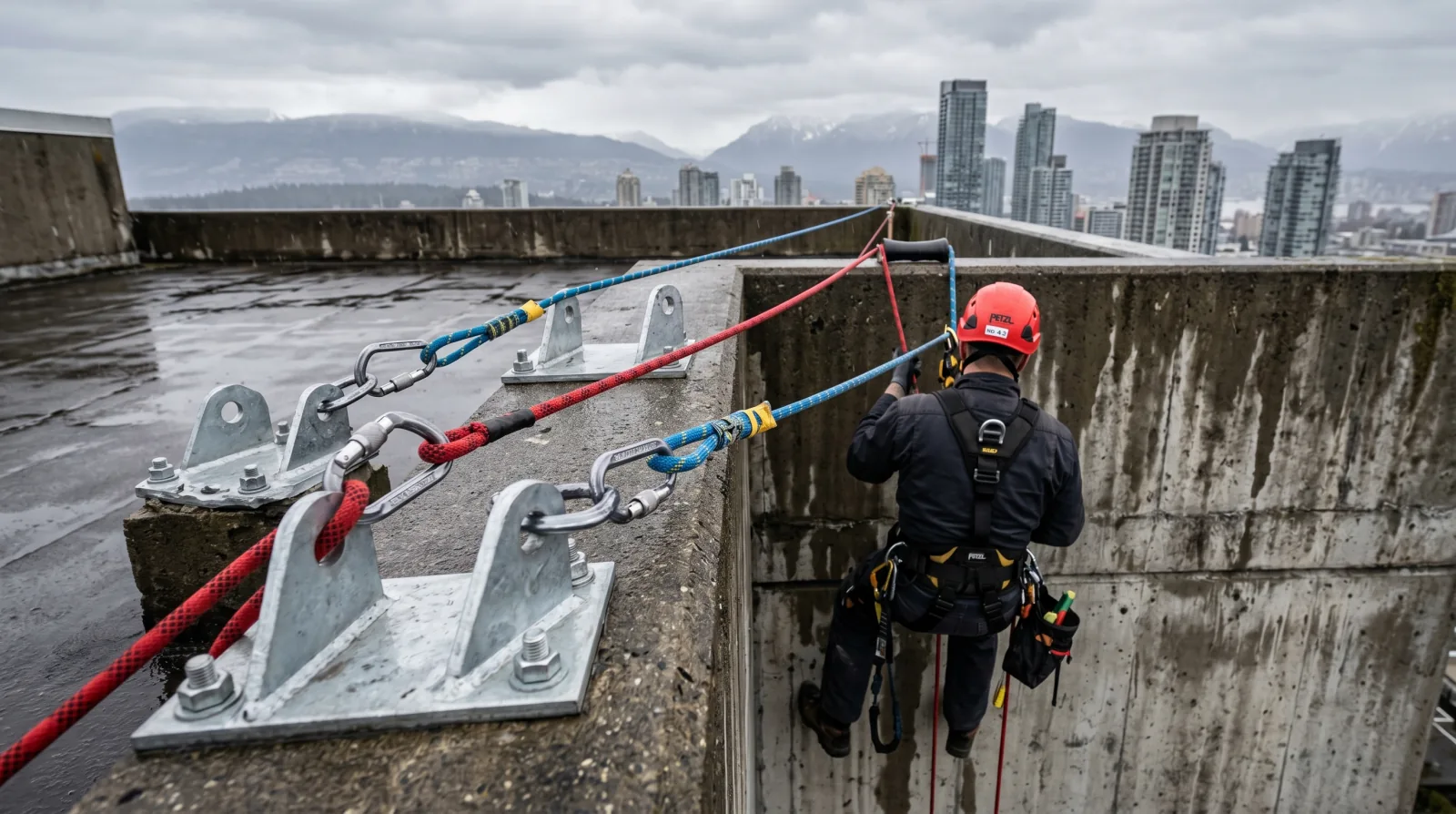
Roof anchors are the structural points on a building’s roof that rope access technicians and suspended platforms attach to. They are, quite literally, what holds a worker to the building. BC regulates them tightly, and the responsibility for keeping them compliant sits largely with the building owner or strata corporation — not with the contractor who shows up once a year.
What WorkSafeBC Part 34 actually requires
The governing rules live in WorkSafeBC OHS Regulation Part 34, which covers rope access work specifically. Two requirements drive almost everything a building owner needs to know.
First, certification. A permanent anchor for a rope access system, and its installation, must be certified by a professional engineer. This is not a formality a contractor can sign off on. An engineer has to assess the anchor, its connection to the structure, and confirm it meets the standard. Until that certification exists, the system is not legal to use.
Second, annual inspection. A permanent anchor must be inspected at least once a year and tested, with the results documented. And if an anchor is ever removed from service, it cannot go back into use until it has been re-inspected and recertified by the manufacturer or a professional engineer. That yearly cycle is the heartbeat of anchor compliance.
Part 34 does not stand alone. Part 11 fall protection sets the broader duty to protect any worker exposed to a fall, and compliant rope access on a Burnaby or Richmond tower has to satisfy both parts at once.
Why the two-rope system is non-negotiable
There is a reason you should never see a rope access technician hanging from a single line. The method is built on redundancy. Every technician works on two independent ropes: a working line that carries their weight and a separate safety backup line that arrests a fall if the working line or its connection ever fails. Each line ties into its own anchor point.
That is also why anchor counts matter. A single drop position needs enough certified anchors to rig both lines independently, often with additional anchors for rigging and edge protection. When an engineer certifies a building’s anchor layout, they are confirming the building can actually support a compliant two-rope setup at every position a crew needs to reach. IRATA and SPRAT — the two international rope access certification bodies our technicians train under — build their entire systems around this principle.
Whose responsibility is it?
This is where strata councils and commercial property managers sometimes get caught. The permanent anchor system is part of the building. It is a fixed installation on the roof, owned by the building, and keeping it certified and inspected is the owner’s duty — the same way a building is responsible for its elevator inspections or its fire systems.
The contractor’s duty is different and additional. Before each use, the rope access crew inspects the anchors themselves and reviews the certification and inspection records. If those records are not current, a reputable contractor refuses the work. We have turned down jobs in North Vancouver and New Westminster where the building had no anchor records at all — not because we doubted the building, but because using uncertified anchors is illegal and unsafe, and no amount of scheduling pressure changes that.
So the practical reality is a handoff: the building keeps the anchors certified and inspected, the contractor verifies that before clipping in. Break either link and the work cannot proceed.
What we find on older buildings
On newer towers, anchor systems are usually engineered in from the start and well documented. The buildings that surprise owners are the older ones across Metro Vancouver — structures from before current anchor standards, or buildings where anchors were added piecemeal over the years.
We routinely find anchors on older Vancouver and Coquitlam buildings that need an engineer’s review before anyone can use them: corroded baseplates, anchors that no longer meet current load requirements, or installations with no certification on file at all. None of that means the building is unusable. It means an engineer needs to inspect, and possibly the building needs anchor repair or replacement, before maintenance crews can safely access the facade. That work is itself a capital item worth tracking in the building’s reserve planning.
What a compliant anchor inspection actually involves
Owners often picture the annual anchor inspection as someone glancing at the rooftop bolts. It is more than that, and understanding what it covers helps a strata budget for it and recognize when it has been done properly.
A proper inspection looks at the whole anchor system, not just the visible anchor head. The engineer or qualified inspector examines each anchor for corrosion, deformation, cracking, and loose or damaged fasteners; checks the connection into the structure, since the anchor is only as strong as what it is bolted to; and confirms the anchors still match the certified layout and current standards. Where the standard requires it, anchors are load tested, and all of it is documented — which is the part that actually matters when a contractor or insurer asks for proof. An inspection with no paperwork is, for practical purposes, no inspection at all.
The roof itself is part of the picture. Anchors are often bolted through roofing membrane or into concrete that is exposed to the same Metro Vancouver weather as the rest of the building. We have found anchors on Burnaby and New Westminster rooftops where the anchor was sound but the surrounding roofing or concrete had deteriorated around the baseplate, compromising the connection. A good inspection catches that, because a perfect anchor on a failing substrate is not a safe anchor.
Timing the inspection well saves money and downtime. The smart move is to schedule the annual anchor inspection alongside other roof and envelope work, so the access and mobilization are shared rather than paid for twice. A building that books its anchor inspection, its roof check, and its envelope review in one coordinated visit gets more done per setup. And lining the inspection up before the busy spring-to-fall maintenance season means the anchors are certified and ready when window cleaning and facade work need them, rather than discovering a lapse the week a project is supposed to start.
When anchors do need repair or replacement, that work should feed straight into the building’s capital planning. Anchor replacement and engineering upgrades are tracked components in a depreciation report, not surprises, and treating them that way means the funding is anticipated rather than scrambled for. A strata that knows its anchors are due for an upgrade in three years can plan it; one that discovers it the day a crew refuses to clip in is reacting under pressure.
Keeping the building able to access itself
Step back and the point of all this becomes clear: a building that lets its anchor certification lapse loses the ability to maintain its own exterior. Window cleaning, sealant renewal, envelope inspection, concrete repair at height — every one of those depends on safe, legal roof access. When the anchors fall out of compliance, all of it stalls.
The fix is simple discipline. Schedule the annual anchor inspection the way you schedule any other building system. Keep the engineer certification, the latest inspection report, the test records, and any repair history together and accessible — a rope access contractor in Vancouver or Surrey will ask for them before mobilizing. Treat anchor replacement and engineering upgrades as tracked capital items in the depreciation report, not surprises.
We work this way on every high-rise we touch, and the rope access building maintenance and high-rise window cleaning services both depend on it. The buildings that keep their anchor records in order are the ones where maintenance happens on schedule and on budget. The ones that let it slide are the ones calling around in a panic when a facade repair suddenly cannot proceed.
The mental shift that helps most is to treat the anchor system like the fire system or the elevators — a piece of building infrastructure with a legal inspection requirement, a paper trail, and consequences for letting it lapse. No competent manager forgets the elevator inspection, because the elevator stops working and everyone notices. The anchors are quieter: nothing visibly breaks when the certification expires, and the cost only shows up the day a crew needs to hang off the building and cannot. Put the annual anchor inspection on the same calendar as the other mandatory building inspections, keep the records with them, and the problem never arises. It is one of the cheapest forms of discipline a Metro Vancouver high-rise can practise, and one of the most consequential when it is missed.
Frequently Asked Questions
More from Rope Access Guide
Rope Access vs Boom Lift for High-Rise Facade Work in BC
A boom lift can reach the lower floors of a Richmond mid-rise from the street. It can't reach the 30th floor of a downtown Vancouver tower. Where each tool wins, and why.
Read article →Swing Stage and Street Use Permits for Downtown Vancouver Facade Work
Before a swing stage touches a downtown Vancouver tower, the City wants a street use permit and a pedestrian protection plan. Here's what that involves, why it delays projects, and how rope access sidesteps most of it.
Read article →Why Gutter and Scupper Cleaning Belongs in Your Rope Access Maintenance Visit
Blocked gutters, scuppers, and roof drains send water where it was never meant to go — usually into the parapet or down the face of the building. Why this belongs in the same rope access visit as window cleaning and sealant inspection, not a separate call.
Read article →