Building envelope specialist vs. general painter: who to hire for high-rise coating work in Vancouver
For a straight repaint of a sound, low-rise wall, a good general painting company does clean work at a fair price, and paying specialist rates there buys you nothing. For a high-rise elastomeric or restoration coating campaign in Metro Vancouver, hire a building envelope specialist. That work depends on rigorous surface prep, measured film build, rope-access certification, and a documented warranty, and those are the things a standard repaint workflow is not built to deliver.
The honest version of this comparison is not "specialists good, painters bad." It is a question about the wall. Sound and low and reachable from the ground means a painting job. Tall, cracking, or leaking, coated with a system that only works at a measured thickness, means envelope work. Get the match wrong in either direction and you either overpay for rigour you do not need or, far worse, put a performance coating on a high-rise without the prep and film-build control that make it perform. Here is how to tell which job you actually have.
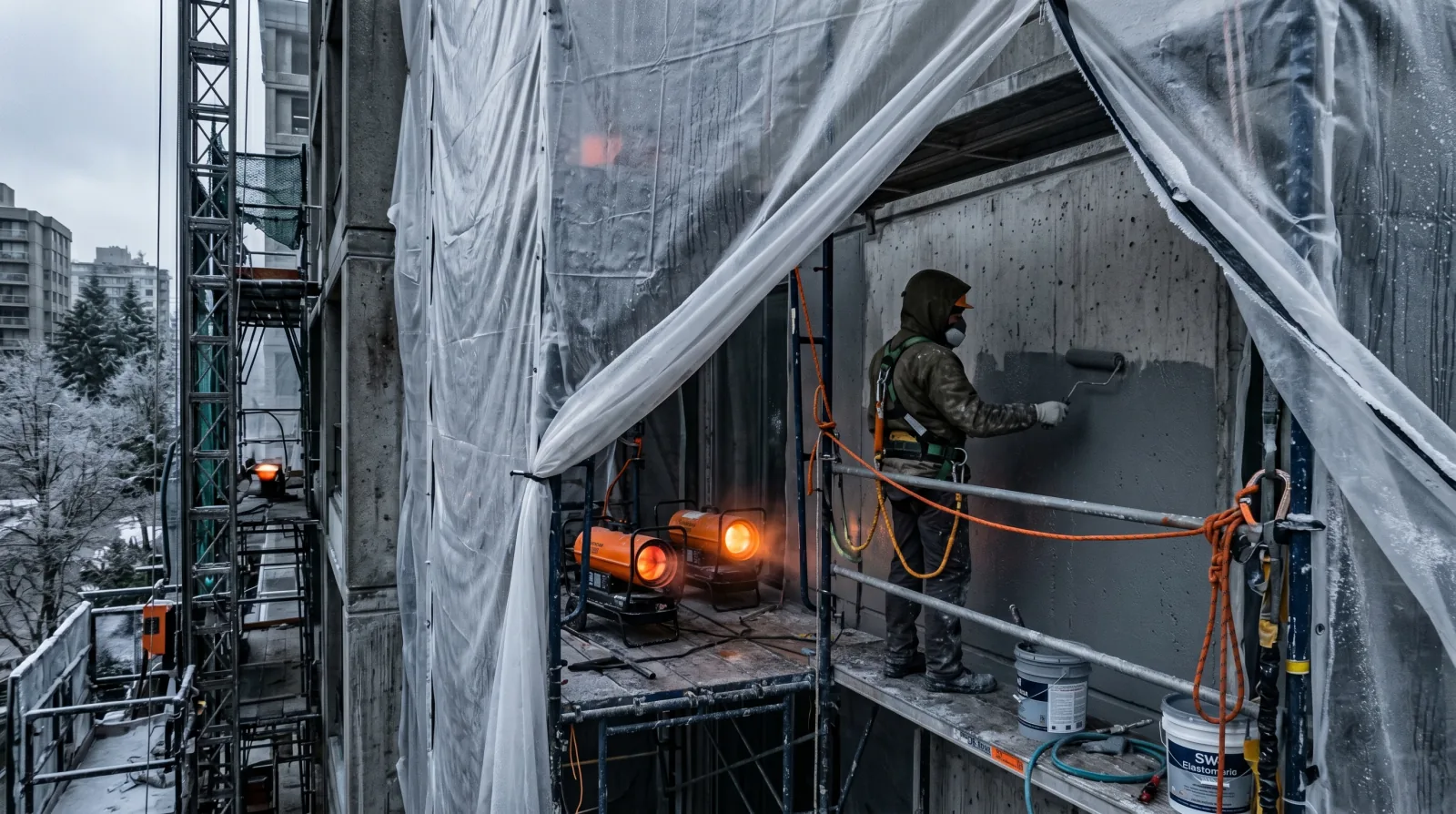
The question is about the wall, not about who is nicer
There is a lazy version of this comparison that says specialists are good and painters are bad. It is wrong, and any honest envelope contractor will tell you so. A skilled general painting company does careful, well-priced work every day: house exteriors on the North Shore, townhouse repaints in Surrey, interior work, decorative finishes. For those jobs a specialist is not just unnecessary, they are the more expensive choice for no added benefit.
The real question is what the wall in front of you actually demands. A three-storey walk-up in New Westminster with a sound, ground-accessible facade and a plan to freshen the colour is a painting job. A twenty-storey concrete strata tower downtown, with hairline cracking and a history of water tracking through the wall, getting an elastomeric restoration coating from rope access, is envelope work. Different demands, different contractor. Match one to the other and you spend the right money in the right place.
Surface prep: where a restoration coating is won or lost
On a sound low-rise wall, standard prep is enough: wash, scrape the loose paint, spot-prime, caulk the visible gaps. A general painter does this well and there is nothing missing from it.
A restoration coating on a Vancouver concrete or stucco high-rise is a different scope. The crew has to sound the substrate to find delamination you cannot see from the ground, chip and patch spalled areas back to solid material, treat active cracks with a filler rated for how much the wall moves, and prime the bare and repaired areas with the correct primer before any topcoat goes on. Skip a step and the coating peels or blisters within a season. On a low-rise that means a repaint next weekend. On a downtown tower it means another rope-access mobilization at full cost, plus notices to every resident whose balcony the crew has to pass. That gap in consequences is why a specialist scopes prep as its own line item instead of burying it in a per-square-foot paint rate, and why the cheapest quote on a high-rise is often the one that quietly assumed the prep away.
Film build: the part you cannot judge by eye
Standard exterior paint goes on thin, and counting coats is a reasonable way to control it. Elastomeric and restoration coatings do not work that way. They only perform at the film build the manufacturer specifies, which is many times thicker than standard paint and applied in more than one coat. Put it on too thin and it loses the crack bridging and waterproofing that are the entire reason you paid for it. You end up with expensive paint that fails like cheap paint.
The control for this is measurement, not judgement. A specialist uses wet-film thickness gauges as the crew applies the coating and tracks coverage rate against the spec, so there is a record of what actually went on the wall. Before you sign for an elastomeric campaign, ask the contractor how wet-film thickness will be monitored and whether you get that documentation at closeout. The answer tells you a lot. Our own approach to that monitoring is described on the exterior coatings service page, and the coating-chemistry side is covered in the elastomeric versus acrylic guide.
Working at height in Vancouver, safely and legally
Above ladder height, facade work falls under WorkSafeBC fall-protection rules in the OHS Regulation, with general fall protection under Part 11 and rope access specifically under Part 34. For rope access, technicians are typically certified through IRATA or SPRAT, the two recognized bodies for working on rope on a building. A legitimate high-rise contractor works to a written fall-protection plan, rigs from engineered roof anchors, and puts each technician on two separate rope lines rather than trusting one.
This is where the access difference between contractor types is sharpest. A general painting company built around ladders and lifts may simply not carry rope-access certification, which caps how high the crew can legitimately go. A painter can subcontract the height work, and some do, but then the coating knowledge and the film-build monitoring still have to come from somewhere. On an occupied Metrotown or downtown tower, the access plan is not a formality. It is what keeps the crew alive and keeps the strata clear of liability. For the access side specifically, see our rope access building maintenance work, and the rope-access specialist versus general contractor guide.
How the two price the same building differently
When a strata gets one quote from a painter and one from an envelope specialist, the gap can look alarming until you read what is inside each number. The painter is usually pricing a repaint: wash, prime, coat, at a per-square-foot rate that is fair for a sound wall. The specialist is pricing a restoration: sounding and crack repair, spalled-concrete patching, movement-rated crack filler, primer, an elastomeric system at a measured film build, rope-access mobilization under a fall-protection plan, resident coordination, and a documented warranty. Those are different scopes of work priced honestly, not the same work at two markups.
The way to compare them is line by line, not bottom line to bottom line. If the cheaper quote is silent on prep, says nothing about film build, and does not mention how the crew reaches the wall, it is cheaper because it left those out, and they are the parts that make the coating last. A specialist quote that itemizes the prep and the monitoring is not padding the number, it is showing you the work. On the right building that work is the difference between a coating that lasts fifteen years and one that fails in three, and the failed one is far more expensive once you add the second mobilization and the disruption.
Coordinating an occupied strata building
A high-rise restoration coating campaign is a project, not a visit. On an occupied strata tower it runs for weeks, has to work around Metro Vancouver rain windows, and needs resident notices for balcony access, parking, and noise. Coastal weather makes the scheduling harder: a water-based coating needs a dry substrate and a dry window to cure, so the crew often follows the weather, coating a sheltered elevation on a wet day and the exposed face when it clears.
A contractor who runs strata projects regularly plans for all of that. They coordinate with the strata council and the property manager, sequence the elevations around the forecast, and keep residents informed. A company that mainly does one-day repaints is not set up for that rhythm, through no fault of its own. It simply is not the work it does. Where the job also involves concrete repair, sealant replacement, or membrane work alongside the coating, that coordination matters even more, which is what our building restoration service is built around.
The hybrid option, and where it goes wrong
A common middle path is a general painter who subcontracts the rope access and applies the coating themselves. On a lower building with a coating the painter knows, this can be a fair, cost-effective arrangement. The trap is assuming that solving the access solves the whole job. It does not. The elastomeric still has to be prepped for, applied at the right film build, and documented, and if the painter is working outside their normal product range with nobody measuring the film build, the height is handled but the coating is not.
If you are considering a hybrid arrangement, make the responsibility explicit before you sign. Who owns the coating specification, who measures and records the wet-film thickness, and who carries the warranty on the coating itself, not just the access? A clear answer in writing turns a risky improvisation into a workable plan. A vague answer, where the access sub points at the painter and the painter points at the product data sheet, is a sign the coating side has no owner, and that is exactly where these jobs fail.
The warranty is only as good as the record behind it
A warranty feels like protection, but on a coating job it is only as strong as two things: the documentation of how the work was done, and the company still being around to honour it. On a low-rise repaint, a good general painter gives a real workmanship warranty and can stand behind it. That is genuine value.
On a high-rise elastomeric campaign, a warranty from a contractor who did not measure the film build or record the prep is hard to enforce. If the coating fails in year four, there is no evidence of whether it was applied to spec, and the discussion turns into your word against theirs. A specialist who logged the wet-film readings and photographed the prep has proof the system was installed correctly, which is what gives the warranty teeth. So the stronger warranty is not automatic based on who signed the contract. It is the one with the paper trail and a contractor built to come back for a callback years later.
The two contractor types compared
Building envelope / coatings specialist
A contractor whose core business is restoration coating and envelope work on mid-rise and high-rise buildings. Crews are trained on surface prep, film-build control, and working at height, and the company carries the certifications and documentation that high-rise work requires.
General painting company
A contractor built around residential and light commercial painting: interiors, fences, houses, low-rise repaints, and decorative finishes. Good general painters do clean, fast, well-priced work within their range, and for the right building they are the sensible choice.
Decision framework: nine questions that point to the right contractor
| Question | Points to | Reason |
|---|---|---|
| Building is a high-rise or mid-rise tower? | Specialist | Above a few storeys the work needs a rope-access or swing-stage crew and a WorkSafeBC fall-protection plan. A general painter set up for ladder-height work cannot legitimately reach or safely staff a downtown or Metrotown tower facade. |
| Coating is elastomeric or a restoration system? | Specialist | Elastomeric only performs at the correct film build. It has to be measured on the wall as it goes on, not judged by eye. A specialist scopes and monitors that; a standard painting workflow generally does not. |
| Straight repaint of a sound, low-rise wall? | General painter is fine | If the substrate is sound, the wall is reachable from the ground, and a standard paint is the right product, a good general painting company does clean work at a lower price. Paying specialist rates here buys you nothing extra. |
| Active cracking or water ingress history? | Specialist | The coating has to bridge cracks and slow water, and the cracks and sealant joints have to be repaired first. That is envelope work, not repaint work, and it needs someone who can sound the wall and scope the repair. |
| Interior or decorative finish work? | General painter is fine | Colour, sheen, and clean cut lines are exactly what a general painter is good at. There is no envelope performance requirement, so specialist certifications add cost without adding value. |
| Coating tied to a warranty the strata will rely on? | Specialist for high-rise coatings | A coating warranty is only as strong as the prep record behind it and the company still being there to honour it. For a major elastomeric campaign, documented film build and a contractor built for callbacks is what makes the warranty real. |
| Envelope engineer or depreciation report involved? | Specialist | When a consultant has specified the coating system, the contractor has to work to that specification and produce the documentation the engineer signs off on. That is the specialist workflow, not a standard repaint. |
| Building is occupied strata or commercial? | Specialist | Coordinating access, resident notices, and a multi-week schedule around Vancouver weather on an occupied tower is a project-management job. A contractor who does this regularly on strata buildings will run it more smoothly than one who does not. |
| Small, sound, low-exposure surface and tight budget? | General painter is fine | Not every wall needs a restoration scope. A sound, sheltered, ground-level surface with a standard paint is exactly where paying for specialist rigour would be waste, and an honest specialist will tell you so. |
Four real Vancouver scenarios
New Westminster three-storey walk-up, colour refresh
Situation: A sound, ground-accessible wood-frame walk-up with no cracking and no leak history. The strata wants to freshen the colour and tidy the trim.
Call: General painting company.
Why: This is a painting job, not envelope work. The wall is sound, reachable from the ground, and a standard exterior paint is the correct product. A good general painter does clean work here at a lower price, and paying restoration-specialist rates would buy certifications and documentation the job does not need.
Downtown Vancouver concrete tower, elastomeric campaign
Situation: A twenty-storey strata with hairline cracking, a history of water tracking through one elevation, and an engineer who has specified an elastomeric restoration coating applied by rope access.
Call: Building envelope coatings specialist.
Why: Everything here is specialist work: rope access under a fall-protection plan, elastomeric applied at a measured film build, crack and sealant repair before coating, and a documented closeout the engineer signs off. A general painter, even a very good one, is not staffed or certified for this, and the coating underdelivers if the film build is eyeballed.
Burnaby mid-rise stucco, cracking and damp on the north face
Situation: A five-storey stucco strata with active cracking and a persistently damp north elevation. The council has quotes from a painter and from an envelope contractor with a wide price gap.
Call: Specialist, and find out why the wall is damp first.
Why: The price gap is the tell. The painter quoted a repaint; the specialist quoted repair of the cracks and moisture source, then a crack-bridging coating. Painting over active damp just blisters the new coating within a season. The higher quote is not padding, it is the work the wall actually needs, and skipping it means paying twice.
Low-rise commercial, painter offers to subcontract the height
Situation: A four-storey commercial building where a trusted local painter offers to bring in a rope-access sub for the upper reaches and handle the coating themselves.
Call: Workable, but pin down who owns the coating knowledge.
Why: Subcontracting the access can work, but the film-build monitoring and the coating expertise still have to come from somewhere. If the painter is applying an elastomeric they do not normally handle and nobody is measuring film build, the height problem is solved but the coating problem is not. Ask who is responsible for the wet-film readings and the warranty before agreeing.
Questions to ask before you approve the scope
- Is surface prep scoped as its own line, with sounding for delamination and crack repair, or folded into a per-square-foot paint rate? A missing prep line is the most common reason a low bid is low.
- How will wet-film thickness be measured during application, and do you get the readings at closeout? For an elastomeric system, "we apply two coats" is not film-build control.
- Is the crew rope-access certified (IRATA or SPRAT), and is there a written WorkSafeBC fall-protection plan with engineered anchors? Confirm it before any work above ladder height.
- What liability and WorkSafeBC coverage does the contractor carry, and does it extend to work at height on an occupied building? Ask to see current certificates.
- Who coordinates resident notices, parking, and the weather-dependent schedule on an occupied strata? Someone has to own the project, not just the painting.
- Is the specified coating the product the engineer or manufacturer calls for, applied to their specification? A cheaper substitute "equivalent" can void the system warranty.
- What does the warranty actually cover, for how long, and what documentation backs it? A guarantee with no prep record and no film-build data is hard to enforce.
- If a painter is subcontracting the height, who owns the coating knowledge and the film-build monitoring? The access being handled does not mean the coating is.
Quick answers
What is the difference between a building envelope coatings specialist and a general painting company?
A general painting company is built around interiors, houses, low-rise repaints, and decorative work, and good ones do that quickly and at a fair price. A building envelope coatings specialist is built around restoration coating on mid-rise and high-rise buildings: crews trained to sound a concrete or stucco facade for hidden delamination, scope crack and sealant repair, apply elastomeric at a measured film build, and work at height under a WorkSafeBC fall-protection and rope-access plan. The distinction is not that one type is better people. It is that high-rise restoration coating asks for prep rigour, film-build control, rope-access certification, and documentation that a standard repaint workflow is not set up to provide. For a sound low-rise wall, the general painter is the right, cheaper choice. For a downtown Vancouver strata tower getting an elastomeric campaign, the specialist is the one who can actually deliver and stand behind it.
Can a general painting company do elastomeric coating on a high-rise in Vancouver?
Two things have to line up, and often they do not. First is access: a high-rise facade needs rope access or swing stage under a WorkSafeBC fall-protection plan, with technicians typically IRATA or SPRAT certified and rigged on dual rope lines from engineered anchors. A general painter set up for ladder and lift work usually does not carry that certification. Second is the coating itself: elastomeric only performs at the correct dry film thickness, which has to be measured with wet-film gauges as the crew applies it. Applied too thin it loses its crack bridging and waterproofing and becomes expensive paint. A standard painting workflow judges coats by eye, which is fine for standard paint and not enough for elastomeric. A painter can subcontract the height access, but the coating knowledge and the film-build monitoring still have to come from somewhere. If they do not, the campaign underdelivers even when the colour looks right on day one.
When is a general painter the right choice over a restoration specialist?
More often than a specialist will admit. If the wall is sound, reachable from the ground or a low roof, has no active cracking or water ingress, and a standard exterior paint is the correct product, a good general painting company will do clean work at a lower price. That covers townhouse and house exteriors, low-rise buildings, fences and railings, interior repaints, and decorative or colour-change work. Paying restoration-specialist rates for that kind of job buys you certifications and documentation you do not need. The specialist earns the premium only when the building is tall enough to need rope access, when the coating is elastomeric or a restoration system that depends on measured film build, or when the substrate needs repair before it can be coated. Match the contractor to the demands of the wall, not to who has the fancier brochure.
Hiring a high-rise coatings contractor
What is the difference between a building envelope coatings specialist and a general painting company?
A general painting company is built around interiors, houses, low-rise repaints, and decorative work, and good ones do that quickly and at a fair price. A building envelope coatings specialist is built around restoration coating on mid-rise and high-rise buildings: crews trained to sound a concrete or stucco facade for hidden delamination, scope crack and sealant repair, apply elastomeric at a measured film build, and work at height under a WorkSafeBC fall-protection and rope-access plan. The distinction is not that one type is better people. It is that high-rise restoration coating asks for prep rigour, film-build control, rope-access certification, and documentation that a standard repaint workflow is not set up to provide. For a sound low-rise wall, the general painter is the right, cheaper choice. For a downtown Vancouver strata tower getting an elastomeric campaign, the specialist is the one who can actually deliver and stand behind it.
Can a general painting company do elastomeric coating on a high-rise in Vancouver?
Two things have to line up, and often they do not. First is access: a high-rise facade needs rope access or swing stage under a WorkSafeBC fall-protection plan, with technicians typically IRATA or SPRAT certified and rigged on dual rope lines from engineered anchors. A general painter set up for ladder and lift work usually does not carry that certification. Second is the coating itself: elastomeric only performs at the correct dry film thickness, which has to be measured with wet-film gauges as the crew applies it. Applied too thin it loses its crack bridging and waterproofing and becomes expensive paint. A standard painting workflow judges coats by eye, which is fine for standard paint and not enough for elastomeric. A painter can subcontract the height access, but the coating knowledge and the film-build monitoring still have to come from somewhere. If they do not, the campaign underdelivers even when the colour looks right on day one.
When is a general painter the right choice over a restoration specialist?
More often than a specialist will admit. If the wall is sound, reachable from the ground or a low roof, has no active cracking or water ingress, and a standard exterior paint is the correct product, a good general painting company will do clean work at a lower price. That covers townhouse and house exteriors, low-rise buildings, fences and railings, interior repaints, and decorative or colour-change work. Paying restoration-specialist rates for that kind of job buys you certifications and documentation you do not need. The specialist earns the premium only when the building is tall enough to need rope access, when the coating is elastomeric or a restoration system that depends on measured film build, or when the substrate needs repair before it can be coated. Match the contractor to the demands of the wall, not to who has the fancier brochure.
Why does surface preparation matter more on a restoration coating job?
Because on a high-rise facade the prep is most of the work and almost all of the risk. A standard repaint on a sound wall can get away with a wash, a scrape, and a spot prime. A restoration coating on a Vancouver concrete or stucco tower cannot. The crew has to sound the substrate for hidden delamination, chip and patch spalled areas back to solid material, treat active cracks with a filler rated for the wall movement, and prime bare and repaired areas with the right primer before the topcoat. Skip or rush any of that and the coating peels or blisters within a season. On a low-rise you scrape and repaint the failure the next weekend. On a downtown or Metrotown high-rise, a failure means another rope-access mobilization at full cost, plus resident disruption. That is why a specialist scopes prep as its own line of work rather than folding it into a per-square-foot paint rate.
How do I know the elastomeric coating was applied at the correct thickness?
You ask before the job starts, and you ask for the record after. Elastomeric performs only at the film build the manufacturer specifies, typically a much thicker system than standard paint, applied in more than one coat. Applied too thin it loses the crack bridging and waterproofing that justify its cost. The way a specialist controls this is with wet-film thickness gauges during application and by tracking coverage rate, so many square feet per pail of product, against the spec. That gives a measured record instead of a guess. Before you sign a contract for an elastomeric campaign on a Vancouver strata tower, ask the contractor how wet-film thickness will be monitored and whether you will get documentation at closeout. A contractor who monitors film build will answer plainly. One who intends to eyeball it will get vague, and that vagueness is your warning.
Why is the specialist quote so much higher, and is it worth it?
The gap almost always comes down to scope, not markup. A painter quoting a sound low-rise wall is pricing a wash, a prime, and a coat, and that is a fair number for that work. A specialist quoting a high-rise restoration is pricing sounding and crack repair, spalled-concrete patching, movement-rated crack filler, primer, an elastomeric system at a measured film build, rope-access mobilization under a fall-protection plan, resident coordination, and a documented warranty. Those are real line items, not padding. The way to test it is to compare what each quote actually includes rather than the bottom number. If the cheaper quote is silent on prep, film build, and access, it is cheaper because it left out the work that makes the coating last. On the right building the specialist premium is worth it; on the wrong building it is waste, and an honest contractor will tell you which one you have.
Can a painter just subcontract the rope access and do the coating themselves?
Sometimes, and on a lower building it can be a reasonable arrangement, but it only solves half the problem. Bringing in a certified rope-access sub handles the height and the fall-protection plan, which is the safety and legal side. It does not by itself handle the coating side: the elastomeric still has to be applied at the correct film build, the substrate still has to be prepped and sounded, and someone still has to monitor and document what went on the wall. If the painter regularly applies that coating system and measures film build, the arrangement can work. If the painter is stepping outside their normal product range and nobody is measuring the film build, the access is covered but the coating is not, and that is where these hybrid jobs go wrong. The question to ask is simple: who owns the coating knowledge and the film-build monitoring, and is that in writing?
What certifications should a high-rise coatings contractor have in BC?
Work on a facade above ladder height falls under WorkSafeBC fall-protection rules in the OHS Regulation, and rope access specifically is governed by Part 34, while general fall protection sits under Part 11. For rope access, technicians are typically certified through IRATA, the Industrial Rope Access Trade Association, or SPRAT, the Society of Professional Rope Access Technicians. Those are the recognized frameworks for working on rope on a building. A legitimate high-rise contractor works under a written fall-protection plan, rigs from engineered anchors, and puts technicians on two separate rope lines rather than one. Ask to see proof of the rope-access certification and confirm the company carries current liability and WorkSafeBC coverage. This is not paperwork for its own sake. On an occupied downtown Vancouver tower, the access plan is what keeps the crew safe and keeps the strata clear of liability if something goes wrong.
Who is liable if something goes wrong at height on our building?
This is why the coverage question is not a formality. When a contractor works at height on your building, their WorkSafeBC registration and liability insurance are what stand between the strata and a claim if a worker is injured or property is damaged. A contractor set up for high-rise work carries coverage scaled to that exposure and operates under a written fall-protection plan, so the responsibility sits with them. A contractor working outside their normal scope, for example a ground-level painter improvising height access, may not have coverage that extends to the work, which can leave the strata exposed. Before any work above ladder height, confirm the contractor carries current WorkSafeBC coverage and liability limits appropriate to the building, and that the fall-protection plan is documented. On an occupied strata, that paperwork is the owners' protection, not red tape.
Is a coating warranty from a general painter as good as one from a restoration specialist?
The building decides it, and the honest answer is that a warranty is only as strong as two things behind it: the prep that was documented and the company still being in business to honour it. On a straightforward low-rise repaint, a good general painter offers a real, useful workmanship warranty and can stand behind it. On a high-rise elastomeric campaign, a warranty written by a contractor who did not measure the film build or document the surface prep is hard to enforce, because there is no record of whether the system was applied correctly. If the coating fails at year four, the argument becomes your word against theirs. A specialist who logged wet-film readings and photographed the prep has evidence the work was done to spec, which is what makes the warranty mean something. So the warranty is not automatically better because of who signed it. It is better when the documentation and the company longevity are there to back it up.
Not sure whether your building needs a specialist or a painter?
We assess concrete and stucco facades across Vancouver, North Vancouver, West Vancouver, and Burnaby, checking substrate condition, crack and moisture status, access requirements, and what the coating actually needs, so you can hire the right contractor and budget the work honestly, whichever type that turns out to be.