Traffic membrane vs. penetrating sealer for parkades: what actually stops the salt from reaching your rebar
A vehicular traffic membrane sits on the slab as a continuous waterproof film. It blocks water and chloride, bridges minor cracks, and protects the structure below. A penetrating sealer soaks into the concrete and only slows the salt. It does not form a waterproof film and cannot bridge a crack. On a suspended parkade slab under a Vancouver tower, that difference is the difference between protecting the rebar and just buying time.
The choice is not really about which product is better. It is about one question: is there occupied space or another slab below the deck? If yes, the requirement is waterproofing and a membrane is the answer. If the slab sits on grade with nothing underneath, a sealer as a maintenance measure can be enough. Get that question wrong and you either overspend on an at-grade pad or, far worse, leave a suspended structural deck unprotected. Here is how to read which one your deck needs.
Why chloride is the whole problem on a parkade deck
Every winter, cars roll into parkades across downtown Vancouver, Metrotown, and Burnaby carrying deicing salt in the slush packed around their tires. That salt melts off onto the slab, and the chloride in it is the number one accelerator of reinforcing steel corrosion. Here is the mechanism, because it drives every decision that follows. Chloride ions migrate down through unprotected concrete, reach the rebar, and set off rust. Rust takes up more room than the steel it forms from, so as the rebar corrodes it expands and pushes the surrounding concrete apart from the inside. That is what causes spalling and delamination, the flaking surface and the hollow-sounding areas you find on an aging deck.
By the time you can see it, the steel has already been corroding for years. So the real job on a parkade slab is not cosmetic. It is keeping chloride away from the steel, and that single goal is what separates a membrane from a sealer. One blocks the chloride; the other only slows it. Everything else on this page follows from that distinction.
What a traffic membrane does, and how a sealer is different
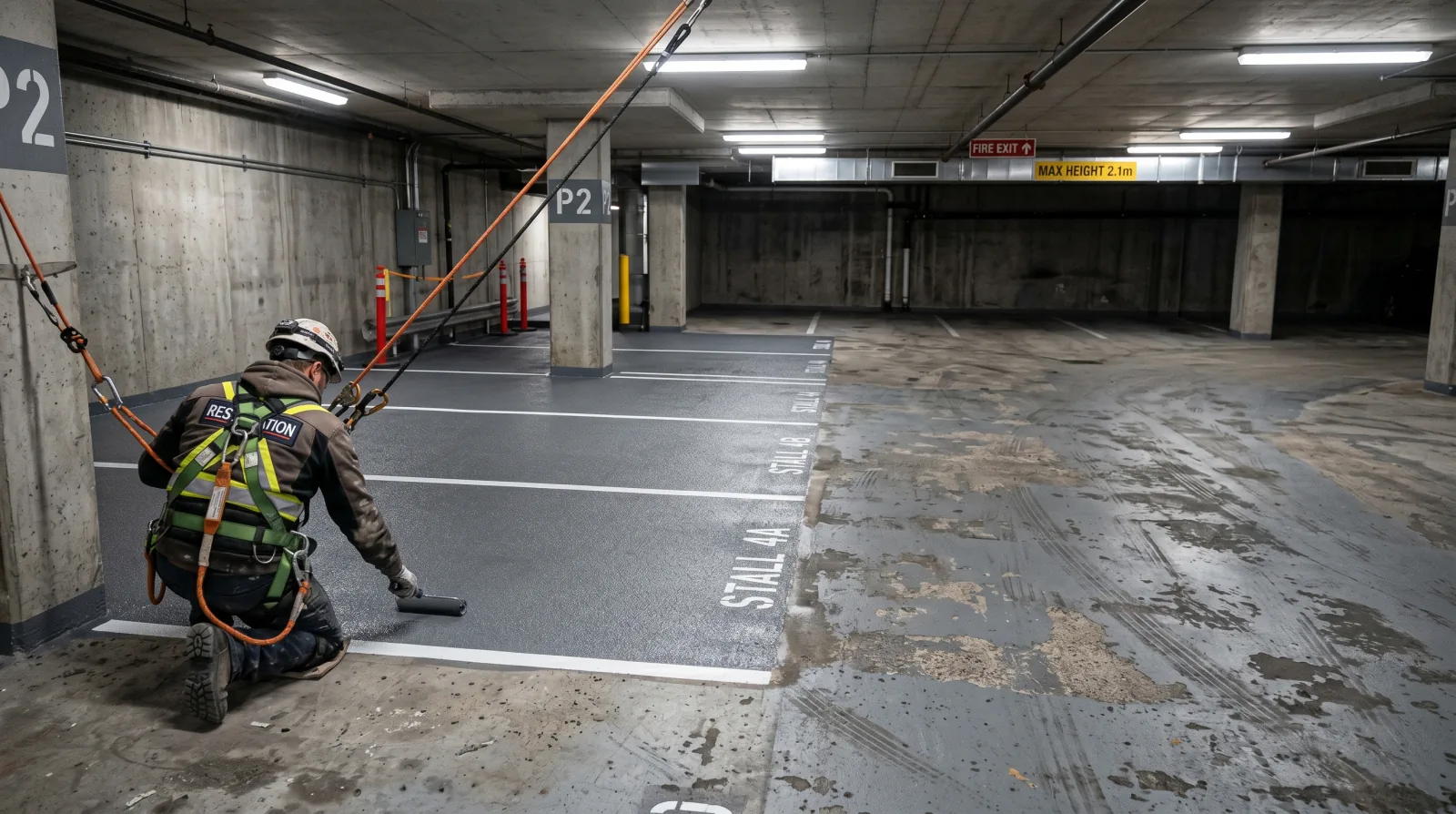
A vehicular traffic membrane is a surface-applied elastomeric system. It is typically a base coat that does the waterproofing plus an intermediate coat broadcast with aggregate for grip and a wearing top coat that gives skid resistance and UV protection. It sits on top of the slab as a continuous barrier. Water and chloride never touch the concrete, because the membrane is in the way. It also bridges minor and hairline cracking, so a small crack does not turn into an open channel down to the rebar. This is true waterproofing.
A penetrating sealer works from the other direction. A silane or siloxane sealer, or a silicate densifier, soaks into the concrete rather than covering it. Silane and siloxane line the pores and make the concrete water-repellent, which slows chloride ingress through the intact surface. That helps, but it is a slowing measure, not a barrier. It does not form a film, and it does not bridge cracks. Where the slab is cracked, or where a joint has opened, salt water still gets straight through to the steel. And that is why a penetrating sealer is not waterproofing, no matter how it gets marketed. It is a maintenance product that slows deterioration on a slab that is otherwise sound.
Suspended slab vs. on-grade: this is the deciding question
The single most important thing to establish is whether the slab is suspended or on grade. A suspended slab has something underneath it, either occupied space or another parking level. That is the normal condition under a downtown high-rise or a Metrotown tower. On a suspended slab the concrete carries structural load and also forms the ceiling of the space below, so water getting through does two kinds of damage at once. It leaks into the space below, and it feeds chloride to the rebar the structure depends on. On a suspended slab, a traffic membrane is the system that actually protects the structure. A sealer alone is not adequate where waterproofing is required, full stop.
An on-grade slab is different. If the concrete sits directly on soil with nothing below it to protect, then the requirement is not waterproofing, it is slowing chloride attack on the concrete itself. In that case a penetrating sealer applied on a maintenance cycle is a defensible and lower-cost choice. We would rather tell a strata their at-grade pad is fine with a sealer than sell them a membrane they do not need. The honest line is simple: no structure below means a sealer can be enough, structure below means a membrane. For the full scope on suspended decks, see our parkade waterproofing service.
Systems compared
Vehicular traffic membrane
A surface-applied elastomeric system that sits on top of the slab: a waterproofing base coat, an intermediate coat broadcast with aggregate for grip, and a wearing top coat that protects everything below it.
Penetrating sealer / densifier
A silane or siloxane hydrophobic impregnation, or a silicate densifier, that soaks into the concrete instead of sitting on top of it. It changes how the concrete behaves rather than covering it with a film.
Decision framework: nine questions that point to the right system
| Question | Recommendation | Reason |
|---|---|---|
| Occupied space or another slab below the deck? | Traffic membrane | A suspended slab needs true waterproofing. Water that gets through shows up as leaks and staining below and, worse, feeds chloride to the rebar. A sealer alone is not adequate here. |
| Slab sits directly on grade with nothing underneath? | Sealer can be enough | If there is no structure below to protect, a penetrating sealer as a maintenance measure to slow chloride attack is a defensible choice. This is one of the few cases where a sealer alone makes sense. |
| Existing cracking in the slab? | Traffic membrane | A sealer cannot bridge a crack, so every crack stays an open path for salt water to the steel. A membrane bridges minor cracking and keeps the water off the concrete. |
| Deicing salt tracked in on vehicles all winter? | Traffic membrane | Chloride is the number one driver of rebar corrosion. A membrane blocks it at the surface. A sealer only slows it, and once the sealer wears the clock speeds back up. |
| Ramp, drive lane, or high-turn area? | Traffic membrane with wearing course | These zones take the most tire abrasion and the most water. They need the aggregate wearing top coat for skid resistance and to protect the waterproofing base coat. |
| Working expansion joints across the deck? | Membrane plus a joint system | A membrane ties into dedicated expansion-joint systems; it does not replace them. A sealer ignores joints entirely, which is where much of the water actually enters. |
| Deck must reopen to traffic fast, or in cold weather? | Consider a fast-cure MMA membrane | Where downtime is costly or the weather window is tight, a methyl methacrylate system cures quickly even in the cold. It costs more but shortens the closure of the parkade. |
| Signs of spalling or delamination already showing? | Repair first, then membrane | Neither system goes over active damage. Delaminated concrete has to be removed and patched, and corroded rebar treated, before any membrane or sealer goes down. Coating over damage buries the problem. |
| Budget only supports a sealer on a suspended slab? | Do not defer waterproofing | A sealer on a suspended slab is not a cheaper membrane, it is a different and lesser thing. Money spent on a sealer where waterproofing is required buys time, not protection, and the repair bill grows while you wait. |
Four real Vancouver scenarios
Downtown Vancouver tower, suspended parkade over retail
Situation: A high-rise with two underground parking levels above ground-floor retail and lobby space. The upper deck shows a few hairline cracks and light surface wear, and salt tracks in every winter.
Call: Vehicular traffic membrane, full system.
Why: There is occupied space directly below, so the requirement is waterproofing, not just chloride slowing. A sealer cannot protect the retail ceiling or reliably keep salt off the rebar, and it does nothing at the cracks. The membrane blocks water and chloride at the surface, bridges the hairlines, and is maintained by recoating the wearing course on schedule.
Suburban strata, at-grade visitor parking pad
Situation: A townhouse strata with an outdoor concrete visitor lot sitting on soil, no structure underneath, good drainage, sound concrete with no delamination.
Call: Penetrating silane sealer on a maintenance cycle.
Why: This is the honest case for a sealer. Nothing below the slab needs protecting, so the job is slowing chloride attack on the concrete itself. A high-solids silane, reapplied on a cycle, does that at a fraction of a membrane's cost. Specifying a full traffic membrane here would be selling protection the slab does not need.
Metrotown parkade with active delamination
Situation: A 1990s tower parkade where a sounding survey finds widespread hollow areas, rust staining, and spalled patches on the suspended deck and soffit below.
Call: Concrete repair first, then a traffic membrane.
Why: Putting any coating over delaminating concrete just buries a spreading problem. The sequence is a condition survey, then removal and patch repair of the unsound concrete with the corroded steel treated, then the traffic membrane over the repaired, sound deck. Skipping the repair to make the quote look cheaper is how the deck gets torn up again in a few years.
North Shore parkade ramp that must stay open
Situation: A strata with a single ramp serving the only parking, so a long full closure is not workable, and the shoulder-season weather window for coating is tight.
Call: Fast-cure MMA membrane, staged in sections.
Why: Where downtime is expensive and the temperature window is narrow, a methyl methacrylate membrane cures quickly even in cool weather, so the ramp can be done in sections and reopened fast. It costs more than a standard polyurethane system, but the shorter closure and the reliable cold-weather cure are worth it for a single-ramp building.
The recoat cycle, and why it is not a fit-and-forget system
The two systems age in different ways, and understanding that changes how you budget. A traffic membrane wears at the top coat first. Tires grind and turn on the wearing course, so ramps, drive lanes, and turning bays lose their top coat faster than a quiet parking stall does. When you recoat on schedule, you are refreshing that wearing course before it wears through to the waterproofing base coat, which preserves the waterproofing for the long haul. Miss the schedule, let the top coat wear through, and water starts reaching the base coat. That turns a routine recoat into a much larger repair.
A sealer has no film to refresh, and worse, no visible signal that it has worn off. It weathers off the concrete surface silently, so an unmonitored sealer can stop protecting the slab long before anyone notices the salt is getting back in. Keeping it working means treating the slab again on a cycle, and traffic, pressure washing, and UV all shorten the interval. The practical takeaway for a strata council is that neither system is fit-and-forget, but a well-maintained membrane keeps a structure waterproof for a long service life, while a sealer is a repeating task that only ever slows the salt. Building the recoat interval into the depreciation report is how you avoid a surprise capital project. If you want a broader read on the whole assembly, our waterproofing contractor team assesses the deck, the joints, and the drainage together.
Standards, testing, and what to verify
Parking structures in Canada are designed and assessed under CSA S413, and repairs to the reinforced concrete are carried out under CSA S448.1. Liquid-applied deck membranes are evaluated against material standards such as ASTM C957 for liquid-applied membranes with an integral wearing surface, and the corrosion condition of the slab is commonly mapped with half-cell potential testing under ASTM C876, which shows where the steel is actively corroding and therefore how far any repair has to go.
Naming those standards matters because each one implies a check you can ask to see. CSA S413 and S448.1 imply an engineer designed the deck assessment and repair on a structural slab. ASTM C957 implies the membrane specified is a tested waterproofing product, not a thin decorative coating. A half-cell survey implies someone measured where the corrosion actually is rather than guessing. A specification that names a product but no standard and no testing is asking you to take the coating on faith, which on a suspended structural deck is not a risk a strata should carry.
Cost drivers, and why the cheap option is often the expensive one
We do not publish a flat per-square-foot price for parkade work, because the number that actually matters is lifecycle cost, and that depends on the deck. The membrane costs more to install than a sealer because it is a multi-coat system with real surface prep, joint detailing, and access requirements. But on a suspended slab that needs waterproofing, the membrane is the lower lifecycle cost, because the alternative is not a cheaper membrane, it is chloride reaching the rebar, spalling concrete, and a structural repair bill that dwarfs the coating.
The classic false economy is putting a sealer on a suspended deck to save money in the current budget year. It looks cheaper on the quote, but it does not stop the water or the salt, so the corrosion clock keeps running while the strata believes the deck is handled. When the spalling shows up, the repair, plus the membrane that should have gone on in the first place, plus the access to do both, costs far more than doing it right once. On an at-grade slab with nothing below, the sealer is the honest lower-cost choice; on a suspended slab, the honest lower-cost choice over time is the membrane.
What neither system will fix
Neither a membrane nor a sealer goes over active damage. If the slab is already spalling or delaminating, the rebar is corroding and the concrete around it has lost its bond. That concrete has to be removed back to sound material, the steel cleaned or treated, and the area patched before anything else happens. Coat over delaminated concrete and the damage spreads underneath while the new membrane loses its grip where the concrete lets go. The correct order on a Vancouver parkade is a condition survey first, sounding the slab for hollow areas, then concrete repair, then the membrane. The placement side of that repair is covered in our shotcrete versus form-and-pour guide, and where corrosion is widespread the cathodic protection versus patch repair guide covers when patching alone is not enough.
Neither system fixes drainage or joints either. A deck that ponds holds salted water against the surface and wears the membrane faster in the low spots, and an expansion joint or a drain that is not detailed correctly leaks no matter how well the open field is coated. A real parkade scope looks at slope, drainage, joints, and penetrations alongside the coating, because a perfectly coated slab with a failed joint still leaks into the space below. A quote that skips the repair or ignores the details to look cheaper on paper is the quote that brings you back to a torn-up deck in a few years.
How to read a contractor's proposal for parkade waterproofing
A strong proposal starts by stating whether the slab is suspended or on grade and building the recommendation from that, then includes a condition survey and slab sounding before any coating so delaminated areas are repaired first. For a membrane it specifies the full system, base coat, aggregate broadcast, and wearing top coat, along with the surface prep, the joint and drain detailing, and a zoned recoat interval. For a sealer on an at-grade slab it names a recognized high-solids silane and a reapplication cycle rather than a generic "sealer."
A weak proposal quotes a single thin "traffic coating" as if it were waterproofing, stays silent on whether the slab is suspended, ignores the joints and drains, and skips the condition survey. On a strata parkade, that difference is the difference between a deck that is protected for decades and one that leaks into the retail below within a few winters. Use the checklist to press any bid toward the first kind, and keep the depreciation report updated so the recoat cycle is funded before it is urgent.
Questions to ask before you approve the scope
- Does the scope confirm whether the slab is suspended or on grade? This is the question that decides membrane versus sealer, and it should be stated explicitly, not assumed.
- Is there a condition survey with slab sounding before any coating, so delaminated areas are repaired first? Coating over hollow concrete is the classic buried defect.
- For a membrane: does it specify the base coat, aggregate broadcast, and wearing top coat as a full system, not just a single coat? A one-coat "traffic coating" is not a waterproofing system.
- How are expansion joints, drains, columns, and penetrations detailed? Most parkade leaks start at terminations, not in the open field.
- What surface prep is specified: shot-blasting or grinding to profile, moisture testing, and cleaning? Membranes debond over dusty, damp, or oily concrete.
- What is the recoat interval for the wearing course, and is it zoned for ramps and drive lanes versus quiet stalls? Wear is not uniform across a deck.
- For a sealer on an at-grade slab: is the reapplication cycle stated, and is the product a recognized high-solids silane rather than a generic "sealer"?
- Is the work tied to CSA S413 / S448.1 with engineering involvement where the slab is structural? On a strata, a suspended deck is an engineered scope.
Quick answers
Does a penetrating sealer waterproof a parkade slab?
No, and this is the most common misunderstanding we correct on site. A silane or siloxane penetrating sealer soaks into the concrete and makes it water-repellent, which slows how fast chloride and water move through the intact surface. But it does not form a film on top of the slab, it does not bridge cracks, and it does not stop bulk water where the concrete is cracked or where a joint has opened. A vehicular traffic membrane is the system that actually waterproofs a slab, because it sits on the surface as a continuous barrier. On a suspended parkade slab in a downtown Vancouver tower, with parking or living space below, a sealer alone is not adequate protection. Think of a sealer as a maintenance measure that buys time, not as waterproofing.
What actually stops road salt from corroding the rebar in a parkade?
Deicing salt chloride is the number one accelerator of reinforcing steel corrosion, so the whole job is keeping chloride away from the steel. Chloride ions migrate through unprotected concrete, reach the rebar, and cause it to rust. Rusting steel expands, and that expansion splits the concrete from the inside, which is what causes the spalling and delamination you see as flaking and hollow-sounding areas on an old deck. A vehicular traffic membrane stops this by putting a continuous waterproof film between the salt water and the concrete, so the chloride never gets in. A penetrating sealer only slows the chloride through the intact surface and does nothing at cracks, which is why it slows corrosion rather than stopping it. On a Vancouver deck where cars track in salt all winter from the North Shore and the highways, blocking chloride at the surface is what protects the structure.
How is the recoat cycle different between a traffic membrane and a sealer?
They wear in completely different ways, so they are maintained differently. A traffic membrane has a waterproofing base coat and a wearing top coat, and it is the top coat that takes the tire abrasion, especially in ramps, drive lanes, and turning areas. When you recoat a membrane on schedule, you are refreshing that wearing course to protect the base coat underneath, so the waterproofing is preserved for the long term. A penetrating sealer has no film to refresh. It wears and weathers off the surface, and reapplication means treating the concrete again on a cycle to keep the water-repellent effect working. The practical difference for a strata is that a membrane, maintained on time, keeps a structure waterproof for many years, while a sealer is a repeating maintenance task that slows deterioration but never makes the slab waterproof. We set the recoat interval for either based on the traffic and exposure your specific deck sees.
Parkade waterproofing questions
Does a penetrating sealer waterproof a parkade slab?
No, and this is the most common misunderstanding we correct on site. A silane or siloxane penetrating sealer soaks into the concrete and makes it water-repellent, which slows how fast chloride and water move through the intact surface. But it does not form a film on top of the slab, it does not bridge cracks, and it does not stop bulk water where the concrete is cracked or where a joint has opened. A vehicular traffic membrane is the system that actually waterproofs a slab, because it sits on the surface as a continuous barrier. On a suspended parkade slab in a downtown Vancouver tower, with parking or living space below, a sealer alone is not adequate protection. Think of a sealer as a maintenance measure that buys time, not as waterproofing.
What actually stops road salt from corroding the rebar in a parkade?
Deicing salt chloride is the number one accelerator of reinforcing steel corrosion, so the whole job is keeping chloride away from the steel. Chloride ions migrate through unprotected concrete, reach the rebar, and cause it to rust. Rusting steel expands, and that expansion splits the concrete from the inside, which is what causes the spalling and delamination you see as flaking and hollow-sounding areas on an old deck. A vehicular traffic membrane stops this by putting a continuous waterproof film between the salt water and the concrete, so the chloride never gets in. A penetrating sealer only slows the chloride through the intact surface and does nothing at cracks, which is why it slows corrosion rather than stopping it. On a Vancouver deck where cars track in salt all winter from the North Shore and the highways, blocking chloride at the surface is what protects the structure.
How is the recoat cycle different between a traffic membrane and a sealer?
They wear in completely different ways, so they are maintained differently. A traffic membrane has a waterproofing base coat and a wearing top coat, and it is the top coat that takes the tire abrasion, especially in ramps, drive lanes, and turning areas. When you recoat a membrane on schedule, you are refreshing that wearing course to protect the base coat underneath, so the waterproofing is preserved for the long term. A penetrating sealer has no film to refresh. It wears and weathers off the surface, and reapplication means treating the concrete again on a cycle to keep the water-repellent effect working. The practical difference for a strata is that a membrane, maintained on time, keeps a structure waterproof for many years, while a sealer is a repeating maintenance task that slows deterioration but never makes the slab waterproof. We set the recoat interval for either based on the traffic and exposure your specific deck sees.
What is a traffic membrane actually made of, and what are the coats for?
Most vehicular traffic membranes on Metro Vancouver decks are polyurethane systems built in coats, each with a job. The base coat is a flexible, aromatic polyurethane that does the waterproofing and bridges minor cracks. An intermediate coat is broadcast with a hard aggregate, usually silica or quartz sand, to build a slip-resistant, abrasion-resistant surface. A top coat, often an aliphatic polyurethane that holds up to UV, locks the aggregate in and takes the tire wear. On decks that have to reopen quickly or be coated in cold weather, a methyl methacrylate system is used instead because it cures fast even at low temperatures. The important idea is that a real membrane is a multi-coat system: a single thin "traffic coating" without the full build is not the same thing and will not protect the slab the same way.
When is a sealer alone actually fine for a parkade or slab?
A penetrating sealer on its own is a reasonable choice when the slab sits directly on grade, on soil, with nothing below it to protect. If there is no occupied space and no lower deck under the concrete, then the job is not waterproofing, it is slowing chloride attack on the concrete itself, and a silane or siloxane sealer applied on a maintenance cycle does that job at a lower cost. An outdoor at-grade parking pad or a ground-level slab with good drainage can be a fair fit. The moment there is a suspended slab, meaning occupied space or another slab below, the requirement changes to real waterproofing and a sealer is no longer adequate. We would rather tell you a sealer is enough for your at-grade slab than sell you a membrane you do not need, and we will say so on the walkthrough.
Can you put a traffic membrane over a slab that is already spalling?
Not directly, and any contractor who says otherwise is setting you up for a callback. Spalling and delamination mean the rebar is already corroding and the concrete around it has lost its bond. That damaged concrete has to be removed back to sound material, the corroded steel cleaned or treated, and the area patched with a repair mortar before any membrane goes down. If you coat over delaminated concrete, the damage keeps spreading under the new membrane and the membrane loses its bond where the concrete lets go. The correct sequence on a Vancouver parkade is a condition survey first, sounding the slab for hollow areas, then concrete repair, then the membrane. Skipping the repair to save money on the front end is how a deck ends up torn up again a few years later.
Why do the expansion joints and drains matter more than the open slab?
Because that is where the water actually gets in. A traffic membrane over the open field of a slab is the easy part; the leaks almost always start at the details, the expansion joints that move with the structure, the drains that carry the water away, and the bases of columns and pipes that penetrate the deck. A membrane has to be terminated and sealed correctly at every one of those, and expansion joints need their own dedicated joint systems that the membrane ties into, not just a smear of coating across the gap. A penetrating sealer does nothing at any of these details. When we assess a parkade, the joints, drains, and penetrations get as much attention as the field, because a perfectly coated slab with a failed joint still leaks into the space below.
How does drainage affect which system to use and how long it lasts?
Standing water is the enemy of any parkade deck, and drainage decides how much of it the coating has to fight. A slab that drains properly to its drains sheds water quickly, so the membrane and the concrete both spend less time saturated with salted water. A slab that ponds, because the slope is flat or the drains are blocked, holds chloride against the surface and wears the wearing course faster in the low spots. That is why we look at slope and drainage during a parkade assessment, not just the coating. Sometimes the right scope includes correcting drainage or adding it, because putting a new membrane on a deck that ponds just means recoating the low spots sooner. Good drainage extends the life of a membrane and makes a sealer marginally more defensible on an at-grade slab.
Why do suspended parkade slabs under Vancouver towers need a membrane and not just a sealer?
A suspended slab is a slab with something underneath it, either occupied space or another parking level, which is the normal setup under a downtown or Metrotown high-rise. On that kind of slab the concrete is a structural element carrying load, and it also acts as the ceiling for whatever is below. Water and chloride getting through do two bad things at once, they leak into the space below and they corrode the rebar that the structure depends on. A penetrating sealer cannot guarantee either problem is stopped, because it does not form a waterproof film and cannot bridge the cracks and joints where water actually gets through. A vehicular traffic membrane is the system that keeps water out of the space below and keeps chloride off the steel. That is why parkade waterproofing on suspended slabs is specified as a membrane system, and it is the standard on the tower parkades we work on across Vancouver and Burnaby.
What standards and codes apply to parkade waterproofing in BC?
Parking structures in Canada are designed and assessed under CSA S413, the standard for parking structures, and repairs to the reinforced concrete are carried out under CSA S448.1. Liquid-applied deck waterproofing membranes are evaluated against material standards such as ASTM C957 for liquid-applied membranes with an integral wearing surface, and corrosion condition is often mapped with half-cell potential testing under ASTM C876 to see where the steel is actively corroding. On a BC strata, a suspended parkade deck is a structural element, so the scope should involve an engineer, and the waterproofing specification should reference the relevant standards rather than just naming a product. Citing the standards is not decoration, each one implies a check, an engineered design, a tested membrane, a corrosion survey, that the strata can ask to see.
How long does a parkade traffic membrane last before it needs work?
How much traffic the deck sees, and where, decides it, so we set expectations by zone rather than giving one number for the whole slab. The wearing top coat in a busy ramp or a tight turning bay wears faster than the same coating in a quiet parking stall, because that is where tires grind and turn. A membrane that is inspected regularly and gets its wearing course recoated before it wears through to the base coat will protect a slab for a long service life. A membrane that is ignored until the top coat is gone and water is reaching the base coat is a much bigger and costlier repair. The honest answer is that a traffic membrane is not a fit-and-forget system, it is a long-life system that depends on a maintenance schedule, and building that schedule into the depreciation report is how a strata avoids a surprise capital project. We assess the wear zone by zone and tell you what your deck needs.
Find out whether your parkade slab needs a traffic membrane or a sealer
We assess parkade decks across Vancouver, Burnaby, North Vancouver, and Richmond. We check whether the slab is suspended or on grade, sound the concrete for delamination, and review crack patterns and drainage, so you know exactly what protects your structure and can budget it in the depreciation report.