Sealant Warranty vs Membrane Warranty on BC Restoration Projects
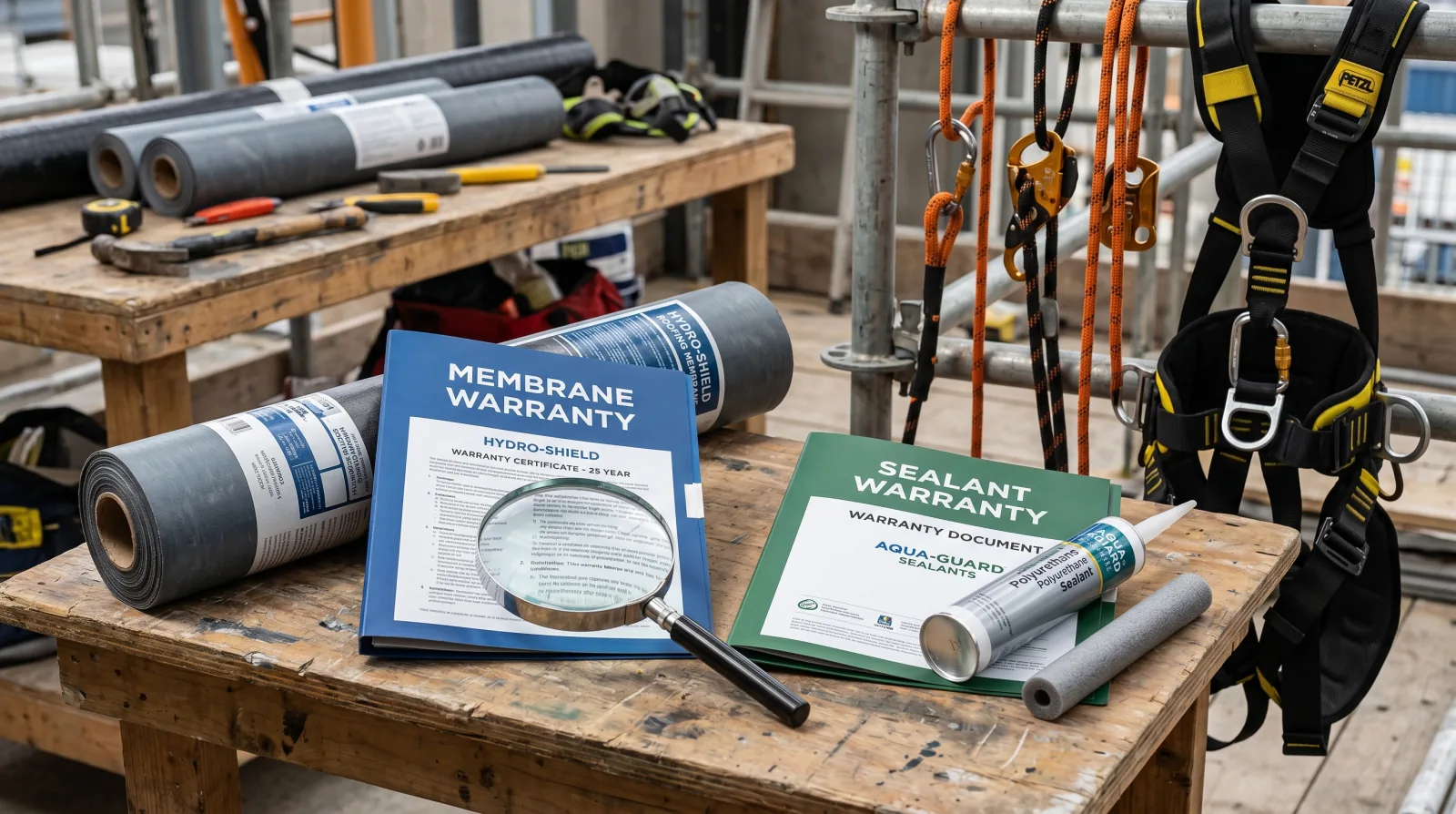
A strata council in Burnaby once handed me a warranty certificate with confidence. Twenty years on the sealant, right there in writing. The window perimeter joints had started leaking after four. They wanted to know how the manufacturer could possibly deny the claim.
The manufacturer denied it cleanly, and they were within their rights. The certificate said twenty years, but it was a material warranty — it covered the sealant being defective in the cartridge, nothing more. The leak came from how the bead was installed. That falls under the contractor’s workmanship warranty, which had expired at two years.
Warranties on restoration work are the most misread documents in the whole project. People see a big number and assume they are protected. The number tells you almost nothing on its own. What matters is which of three or four separate promises you are actually holding.
The warranties are not one thing
On a typical building-envelope restoration there are several distinct warranties in play, and they do not overlap the way owners expect.
The manufacturer material warranty covers the product itself. If the sealant, membrane, or coating is defective coming out of the pail, the manufacturer replaces the material. These run long — 10, 15, sometimes 20 years — because genuine material defects are rare. A long material warranty is cheap for a manufacturer to offer.
The contractor workmanship warranty covers the installation. Did the crew cut the joint clean, prime it, set the right backer rod, tool the bead to wet both faces? This is where almost every real-world failure lives, and these warranties are short — often two to five years.
The manufacturer system warranty is the one worth having. It covers the product and the installation together, as a working assembly, but the manufacturer only offers it when the work is done by an approved applicator and inspected to their standard. A system warranty closes the gap between the long material warranty and the short workmanship warranty.
Material-only, material-and-labour, and system
It helps to think of warranty coverage as a ladder.
At the bottom is material-only — the manufacturer replaces a defective product, and you pay all the labour to tear out and redo the work. On a tower facade, the labour and access dwarf the material cost, so a material-only warranty is close to worthless for the building.
In the middle is material-and-labour, where the manufacturer covers both the product and the cost of reinstalling it if the product fails. Better, but it still hinges on proving the product, not the install, was at fault.
At the top is the system warranty, where the manufacturer warrants the whole assembly performs. If water gets through, they are on the hook regardless of whether the root cause was product or installation, because they certified the applicator and inspected the job. This is the only level that genuinely protects a strata against the failure mode that actually happens.
The same ladder applies whether you are buying sealant restoration, a waterproofing membrane, or an exterior coating. The product changes; the warranty structure does not.
Why membrane warranties read differently than sealant warranties
A waterproofing membrane and a joint sealant fail for different reasons, and their warranties reflect that.
Membrane warranties tend to emphasize coverage area and water-tightness over a continuous surface. A liquid-applied or sheet membrane on a planter, balcony, or parkade deck is warranted to keep water out across the field. The common claim is a pinhole, a seam failure, or a detail at a penetration. Traffic-bearing membranes on a parkade carry shorter terms because tires and turning loads physically wear them — that is also why a sensible owner plans a recoat schedule rather than waiting for the warranty clock to run out.
Sealant warranties hinge on joint movement. A sealant is rated for a movement capability — say plus or minus 25 or 50 percent of the joint width. If the actual joint moves more than that, the bead tears, and the manufacturer points to a design or detailing problem, not a product defect. This is why the joint design matters as much as the product, and why the spec has to state the expected movement.
What voids them
Manufacturers do not deny claims arbitrarily. They deny them on documented exclusions, and the same handful come up again and again on BC jobs.
- Substrate condition — applying over a damp, dirty, dusty, or contaminated surface. On coastal concrete, residual moisture is the usual culprit. No prep documentation, no claim.
- Wrong primer or no primer — adhesion to glass, anodized aluminum, and concrete depends entirely on the right primer. A skipped primer voids coverage instantly.
- Incompatible materials — silicone over polyurethane, or a backer rod that off-gasses and bubbles the bead. Material compatibility is not optional, and our note on polyurethane vs silicone covers why you cannot mix them.
- Movement beyond rating — a joint that moves more than the product allows.
- Application outside the spec window — sealant or membrane installed below the minimum temperature, or not given the cure time the data sheet requires. A wet Vancouver shoulder season pushes a lot of crews to cut these corners.
- Later trade damage — a follow-on contractor cuts through the membrane and the warranty is gone at that location.
The thread running through all of these is documentation. The manufacturer’s first request on any claim is proof the product was installed to spec. If the contractor cannot produce surface-prep records, adhesion test results, and inspection sign-offs, the claim is dead regardless of how the work was actually done.
What a strata should demand in the spec
This is the part councils control, and the part they most often leave to chance. The warranty you get is the warranty you specified — write it into the contract before signing, not as an afterthought at completion.
- Name the exact products. No substitutions without engineer approval. Substitution is a classic way a warranty quietly downgrades from system to material.
- Require a manufacturer system warranty installed by an approved applicator. Confirm the contractor actually holds that approval. Ask for the certificate.
- Set a minimum workmanship term in writing. Five years is a reasonable floor for sealant and membrane work on a strata.
- Require documented surface prep, mock-ups, and adhesion testing, retained and handed over at completion. This is your evidence file for any future claim.
- Require a written warranty package at handover — every certificate, registered, with the building named as the holder.
- Make warranties transferable so a future owner or amalgamation does not lose coverage.
Have the building envelope consultant read the warranty language before the contract is signed. This is also where coordinating the restoration project properly pays off — the warranty terms belong in the tender documents the consultant prepares, not in a brochure the contractor hands over at the end.
Where the 2-5-10 sits
Owners sometimes assume the BC 2-5-10 home warranty backstops restoration work. It generally does not. The 2-5-10 is mandatory third-party coverage on new residential construction and substantial reconstruction — two years on labour and materials, five years on the building envelope, ten on structure. Routine restoration on an aging building falls outside it. On an older strata, the manufacturer and contractor warranties you negotiate are the only coverage you have, which is exactly why the spec language deserves real attention.
The exclusion nobody reads
One line appears in almost every restoration warranty and almost nobody reads it: consequential damage is excluded. The warranty repairs or replaces the failed seal, membrane, or coating. It does not pay for the drywall, flooring, insulation, or resident contents the leak destroyed on the way through.
That single exclusion is the strongest argument for treating envelope components as planned wear items on a regular inspection cycle. The warranty fixes the cause. The strata pays for the damage. Catching a failing joint before it leaks keeps the whole event inside the cheap column.
Related guides
- Sealant and Caulking Hub — sealant types, lifespan, and BC-specific considerations
- Caulking Removal vs Cap-Bead Restoration — when full removal protects your warranty
- Coordinating a Strata Exterior Restoration Project — getting warranty terms into the tender
- The BC 2-5-10 Home Warranty and the Building Envelope — what new-construction coverage does and does not include
Frequently Asked Questions
More from Sealant & Caulking Guide
Field Sealant Adhesion Testing on BC Restoration Projects
A sealant that won't stick is a leak waiting to happen. Why a hand pull test on a Surrey restoration project catches the failure before it ever ships.
Read article →Expansion Joint Failure Between Precast Concrete Panels in Vancouver
The joints between precast panels on a Vancouver high-rise move constantly, and sealant is the only thing keeping rain out. Why they fail and how to fix them.
Read article →Window Perimeter Sealant Failure on Vancouver Curtain Wall Towers
The sealant around window and curtain wall joints is the first line of defence against wind-driven rain on a Vancouver tower — and the first thing to fail. How to spot it, why it happens, and what restoration actually involves.
Read article →