Coordinating a Strata Exterior Restoration Project in BC
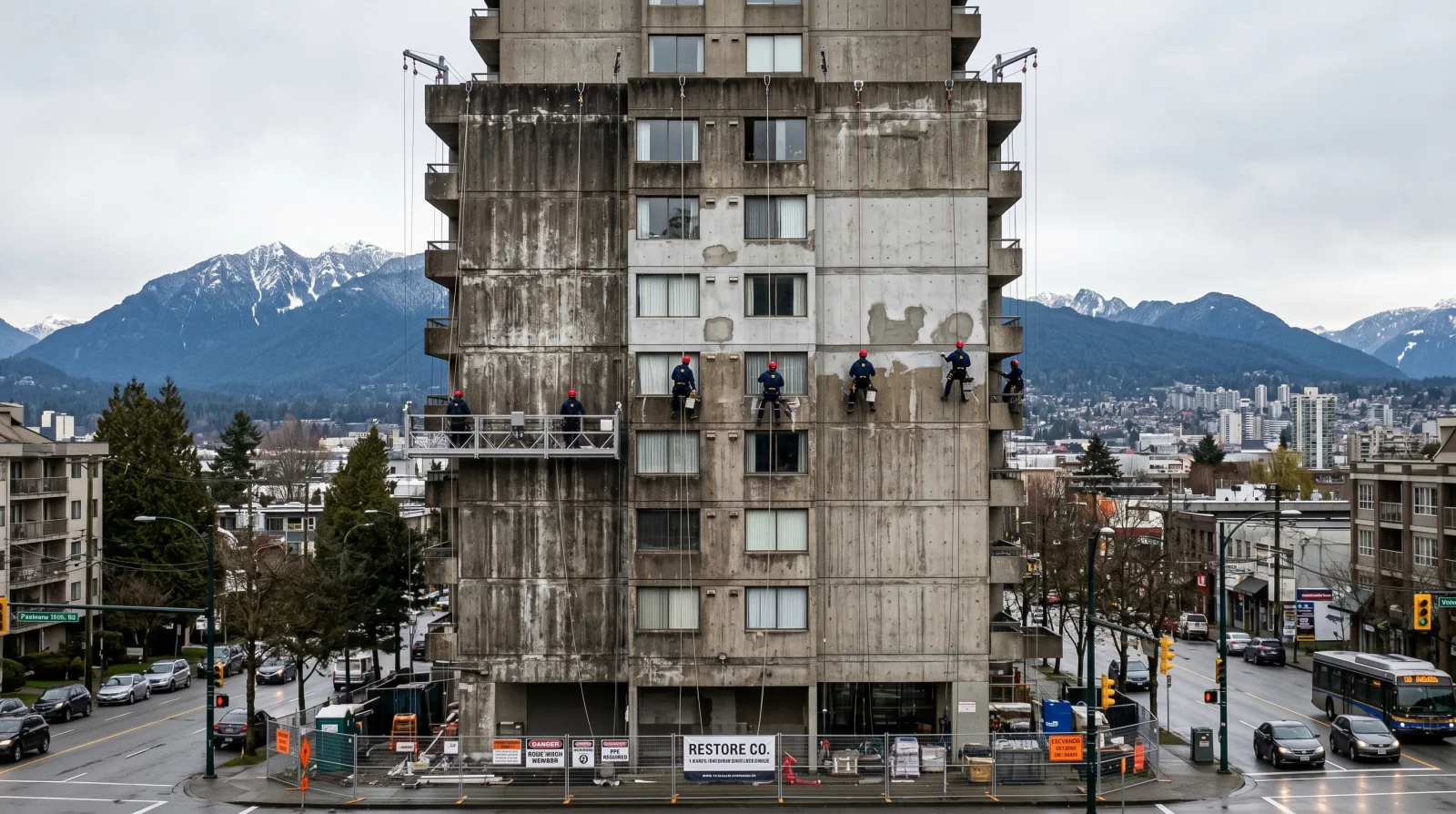
A restoration project is a coordination problem first
The hardest part of a strata exterior restoration is rarely the physical work. Our crews know how to repair concrete, renew membranes, and reseal a facade. What makes or breaks these projects is the coordination — getting the consultant, the contractor, the municipality, the strata council, and a few hundred residents all moving in the right order, at the right time, with the right approvals and funding in place. Get that sequence right and a major restoration runs smoothly. Get it wrong and the project stalls, the costs climb, and the owners revolt.
So it is worth understanding how these projects actually run in BC, because a strata council that knows the sequence can steer it. The work has a logical order, and most of the expensive mistakes come from doing things out of order — picking a contractor before there is a scope, starting work before the permit, or hitting residents with a notice the week before scaffolding goes up.
The sequence that works
A well-run exterior restoration on a Metro Vancouver strata follows a recognizable path:
- Condition assessment establishes what is actually wrong with the building and how urgent each item is.
- Engineer’s scope and design turns those findings into a defined repair scope, with specified materials and details.
- Strata approval and funding secures the owners’ authorization and the money — from reserves, a special levy, or financing.
- Permits are obtained from the municipality, along with any street-use permits for access equipment.
- Contractor selection happens against a defined scope, so bids are comparable and nobody is guessing.
- Resident notification prepares owners for the disruption before it arrives.
- The work proceeds with engineering review confirming it meets specification.
- Final sign-off closes out the project and documents it for the building’s records.
Each stage depends on the one before it. The single most common error we see is jumping to step five — hiring a contractor — before steps one and two exist, which produces vague scopes, incomparable bids, and disputes mid-project.
The BC rules that govern envelope work
Exterior restoration in BC is regulated, and councils need to know which rules bite on their project. The big one is the Building Envelope Renovation Regulation. When a renovation affects 60% or more of any cladding surface and meets the cost threshold, the work must be carried out by a licensed Building Envelope Renovator with home warranty insurance in place. A full re-cladding of a Vancouver or Burnaby tower triggers this; a localized sealant or coating repair generally does not. Knowing which side of that line your project falls on matters, because it changes who can legally do the work and what insurance must be in place.
Responsibility for organizing the work sits with the strata corporation. Under the division of repair duties, the corporation is responsible for repairing and maintaining common property, and the building envelope is almost always common property. So it is the council’s project to run, not an individual owner’s.
And most substantial work needs a permit. Structural concrete repair, re-cladding, window replacement, and envelope modifications generally require a municipal building permit — the BC building permit hub helps identify what each municipality wants. In denser areas, street-use permits for swing stages, hoarding, or material staging add another layer that has to be built into the schedule.
Funding without a crisis
Money is where restoration projects most often go sideways. Large envelope work — a re-cladding, a major concrete restoration — usually costs more than a strata’s reserve can absorb outright, which means a special levy, financing, or a combination. Those are exactly the funding models a depreciation report lays out over 30 years.
The councils that handle this well plan the funding early, from the depreciation report, so that when the project arrives the money strategy is already understood and the levy vote is a confirmation rather than a shock. The councils that struggle are the ones reacting to an emergency, forced to pass a large special levy under time pressure with anxious owners. The funding mechanics are the same either way; the difference is whether the planning happened in advance.
Keeping residents informed and safe
A restoration project lands directly on the people living in the building. For months, there may be crews on ropes outside their windows, restricted balcony access, noise, and exclusion zones at the entrances. How the council manages that communication shapes the entire experience.
The strata owes residents reasonable notice before crews need access to or near their units, and the best projects go well beyond the minimum — an owner information session before the AGM, written notices as the work approaches each elevation, and clear answers about what to expect. On the safety side, rope access and swing stage crews work under WorkSafeBC fall protection rules on two independent lines, and the project sets up exclusion zones, overhead protection, and signage so residents stay clear of work areas and dropped-object hazards while still being able to use entrances and balconies safely. None of that is an afterthought; it is part of planning the job.
Choosing the consultant and the contractor
Two hires decide the quality of a restoration project, and stratas often get the order and the relationship between them wrong. The consultant — the engineer or building envelope specialist — and the contractor play different roles, and keeping those roles distinct protects the building.
The consultant comes first, and works for the strata. They assess the building, design the repair scope, specify the materials and details, and review the work as it proceeds to confirm it meets that specification. Their independence is the point: because they are not the ones doing the physical work, they have no incentive to cut a corner to make a margin, and their field review is a genuine check on quality. On a significant envelope or concrete project, that independent oversight is what stands between the strata and work that looks finished but was not done to spec. Trying to save money by skipping the consultant and letting a contractor both design and build the repair removes that check exactly where it matters most.
With a consultant’s scope in hand, contractor selection becomes a fair contest. Every bidder is pricing the same defined work, so the strata can compare bids meaningfully instead of guessing why one number is half another. Without that scope, “bids” are just contractors each imagining a different project, and the lowest one usually imagined the least. When we bid envelope and concrete work, a clear consultant scope is what lets us give an honest, comparable price — and lets the strata trust it.
What should a strata look for in the contractor itself? Relevant experience on similar buildings and similar work; proper licensing and insurance, including the Building Envelope Renovator licensing where the project triggers it; certified crews for the access method, meaning IRATA or SPRAT rope access technicians working under WorkSafeBC fall protection rules; and a track record the strata can actually check by talking to other buildings. On a Burnaby or Vancouver tower, the contractor’s ability to coordinate access, manage resident disruption, and work to the consultant’s specification matters as much as the unit price.
The relationship to protect throughout is the triangle: the strata owns the project and the funding, the consultant safeguards the technical quality, and the contractor executes. When those three roles stay clear, problems surface early and get resolved. When they blur — when the contractor is also the designer, or the consultant is sidelined to save a fee — the building loses its safeguards precisely on the work that is hardest to inspect after the fact.
Pulling it together
Every piece of this connects back to one document the council should already have in hand: the depreciation report. It forecasts when the envelope components will need work and how to fund them, which means it should be driving restoration planning years before the crews arrive. With the July 1, 2026 depreciation report deadline now in force across Metro Vancouver, councils have current forecasts that should feed straight into their restoration timelines.
The strata restoration process guide walks through how the physical work is staged, and the building restoration service page covers how we coordinate with engineers, municipalities, and councils across Burnaby, Vancouver, Richmond, and the North Shore. A restoration done in the right order, with the funding planned and the residents kept informed, is a manageable project. The same work done reactively, out of sequence, is the one owners are still complaining about years later. The physical work (the concrete, the membranes, the sealant, the coatings) is the part we control and stand behind with a warranty. Whether the project as a whole goes well comes down to the coordination around it, and that starts long before anyone clips into a rope. A council that gets the sequence, the funding, and the communication right has done the hardest part of the job before the first crew arrives on site in Vancouver, Burnaby, or the North Shore.
Frequently Asked Questions
More from BC Strata Building Envelope Guide
Funding a Building Envelope Restoration in a BC Strata
Special levy, contingency reserve fund, or financing? How a Coquitlam strata pays for a major envelope restoration under the Strata Property Act, and how to phase the cost.
Read article →Building Envelope Warranty Claims for BC Strata Corporations
When a New Westminster strata finds an envelope defect, the first question is who pays — the 2-5-10 warranty or the owners. How to tell a warranty defect from maintenance, document it, and meet the deadlines that decide the answer.
Read article →Building Envelope Engineer vs Contractor: Roles on a BC Strata Project
On a Coquitlam strata restoration, the engineer specifies and the contractor builds. Who does what, who warranties what, and why you need both on a project.
Read article →