Parkade Slab Restoration in Vancouver: What's Eating Your Concrete From Below
What’s actually eating your parkade concrete
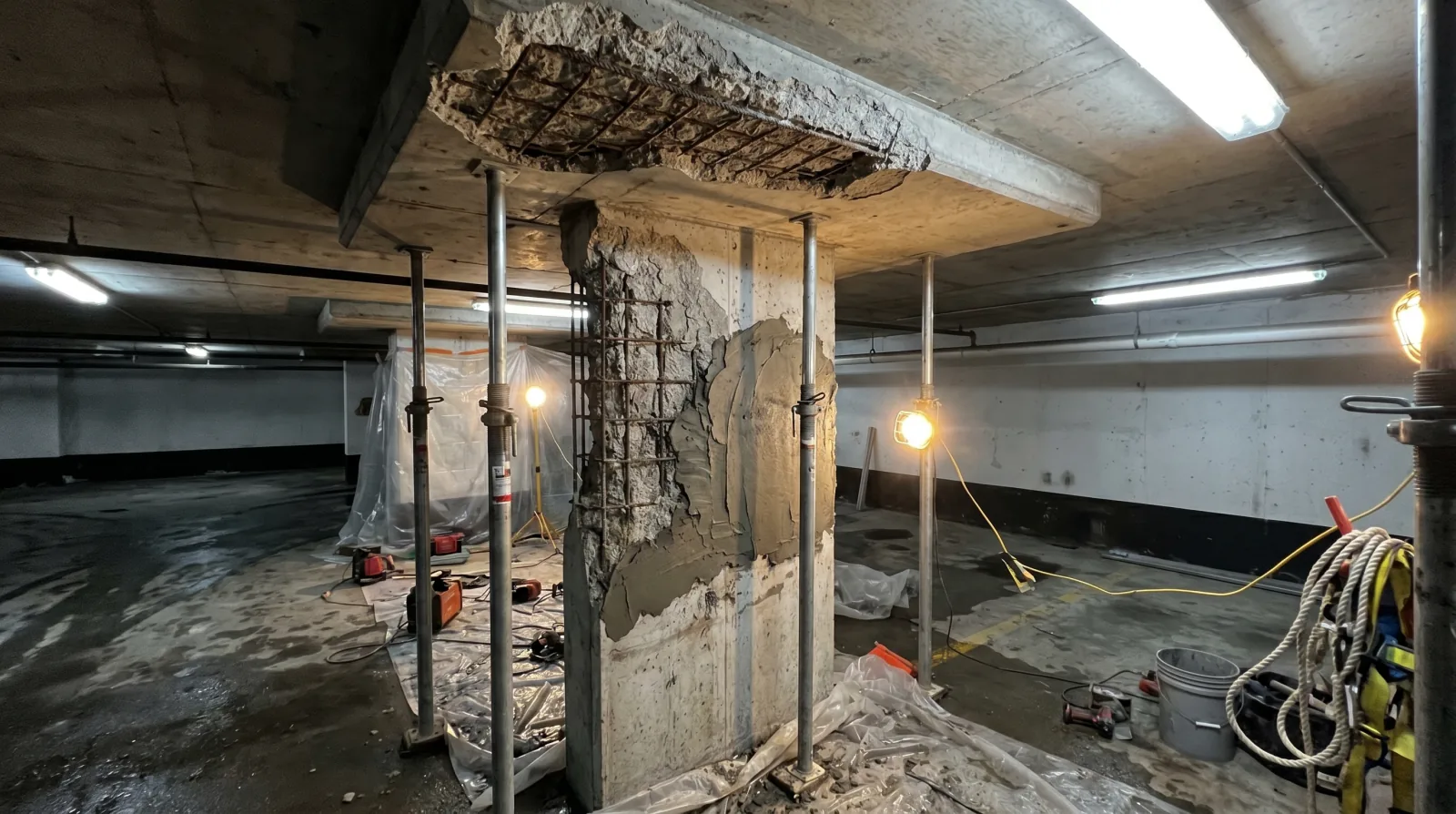
A parkade deteriorates from a different direction than the rest of the building, and from below. While balconies and facades lose their concrete to wind-driven rain and coastal air, a parkade gets its damage from what your residents drive in every winter. Road salt and slush come off the tires, dissolve in water pooling on the deck, and the resulting chloride brine soaks down through the concrete to the reinforcing steel. The steel corrodes, expands, and cracks the concrete off the underside of the slab — the soffit — and off the bases of the columns. By the time you see rust stains and hanging mineral deposits on the ceiling of level P2, the chloride has been working for years.
It’s the same corrosion mechanism that hits a balcony, just fed by a heavier, more concentrated chloride dose. The chemistry behind it is covered in the rebar corrosion and spalling guide.
The suspended slab problem
Most Vancouver parkade decks are suspended slabs — concrete supported on columns with open space underneath, rather than poured on the ground. That geometry is what makes parkade deterioration serious. Water and chloride enter from the driving surface on top, but the damage shows on the soffit below, where there are people, parked cars, and structural columns. Falling concrete and exposed corroded steel become both a safety hazard and a structural question at the same time.
This is why a deteriorating parkade gets an engineer, not a handyman. The reinforcing steel in a slab and column is carrying real load, and progressive section loss from corrosion lowers that capacity. The repair-or-replace decision on a structural parkade element is made by a qualified engineer against CSA S448.1 — the same standard that governs building concrete repair — using sounding surveys, half-cell potential mapping, and chloride sampling at the depth of the bar. How that call gets made is laid out in the repair vs. replace guide.
How the repair runs without shutting the whole parkade
The constraint that shapes every parkade project is that residents and tenants still need somewhere to park. So the work is phased. A section gets isolated and ventilated, shoring posts go in to support the slab while concrete is removed, the crew chips back to sound material and treats or replaces the steel, polymer-modified repair mortar is placed, and the section cures before it’s reopened. Then the crew moves to the next bay. Done well, a portion of the parkade stays available through most of the program.
The deck waterproofing is the other half of the job. A parkade traffic membrane — polyurethane, or PMMA where the traffic is heavy and downtime has to be short — is what keeps the next round of chloride out of the repaired concrete. Restore the slab and skip the membrane and you’ve reset the clock to where you started. The sequence is concrete first, then membrane over the sound, repaired deck.
Three waterproofing barriers that keep a parkade dry
A well-maintained parkade relies on three distinct systems working together. Understanding them helps a strata council or property manager know where a problem is actually coming from.
1. Traffic-bearing membrane (the deck surface). A multi-layer polyurethane or PMMA system applied to the driving surface. It bridges structural cracks, resists tire abrasion and automotive fluids, and prevents chloride brine from contacting the concrete. Signs of failure: worn-through drive lanes, bubbling or peeling coating, active drips through the underside of the slab.
2. Expansion and control joints. Large parkades are cast in sections; the gaps between them are sealed with heavy-duty elastomeric gland systems or high-movement polyurethane sealants. These allow the building to move without cracking the slab. Signs of failure: water dripping along the joint line on lower levels, torn or bulging sealant, cracking along the joint edges. Joints should be inspected annually and typically require replacement every 8–12 years.
3. Crystalline waterproofing (foundation walls). For vertical concrete walls retaining soil, hydrostatic pressure from the local water table pushes water inward. Crystalline waterproofing penetrates the concrete capillaries and grows microscopic crystals that seal the pores. Signs of failure: damp patches on foundation walls, bubbling paint on concrete columns, puddles at wall-to-floor cold joints.
When calcite stalactites are dripping from the ceiling and the liquid is hitting parked vehicles, the calcium carbonate solution in that water chemically etches automotive clear coat. The staining bonds to the paint and requires professional acid washing or compounding to remove, well beyond a car wash. That is why an active parkade leak is a strata liability, not only a structural concern.
Catching it before it’s structural
The cheapest parkade restoration is the one you start while it’s still maintenance. The warning signs are not subtle once you know them: rust staining and white efflorescence streaking the soffit and columns, drummy concrete when you tap it, cracking and ponding on the driving surface, and mineral stalactites hanging where water has been running through. A parkade that’s developing these is a parkade to assess this year, not in three.
For a BC strata, the parkade slab and its membrane should already be line items in the depreciation report — the report that’s now mandatory on a five-year cycle, with a July 1, 2026 deadline for Metro Vancouver buildings without a current one. A building that planned for its parkade isn’t scrambling to levy for it. One that ignored the soffit stains is.
In our parkade projects across Metro Vancouver, the most common finding on first assessment is that chloride has already reached rebar depth in the drive lane areas while the stall areas are still sound — typically because the drive lanes carry the salt brine concentrated off tire tracks and the membrane wears through there first. That pattern means the repair scope is usually smaller than a full-deck replacement if caught early, but it grows fast once the drive lane slab starts delaminating.
We assess and restore concrete parkades for strata and commercial buildings across Vancouver, North Vancouver, West Vancouver, and Burnaby. If your soffit is staining or your traffic membrane is past its life, request a condition assessment and we’ll tell you what the chloride has actually done to the slab.
Related reading
Frequently Asked Questions
More from Parkade Waterproofing Guide
Expansion Joint Systems on Vancouver Parkade and Plaza Decks
A leak staining the cars in a Vancouver parkade often starts at a deck expansion joint above. How compression seals, strip seals, and membrane joints work — and fail.
Read article →Negative-Side Waterproofing of Below-Grade Walls in Vancouver
When you can't dig up a leaking foundation wall in Richmond's high water table, you waterproof from the inside. How crystalline coatings work, what they can and can't do, and where their limits are.
Read article →Cathodic Protection for Chloride-Contaminated Parkades in Vancouver
Road salt drives chloride deep into Surrey and Vancouver parkade slabs, and patch repair alone won't stop the corrosion it starts. When cathodic protection makes sense, how it works, and what it costs you to ignore it.
Read article →