Rainscreen Walls and the Leaky Condo Legacy in Metro Vancouver
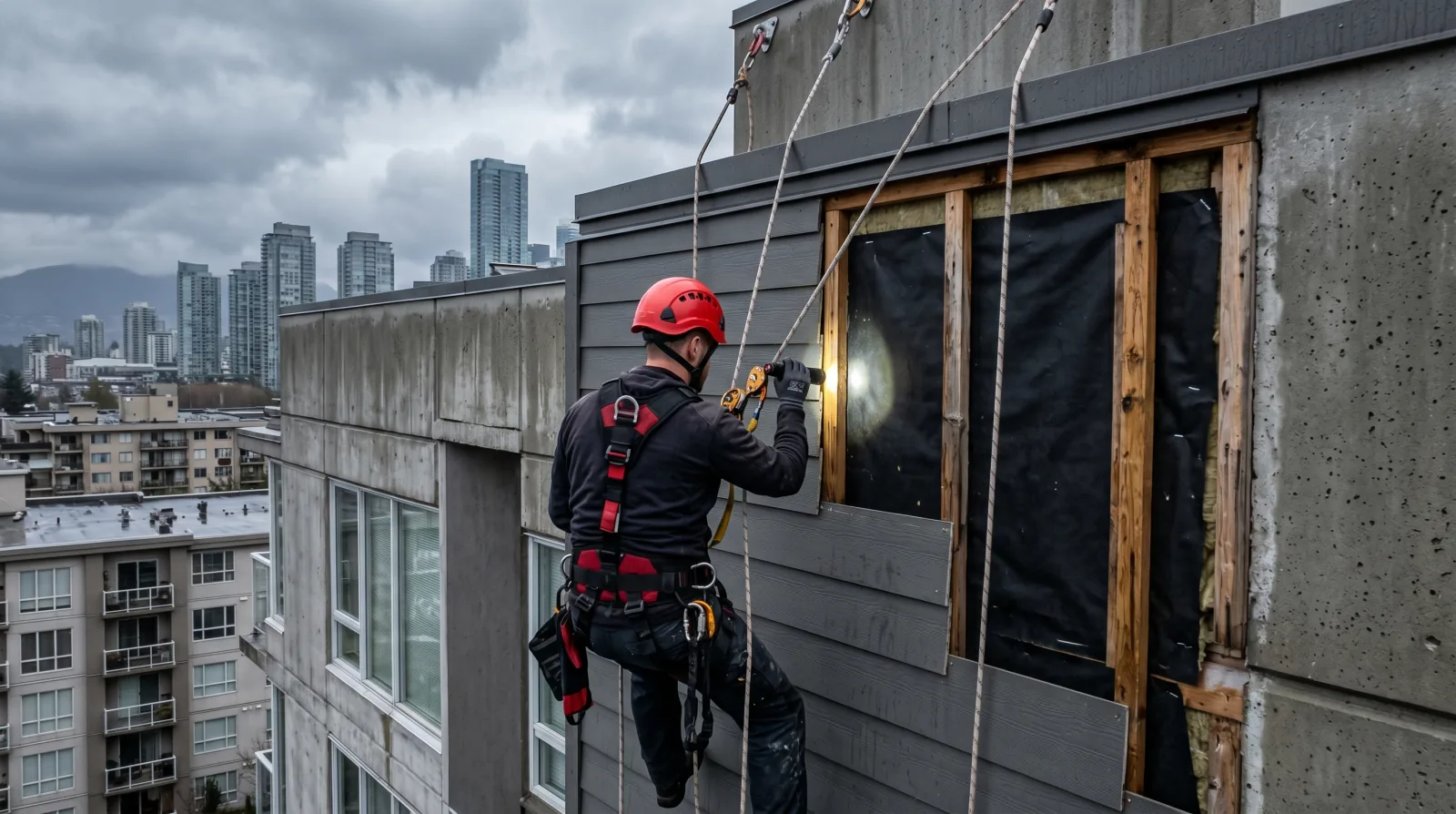
The crisis that rewrote how BC builds walls
Every building envelope contractor working in Metro Vancouver today is working in the shadow of the leaky condo crisis. It is not history — it is the reason the walls are built the way they are, and the reason so many older buildings in Burnaby, Surrey, and the North Shore still need the work we do.
Through the 1980s and 1990s, thousands of condominiums and townhouses went up across the Lower Mainland using face-sealed wall assemblies. The idea was simple and, in a dry climate, defensible: seal the outside face of the wall tight enough that water never gets in. The problem is that no seal is perfect, and this is not a dry climate. When wind-driven rain found its way past a cracked sealant joint or a poorly flashed window, it had nowhere to go. It sat in the wall, soaked the framing, and rotted the structure from the inside out — often for years before anyone saw a stain on the drywall.
The scale was staggering. The record of the crisis notes that roughly 45% of the nearly 160,000 strata units built in BC between 1985 and 2000 had envelope leak problems. The financial damage ran into the billions, and the special assessments levied on owners to fix it bankrupted some households.
What the Barrett Commission changed
In 1998 the province struck a commission of inquiry — the Barrett Commission — to figure out what went wrong. Its report produced 82 recommendations, and the most consequential of them pushed the industry toward one idea: stop relying on a perfect face seal, and build walls that can drain and dry.
That idea is the rainscreen. Vancouver wrote rainscreen requirements into its building by-law in the late 1990s, and the BC Building Code adopted rainscreen requirements for coastal climates in 2006. The commission also pushed for qualified building envelope professionals to be involved in design and field review — recognition that the envelope is a specialty, not an afterthought.
For owners, the practical takeaway is a date. A building put up before its municipality required rainscreen construction, and never renovated since, is very likely still carrying the original face-sealed wall. That single fact shapes its entire maintenance future.
How a rainscreen actually works
A rainscreen wall does something a face-sealed wall does not: it assumes water will get past the outer cladding, and it gives that water a way out.
Behind the cladding sits a deliberate air cavity — usually somewhere between 10 and 25 mm — held open by furring strips. Behind the cavity is the water-resistive barrier and the structure. Rain that gets past the cladding runs down the back of the cladding or the face of the barrier, drains out through weep openings at the base of the cavity, and the venting lets air move through to dry whatever moisture is left. The pressure-equalized cavity also reduces the force that drives rain inward in the first place.
The cladding is no longer the only thing standing between the weather and the framing. It is the first of several layers, each with a job. That redundancy is the whole point, and it is why a single failed sealant joint on a rainscreen wall rarely causes the catastrophic hidden rot that defined the crisis.
Rainscreen walls are not maintenance-free
Here is where we spend a lot of our time correcting a misconception. Strata councils sometimes assume that because their building has a rainscreen, the envelope takes care of itself. It does not.
The cavity only works if it stays drained and vented. We have opened up walls in Richmond and Coquitlam where the weep openings at the base were packed with debris, or where a previous trades crew caulked across the drainage path during a window replacement and sealed the cavity shut. A blocked rainscreen cavity behaves like a face-sealed wall — it traps water — except now the water is hidden behind cladding that everyone assumes is protecting them.
The sealant joints, flashings, and coatings on a rainscreen wall still age and still need replacement on schedule. The difference is consequence, not absence, of maintenance. On a face-sealed wall a failed joint can mean structural rot; on a rainscreen wall the same joint failure is usually caught and drained before it does structural harm — provided the cavity is doing its job. Keeping those details intact is ordinary envelope work: sealant renewal, flashing repair, and coatings, the same services covered across our building envelope repair and sealant and caulking work.
The older building problem in Metro Vancouver
The buildings that worry us most are the pre-rainscreen towers and low-rises that have never been renovated. They are common across the Lower Mainland — Vancouver’s West End, older Burnaby and New Westminster stock, mid-1990s Surrey complexes — and they share a vulnerability: the sealant and coatings are not a backup layer, they are the entire weather barrier.
On these buildings, sealant maintenance is not cosmetic. A failed joint around a window or at a panel transition is a direct path to the structure. That is why we push owners of older buildings toward shorter inspection and sealant-renewal cycles than a comparable rainscreen building would need. Coastal exposure makes it worse — wind-driven rain on an exposed West Vancouver or North Vancouver elevation drives moisture into joints with force a sheltered building never sees, and Vancouver already averages roughly 1,189 mm of precipitation a year.
How often these buildings need inspecting
The maintenance cadence is where the rainscreen-versus-face-sealed distinction stops being history and starts being a line in your budget. The two wall types do not need the same attention, and treating them as if they do is how stratas either overspend or get caught out.
On a true rainscreen building, the envelope has redundancy built in, so a regular cycle of envelope inspections — checking sealant, flashings, drainage, and coatings every few years and after major storms — is usually enough to stay ahead of trouble. The cavity buys time. A joint that starts to fail gets caught at the next inspection, and the drainage behind it protects the structure in the meantime. The work is steady and predictable.
A pre-rainscreen, face-sealed building does not give you that margin, and its inspection cadence has to be tighter to compensate. Because the sealant and coatings are the only barrier, a failure that would be a minor finding on a rainscreen building is a direct path to the structure here. We push owners of these buildings toward shorter intervals between sealant reviews and envelope inspections, and toward acting on findings immediately rather than deferring them to the next budget year. On an exposed elevation in West Vancouver or against the North Shore slopes, where wind-driven rain is relentless, that vigilance is the difference between maintenance and a major repair.
There is also a documentation angle that matters for both. Every envelope inspection and repair should be logged — what was found, what was done, when. That record does three jobs: it shows the next consultant the building’s history, it supports the building’s depreciation report with real condition data, and it demonstrates the diligent maintenance that protects a strata’s position if there is ever an insurance or warranty question. We have seen well-maintained buildings with thin records struggle to prove it, and that gap costs them. The buildings that age best are the ones where someone treated the envelope as a tracked system from the start — inspected on a cadence that matched the wall type, repaired on time, and written down.
When a building needs the full upgrade
Sometimes sealant and coating maintenance is no longer enough, and the right answer is a full envelope renovation — re-cladding the building over a new drained, vented cavity with updated flashings and a fresh water-resistive barrier. This is a major capital project, and in BC it is regulated: under the Building Envelope Renovation Regulation, qualifying renovations must be carried out by a licensed Building Envelope Renovator with home warranty insurance in place.
For a strata, this is the kind of work a depreciation report should be anticipating years in advance, because the cost is large enough to require real reserve planning or a special levy. The strata depreciation report guide covers how envelope items show up in that planning, and our work on the July 1, 2026 depreciation report deadline explains why this is the season Metro Vancouver councils are confronting these numbers.
The leaky condo crisis was an expensive lesson in physics: in this climate, you cannot keep water out by sealing the surface alone. You have to let the wall drain and dry. Whether your building was built with that principle or needs to be brought up to it, the maintenance discipline is the same — keep the layers that shed and drain water doing their job, and catch the failures early. On a coast where the rain is measured in metres a year, the buildings that take that discipline seriously are simply the ones that stay dry while their neighbours in Burnaby, Surrey, and along the North Shore keep fighting leaks.
Our rainscreen systems hub collects the full set of working guides on this topic, from how the assembly actually works to what a retrofit involves on an occupied building.
Frequently Asked Questions
More from BC Strata Building Envelope Guide
Funding a Building Envelope Restoration in a BC Strata
Special levy, contingency reserve fund, or financing? How a Coquitlam strata pays for a major envelope restoration under the Strata Property Act, and how to phase the cost.
Read article →Building Envelope Warranty Claims for BC Strata Corporations
When a New Westminster strata finds an envelope defect, the first question is who pays — the 2-5-10 warranty or the owners. How to tell a warranty defect from maintenance, document it, and meet the deadlines that decide the answer.
Read article →Building Envelope Engineer vs Contractor: Roles on a BC Strata Project
On a Coquitlam strata restoration, the engineer specifies and the contractor builds. Who does what, who warranties what, and why you need both on a project.
Read article →