Contingency reserve fund vs. special levy: two ways a BC strata pays for envelope work
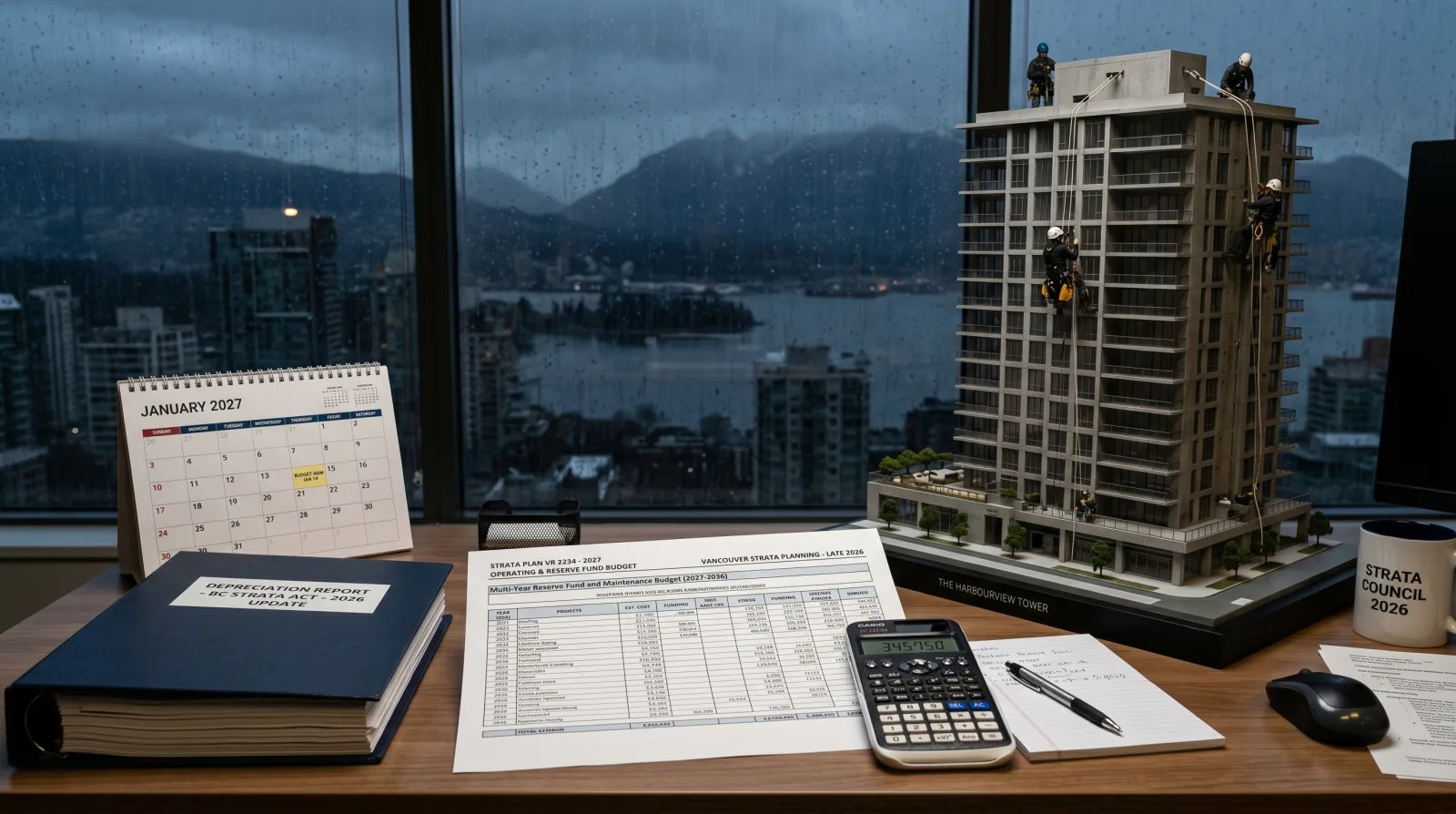
These are not competing options. They work together. The contingency reserve fund is money the strata saves over years through regular fees, and under section 96 of the Strata Property Act it can pay for repairs recommended in the most current depreciation report on a majority vote, 50% plus one. A special levy is the one-time charge that fills the gap when the fund is short, and it needs a 3/4 vote under section 108. That vote gap is the core tradeoff: the reserve fund route is easier to approve and easier on owners, while the levy route is a harder vote and a lump-sum hardship. A healthy reserve fund and a current depreciation report are what turn a shocking surprise levy into planned, funded maintenance.
Think of it this way. The reserve fund is the plan: money set aside year by year so the cash is there when a sealant cycle, a membrane, or a coating reaches end of life. The levy is what happens when the plan falls short, either because the building underfunded its reserve for years, because the project is too large for any reserve to carry, or because the real condition turned out worse than the report estimated. When the fund still cannot cover a full envelope restoration, a levy for the balance is unavoidable, and the council’s job is to size it honestly and give owners as much warning as possible.
What each one actually is
The contingency reserve fund is a savings account. Every owner pays into it through their regular strata fees, and it is meant for common expenses that happen rarely or do not fall on a predictable annual cycle. Building envelope work is the classic example: sealant renewal, membrane replacement, coating recoats, and concrete repair all come due on multi-year schedules that the reserve fund is designed to save toward. The fund is established under section 92 of the Strata Property Act, which is why it exists for exactly this kind of infrequent, large expense rather than the day-to-day operating costs.
A special levy is different. It is a one-time charge, collected from owners on top of their regular fees, for a specific project. Councils reach for a levy when a project costs more than the reserve fund holds. It is not a savings tool. It is the way a strata raises a large amount quickly when the money was not saved in advance. The two are not rivals. In almost every large envelope project, the reserve pays for part and the levy fills the rest. Getting the balance right between them is the real skill.
The vote threshold is not the same, and that matters
Here is the part many councils miss. Spending from the reserve fund for a repair, maintenance, or replacement that is recommended in the most current depreciation report needs only a majority vote, 50% plus one, under section 96 of the Strata Property Act. The same section keeps the majority route open when the spending is authorized under section 98. A special levy always needs a 3/4 vote under section 108. That gap is real, and it is political. A 3/4 vote means three out of four owners present and voting have to say yes. On a large bill, that is a hard number to reach, and it is where councils lose funding votes.
So a strata that kept its depreciation report current and its reserve fund healthy can approve the same envelope work on the easier majority vote, while a strata that has to levy for it faces the harder 3/4 threshold. Two buildings can need the identical repair, and the one that planned ahead has a much easier path to funding it. This is one of the strongest practical reasons to keep the depreciation report current and to fund the reserve toward what the report recommends, not just to the legal minimum.
There is also an emergency path. Section 98(3) lets the strata spend from the operating fund or the reserve fund without a prior vote when there are reasonable grounds that an immediate expenditure is needed to ensure safety or prevent significant loss or damage. It has to be the minimum needed, and owners must be told as soon as feasible. That covers active water ingress attacking the structure or a facade element at risk of falling, not planned work someone wants to fast-track. So there are three thresholds to keep straight: majority under section 96 for depreciation-report items, no prior vote under section 98(3) for genuine emergencies, and 3/4 under section 108 for a special levy.
The 10% minimum is a floor, not a target
The Strata Property Regulation sets a minimum annual contribution to the reserve fund of at least 10% of the operating fund budget, with section 93 governing how the strata sets the amount subject to the regulation. Many councils treat that 10% as the number they are supposed to hit. It is not. It is the lowest the law allows, set for buildings that have a current depreciation report guiding a higher contribution. On its own, 10% of an operating budget rarely comes close to what a building needs to save for major envelope replacements.
Picture what that means over 20 years. A building that contributes only the minimum, year after year, is quietly falling behind the real cost of the components that are aging on its walls and roof. The shortfall does not show up on any single annual budget. It shows up all at once, on the day a membrane fails or a wall assembly has to come off, when the reserve holds a fraction of the bill. That is the mechanism behind the surprise levy that owners dread. It is almost always a symptom of years of minimum funding, not of bad luck. The depreciation report is what tells the strata the real number it should be saving each year, and buildings that fund toward that number instead of the floor are the ones that avoid the shock.
Why the depreciation report is the quiet hero here
A strata’s reserve fund is only as good as the plan behind it. The depreciation report estimates the repair and replacement cost of the building’s major components and their expected service lives, then models how much the strata should set aside each year to have the money ready. Existing stratas of five or more lots must obtain a report on a five-year cycle. In Metro Vancouver, the Fraser Valley, and the Capital Regional District, the deadline is July 1, 2026. For the rest of British Columbia, including the Southern Gulf Islands and Bowen Island, it is July 1, 2027. As of October 27, 2025, the report must be prepared by a designated qualified professional, such as an engineer, architect, architectural technologist, applied science technologist or certified technician, accredited appraiser, certified reserve planner, or professional quantity surveyor.
There is also new support for brand-new buildings. For stratas established on or after July 1, 2027, developers must contribute a minimum of $5,000 plus $200 per strata lot, to a maximum of $30,000, toward the first depreciation report. That helps a young strata start with a real plan instead of a blank page. When the report is current and the strata funds toward it, envelope replacements arrive on schedule with money already saved, and they can be approved on the majority vote under section 96. When the report is missing, stale, or ignored, the building runs into a failure it did not save for, and the only fast fix is a levy. For what the envelope section of the report actually means, see our depreciation report guide, and if you are deciding between a building enclosure condition assessment and a full depreciation report, compare them in our BECA vs. depreciation report guide.
Why Metro Vancouver stock makes envelope underfunding dangerous
The local climate is hard on building envelopes. Metro Vancouver gets long stretches of wind-driven rain, and wind-driven rain finds every weak joint, failed sealant line, and tired membrane. Water that gets past the outer surface can sit inside a wall assembly for months, doing damage no one sees from the outside. That is different from a dry climate where a small envelope defect might go unnoticed for years without consequence. Here, a neglected envelope gets punished.
There is also history. The leaky-condo era of the 1980s and 1990s left a large stock of wood-frame buildings that were built with details that could not keep water out in this climate. Many have been repaired, but many still carry the risk of hidden moisture damage, and the cost of fixing a failed wall assembly on one of these buildings is high. A strata in this region that underfunds its reserve is taking a bigger gamble than one in a drier place, because the odds that the envelope will need serious work within a normal ownership span are simply higher. The reserve fund and a current depreciation report are the tools that let a building in this climate plan for that reality instead of being blindsided by it.
The failure modes owners never budget for
The scariest part of envelope funding is the damage no one can see. A depreciation report is usually built on a visual walkthrough. The person doing it looks at the building, notes the condition of what is visible, and estimates costs and service lives from that. That is a reasonable way to plan, but it has a real limit: a visual review cannot see inside a wall assembly. Water can be tracking behind cladding, rotting sheathing and framing, with almost nothing showing on the surface until the damage is advanced.
So a report can honestly estimate a moderate project, the strata can fund toward it, the vote can pass, and then the contractor opens the assembly and finds the real scope is far larger. Now the reserve that was sized for the estimate is short, and the gap has to be closed fast, usually with a levy. This is not a failure of the report or the council. It is the nature of hidden damage. The practical defenses are to treat a visual estimate as a floor rather than a firm number on an older or rain-exposed building, to consider some investigative openings or moisture testing before finalizing a budget, and to keep the reserve from being drained to zero so there is something left when the scope grows.
Drawing the CRF down first, and why not to zero
When a project is bigger than the reserve, the usual move is to use the reserve for part and levy for the rest. Drawing the reserve down first is almost always the right call, because it shrinks the levy owners have to approve and pay, and the reserve draw for a depreciation-report item can often be approved on the easier majority vote. A smaller levy is easier to pass at the 3/4 threshold and easier on owners who struggle with a lump sum.
The caution is that emptying the reserve to zero leaves the building with nothing for the next unbudgeted expense. On an aging envelope in this climate, that next surprise is a question of when, not if. So most councils draw the fund down to a sensible floor, sized against what else the depreciation report says is coming in the next several years, then cover the remaining project cost with a levy or a strata loan. The right floor depends on the building’s risk profile and its other upcoming components. This is a financial planning question, and the qualified person who prepared your depreciation report, together with your licensed property manager, should help you model it before the vote.
Emergency spending under section 98(3), realistically
Section 98(3) is narrow and it is meant to be. It lets the strata spend without a prior vote only when there are reasonable grounds to believe an immediate expenditure is necessary to ensure safety or to prevent significant loss or damage. Active water entering units during a storm and heading for structural framing can qualify. A facade element that could fall and hurt someone can qualify. A planned recoat that someone wants to start early does not qualify, no matter how convenient it would be to skip the vote.
The rules attached to it keep it honest. The spending must be the minimum needed to deal with the emergency, not the full permanent fix, and owners must be informed of the amount and purpose as soon as feasible. In practice, council authorizes enough to stop the damage and make the situation safe, then brings the permanent repair and any funding to replenish the reserve to owners as a normal vote or levy. If you are unsure whether a situation truly qualifies as an emergency under this section, get advice from your strata lawyer before spending, because misusing the emergency power can create its own legal problems.
What the reserve fund cannot do
The reserve fund cannot cover a full recladding on its own for most older buildings. A full recladding on a mid-rise or high-rise is one of the largest envelope projects a strata will ever face, and unless the building funded well above the minimum for many years toward exactly that replacement, the reserve will hold only a fraction of the cost. The same is true of a major water-ingress repair that turns into a wide wall-assembly rebuild. These are the projects where a levy is not a sign of failure. It is the honest arithmetic of a big number meeting a fund that was never sized to carry it alone.
When a levy is unavoidable, the council’s job changes. It is no longer about choosing between the reserve and a levy. It is about sizing the levy on a real, scoped number, drawing the reserve down to a sensible floor to shrink that number, deciding whether to phase the work across cycles, and comparing a strata loan so owners who cannot raise a lump sum have a path. Getting the scope right before the vote is what keeps owners deciding on a real figure instead of a guess. Our building envelope repair team scopes the work and can phase a large restoration to match what the reserve and a levy can realistically fund in each cycle, and for heritage or mixed-use buildings our building restoration team handles the wider scope. If the balance is large enough that a levy will be hard on owners, weigh it against borrowing in our special levy vs. strata loan guide.
How to read the reserve-fund section of a depreciation report
When you open a depreciation report, go past the summary and find the funding model. The report lists the building’s major components, the estimated cost to repair or replace each one, and the expected remaining service life. From that it projects a funding plan, usually showing more than one scenario: what happens if the strata contributes the minimum, and what happens if it contributes more. Look for the year each envelope component is expected to reach end of life, and check whether the projected reserve balance in that year is enough to cover it.
A few things are worth flagging. Note the date the report was prepared and whether it is within the five-year cycle, because a stale report may not reflect current costs or condition. Note whether the envelope assessment was visual only, because that tells you how much cushion to build in for hidden damage. Note the assumptions behind the cost estimates, since construction costs move and an old estimate can understate today’s price. And compare the report’s recommended annual contribution against what your strata actually pays. If you contribute far less than the report recommends, the funding plan on paper does not match reality, and that gap is the early warning of a future levy. For the strata manager and council, reading this section carefully once a year is the single best habit for catching a funding problem while there is still time to fix it with contributions instead of a shock levy.
Four Metro Vancouver scenarios
The right funding call depends on the building, its reserve, and what the depreciation report says. Here are four realistic situations and the honest call for each.
Well-funded 2005 concrete tower, sealant cycle due
Situation: A 90-unit concrete high-rise built in 2005 has contributed above the minimum for years. The current depreciation report shows the exterior sealant joints reaching end of life this year, with an estimate the reserve can cover. Council has the money and a clear recommendation in hand.
Call: Pay from the CRF on a majority vote under section 96.
Why: Because the sealant renewal is recommended in the most current depreciation report, the strata can approve the spending on a majority vote (50% plus one), not the 3/4 a levy would need. The money is already saved, so there is no lump sum on owners and no collection delay. This is the reserve fund working exactly as designed: a planned replacement, funded in advance, approved on the easier vote.
1990s wood-frame strata that only ever paid the 10% minimum
Situation: A 24-unit wood-frame building from 1997 contributed only the 10% minimum to the reserve for more than 20 years. The depreciation report now flags failing cladding and window perimeters, and testing confirms the wall assembly needs a full recladding. The reserve holds a small fraction of the estimated cost.
Call: A large special levy is unavoidable, sized honestly and phased if possible.
Why: There is no way to fund a recladding of this size from a reserve that was starved for two decades. Drawing the fund down first will trim the levy a little, but the bulk must come from a 3/4 vote under section 108. The honest move is to scope the work accurately, present a real number, and give owners maximum warning. Council should also compare a strata loan, because spreading the cost over years may pass more easily than a heavy one-time bill.
Sudden active water ingress in mid-winter
Situation: During a January storm, water starts entering several top-floor units through a failed roof-to-wall transition. Interior finishes are getting wet, and left alone the water will reach structural framing. There is no general meeting scheduled for weeks.
Call: Spend under section 98(3) first, then hold the vote for the balance.
Why: Section 98(3) lets the strata spend from the reserve or operating fund without a prior vote when there are reasonable grounds that an immediate expenditure is needed to ensure safety or prevent significant loss or damage. Council authorizes the minimum needed to stop the water and protect the structure, then tells owners as soon as feasible. Once the emergency is contained, the permanent repair and any funding to replenish the reserve go to owners as a normal vote or levy.
Healthy reserve, but the report missed hidden damage
Situation: A 40-unit building has a decent reserve and a current depreciation report that estimated a moderate membrane and coating project. Once the contractor opens the assembly, they find rot and moisture damage the visual report could not see. The real scope is now well above the reserve balance.
Call: Draw the CRF down to a floor, then levy for the gap. Do not empty the fund.
Why: This is the less obvious call. The instinct is to spend the whole reserve to keep the levy small, but that leaves nothing for the next surprise on an aging envelope. The better move is to draw the fund down to a sensible floor, cover the confirmed extra scope with a special levy under section 108, and update the depreciation report to reflect the true condition so the next cycle is funded properly.
Decision framework: which source pays for the work
| Question | Recommendation | Reason |
|---|---|---|
| Is the work recommended in the current depreciation report? | Use the CRF first | Repairs, maintenance, or replacement recommended in the most current depreciation report can be paid from the reserve fund on a majority vote under section 96, a lower bar than a levy. If the fund has the money, this is the cleanest route. |
| Does the reserve fund hold enough to cover the full cost? | CRF alone | A well-funded reserve means no levy at all. This is the payoff of years of proper contributions and following the depreciation report. |
| Does the fund cover only part of the project cost? | CRF plus a levy | Most large envelope projects use the reserve fund for part and a special levy for the balance. Drawing the fund down first shrinks the levy owners have to approve and pay. |
| Is the work an emergency (active safety risk or loss)? | CRF under s.98(3) | Section 98(3) allows immediate reserve fund spending without a prior vote when there are reasonable grounds that an urgent expenditure is needed to ensure safety or prevent significant loss or damage. It must be the minimum needed, and owners must be told as soon as feasible. |
| Is the building young or the reserve badly underfunded? | Expect a levy | If there is little in the fund, a major envelope project will need a special levy for most of the cost. There is no way around it except starting to build the fund now for the next cycle. |
| Did the depreciation report underestimate the real condition? | Levy likely | A report based on a limited visual walkthrough can miss hidden moisture damage. When the true scope is worse than the reserve was built for, the gap is usually closed by a levy. |
| Is the safety repair a majority vote short of the 3/4 needed for the levy? | Consider s.108 court approval | Under section 108, if the levy is for maintenance or repair necessary for safety or to prevent significant loss, and the resolution gets a majority but under 3/4, the strata can apply to the BC Supreme Court to approve it. Get legal advice before going this route. |
| Do owners want a lump sum split that is not by unit entitlement? | Needs unanimous vote | A special levy is normally split by unit entitlement under sections 99 and 100. A different, fair-division split needs a unanimous vote of all owners, which is hard to get, so most levies stay on the unit-entitlement formula. |
| Will emptying the reserve to zero leave nothing for the next surprise? | Draw down, do not empty | Draw the CRF down to a sensible floor rather than to zero, then levy or borrow for the balance. Emptying the fund leaves the building exposed to the next unbudgeted failure. |
| Is the lump sum too hard on owners even after the CRF draw? | Compare a strata loan | If the balance after the reserve draw is still a heavy lump sum, borrowing can spread the cost over years so owners pay in instalments. Weigh the interest cost against the hardship of a large one-time levy. |
The two funding sources compared
Contingency reserve fund (CRF)
A savings account the strata builds up over years for common expenses that happen rarely or not on a regular annual cycle. Every owner contributes to it through their regular strata fees.
Special levy
A one-time charge collected from owners for a specific project, on top of regular strata fees, used when the reserve fund cannot cover the cost.
Questions to ask before you set the reserve contribution or approve a levy
Put these to your council and the person who prepared your depreciation report before you set the annual contribution or take a levy to a vote. The red-flag note under each one is the answer that should make you slow down and get more information.
- How much does the depreciation report say we should be contributing each year, and how does that compare to the 10% minimum we actually pay? Red flag: council only knows the 10% floor and has never modeled the report’s recommended contribution. That gap is where surprise levies come from.
- When was the depreciation report last updated, and is it within the five-year cycle and the July 1, 2026 or July 1, 2027 deadline for our region? Red flag: the report is more than five years old, predates the current rules, or the provider was not a designated qualified professional.
- Was the envelope condition assessed by a visual walkthrough only, or did anyone open the assembly or do moisture testing? Red flag: a visual-only review on a rain-exposed building. Hidden moisture damage can push the real scope far past the estimate.
- What is the current reserve balance, and what other major components are due in the next five to ten years besides the envelope? Red flag: the envelope project would empty the fund with a roof, elevators, or plumbing also coming due soon.
- For this specific repair, is a majority vote under section 96 available because it is in the depreciation report, or do we need a 3/4 vote? Red flag: council assumes every reserve draw needs 3/4. Confirm the correct threshold for your resolution with your strata lawyer or licensed property manager.
- If we levy, how will the shares be split, and are all owners on the unit-entitlement formula under sections 99 and 100? Red flag: someone proposes a non-standard split without realizing it needs a unanimous vote.
- What happens if the 3/4 levy vote fails, and does the safety exception under section 108 (court approval) apply to this work? Red flag: no backup plan for a failed vote on urgent safety work. Ask your strata lawyer whether the court-approval route fits.
- How many owners are likely to struggle with a lump sum, and have we compared a strata loan to spread the cost? Red flag: a large levy is pushed to a vote without checking owner hardship or comparing financing options.
- Is the project cost a real, scoped number from a contractor or consultant, or a rough figure from the depreciation report? Red flag: owners are being asked to vote on an estimate that has not been confirmed by anyone who will actually do or oversee the work.
- After this project, what contribution level keeps the reserve on track for the next cycle so we do not levy again in a few years? Red flag: the plan stops at paying for this project and does not raise contributions, setting up the next surprise levy.
Quick answers
What is the difference between a contingency reserve fund and a special levy in BC?
A contingency reserve fund (CRF) is a savings account the strata builds up over years through owners’ regular strata fees, meant for common expenses that happen rarely or not on an annual cycle. A special levy is a one-time charge collected from owners for a specific project when the reserve fund cannot cover it. The reserve fund spreads cost smoothly over time, while a levy asks owners for a lump sum on short notice. Under the Strata Property Act, spending from the reserve fund for a repair recommended in the current depreciation report needs only a majority vote under section 96, while a special levy always needs a 3/4 vote under section 108. In short, the reserve fund is the plan, and the levy is what fills the gap when the plan falls short.
How much does a BC strata have to keep in its contingency reserve fund?
The Strata Property Act and its regulation set a minimum annual contribution, not a minimum balance. The strata must contribute at least 10% of its annual operating fund budget to the reserve each year, with section 93 governing how the strata sets the amount subject to the regulation. That is a floor, not a target: most buildings need to contribute well above 10% to actually have enough saved when major envelope components reach end of life. The depreciation report is what tells the strata how much it should really be setting aside, because it estimates the repair and replacement cost and expected life of the building’s major items. A building that only ever contributes the 10% minimum will almost always face a special levy when a big project arrives.
Does a strata reserve fund draw need a 3/4 vote like a special levy?
Not always, and this is an important difference. Under section 96 of the Strata Property Act, spending from the reserve fund needs only a majority vote (50% plus one) when the repair, maintenance, or replacement is recommended in the strata’s most current depreciation report, or when it is authorized under section 98. Other reserve fund spending that is not in the depreciation report needs a 3/4 vote. A special levy, by contrast, always needs a 3/4 vote under section 108. So a strata that has kept its depreciation report current and its reserve fund healthy can approve envelope work on a lower vote threshold, which is one more reason the depreciation report matters. Confirm the correct threshold for your specific resolution with your property manager or strata lawyer before the meeting.
Reserve fund and special levy questions
What is the difference between a contingency reserve fund and a special levy in BC?
A contingency reserve fund (CRF) is a savings account the strata builds up over years through owners’ regular strata fees, meant for common expenses that happen rarely or not on an annual cycle. A special levy is a one-time charge collected from owners for a specific project when the reserve fund cannot cover it. The reserve fund spreads cost smoothly over time, while a levy asks owners for a lump sum on short notice. Under the Strata Property Act, spending from the reserve fund for a repair recommended in the current depreciation report needs only a majority vote under section 96, while a special levy always needs a 3/4 vote under section 108. In short, the reserve fund is the plan, and the levy is what fills the gap when the plan falls short.
How much does a BC strata have to keep in its contingency reserve fund?
The Strata Property Act and its regulation set a minimum annual contribution, not a minimum balance. The strata must contribute at least 10% of its annual operating fund budget to the reserve each year, with section 93 governing how the strata sets the amount subject to the regulation. That is a floor, not a target: most buildings need to contribute well above 10% to actually have enough saved when major envelope components reach end of life. The depreciation report is what tells the strata how much it should really be setting aside, because it estimates the repair and replacement cost and expected life of the building’s major items. A building that only ever contributes the 10% minimum will almost always face a special levy when a big project arrives.
Does a strata reserve fund draw need a 3/4 vote like a special levy?
Not always, and this is an important difference. Under section 96 of the Strata Property Act, spending from the reserve fund needs only a majority vote (50% plus one) when the repair, maintenance, or replacement is recommended in the strata’s most current depreciation report, or when it is authorized under section 98. Other reserve fund spending that is not in the depreciation report needs a 3/4 vote. A special levy, by contrast, always needs a 3/4 vote under section 108. So a strata that has kept its depreciation report current and its reserve fund healthy can approve envelope work on a lower vote threshold, which is one more reason the depreciation report matters. Confirm the correct threshold for your specific resolution with your property manager or strata lawyer before the meeting.
Can a strata use the reserve fund for emergency envelope repairs without a vote?
Yes, within limits. Section 98(3) of the Strata Property Act allows the strata to spend from the operating fund or reserve fund without a prior owner vote when there are reasonable grounds to believe an immediate expenditure is necessary to ensure safety or to prevent significant loss or damage. Active water ingress that is damaging the structure, or a facade component at risk of falling, can qualify. The spending must not exceed the minimum amount needed to deal with the emergency, and the strata must inform owners of the amount and purpose as soon as feasible. This is for genuine emergencies, not for skipping the vote on planned work. When in doubt about whether a situation qualifies, get advice from your strata lawyer before spending.
Why does a healthy reserve fund reduce the chance of a special levy?
A building envelope wears out on a schedule that a good depreciation report can predict: sealant joints, membranes, and coatings all have expected service lives. If the strata saves toward those replacements year by year through the reserve fund, the money is there when the work is due, and no levy is needed. A strata that underfunds its reserve is effectively betting that nothing will fail before it is ready, and on a Metro Vancouver building exposed to heavy wind-driven rain, that bet usually loses. When a major component fails and the fund is short, the only way to close the gap quickly is a special levy. So the reserve fund and the depreciation report together are the tool that turns a surprise levy into a planned, funded replacement.
When is a special levy for envelope work unavoidable?
A levy becomes hard to avoid when the project cost is much larger than the reserve fund can cover. That happens most often in three situations: a young building that has not had time to build up its reserve; a building that underfunded its reserve for years by contributing only the minimum; and a building where the real envelope condition turned out worse than the depreciation report estimated, usually because hidden moisture damage was not visible during a limited visual walkthrough. Full recladding or major water-ingress repair on a mid-rise or high-rise almost always exceeds a typical reserve balance, so even a well-funded building may need a levy for part of the cost. The reserve fund shrinks the levy, but it does not always eliminate it.
Should we draw down the reserve fund before charging a special levy?
Usually yes, because it lowers the levy owners have to approve and pay, and the reserve draw can often be approved on a lower vote threshold. The caution is that emptying the reserve fund leaves nothing for the next unexpected expense, so most councils draw the fund down to a sensible floor rather than to zero, then cover the remaining project cost with a levy or a strata loan. The right balance depends on your building’s risk profile and what else the depreciation report says is coming. This is a financial planning question that your property manager, and ideally the qualified person who prepared your depreciation report, should help you model before the vote.
How are special levy shares split among owners in BC?
A special levy is normally split by unit entitlement under sections 99 and 100 of the Strata Property Act, which is the same formula used for regular strata fees. Larger units pay more, smaller units pay less, in proportion to their unit entitlement. If owners want a different, fair-division split, that needs a unanimous vote of all owners, which is very hard to get, so most levies stay on the standard formula. If an owner sells before the levy is fully paid, the unpaid portion splits at the conveyance date under section 108, so the buyer and seller share it according to when the sale closes. Confirm the exact split and any disclosure duties with your strata lawyer or licensed property manager.
What happens if an owner does not pay a special levy?
A late special levy is a debt owed to the strata. The strata can charge interest on the unpaid amount as allowed by the regulations, and it can register a lien against the owner’s unit to secure the debt. If it goes unpaid, the strata has legal steps available to collect, which can end in a forced sale of the unit in serious cases. This is why councils try to size levies to what owners can realistically pay and offer instalment schedules. Arrears also hurt the whole building, because the strata may be short of cash mid-project while the contractor waits to be paid. For collection steps and timing, work with your strata lawyer or licensed property manager.
When does my strata need a depreciation report, and who can prepare it?
Existing stratas of five or more lots must obtain a depreciation report on a five-year cycle. The deadline is July 1, 2026 for Metro Vancouver, the Fraser Valley, and the Capital Regional District, and July 1, 2027 for the rest of British Columbia, including the Southern Gulf Islands and Bowen Island. As of October 27, 2025, the report must be prepared by a designated qualified professional, such as an engineer, architect, architectural technologist, applied science technologist or certified technician, accredited appraiser, certified reserve planner, or professional quantity surveyor. For stratas established on or after July 1, 2027, developers must contribute a minimum of $5,000 plus $200 per strata lot, to a maximum of $30,000, toward the first depreciation report. Check your building’s specific obligations with your property manager.
Can a special levy pass with less than a 3/4 vote?
A special levy normally needs a 3/4 vote under section 108, and if that vote fails, the levy does not pass. There is one narrow path: if the levy is for maintenance or repair that is necessary to ensure safety or to prevent significant loss or damage, and the resolution gets a majority but under 3/4, the strata can apply to the BC Supreme Court to approve the levy. This is not automatic and involves a legal process, so it is used for genuine safety-driven work where owners are split. Do not plan around it as a normal route. If you think your situation might qualify, get advice from your strata lawyer before the meeting.
Can the reserve fund pay for a full recladding on its own?
Almost never on an older building. The reserve fund holds only what the strata has saved, and a full recladding on a mid-rise or high-rise is one of the largest envelope projects a building will ever face. Unless the strata funded well above the minimum for many years toward exactly this replacement, the reserve will cover only part of the cost. The realistic pattern is to draw the reserve down to a sensible floor and cover the balance with a special levy or a strata loan. The reserve fund shrinks the levy and can pay for planned, staged work, but it is rarely enough to carry a full recladding by itself.
Know the real envelope cost before you set the reserve or the levy
We assess and scope building envelope work for strata and commercial buildings across Vancouver, North Vancouver, West Vancouver, and Burnaby, so your reserve fund plan and any levy are based on a real project cost. Confirm vote thresholds and legal steps with your strata lawyer or property manager.