Special levy vs. strata loan: how to fund a building envelope restoration in BC
Both routes need the same 3/4 owner vote under the BC Strata Property Act, so the legal bar is not what separates them. A special levy collects the money from owners up front and keeps the strata debt-free, but it can hit an owner with a lump sum they cannot raise. A strata corporation loan spreads the cost into higher fees over several years and lets urgent work start right away, but every owner shares the interest for the full term. The right choice comes down to three things: how many of your owners can fund a lump sum, how urgent the envelope work is, and what the total interest costs when you weigh it against the hardship and arrears risk of a big levy.
Think of it this way. A special levy fits a building where most owners hold the cash or their own credit, where the council wants no debt on the books, and where the project can wait for instalment money to come in before major work starts. A strata loan fits a building where a real share of owners cannot produce a lump sum, where the work is urgent and cannot wait, or where the council wants the cost spread so no owner is forced to sell. Many large Metro Vancouver projects use a blend of both, plus the reserve fund. This guide walks through how each option actually works, where each one fails, and how to model the choice with real numbers before your owners vote.
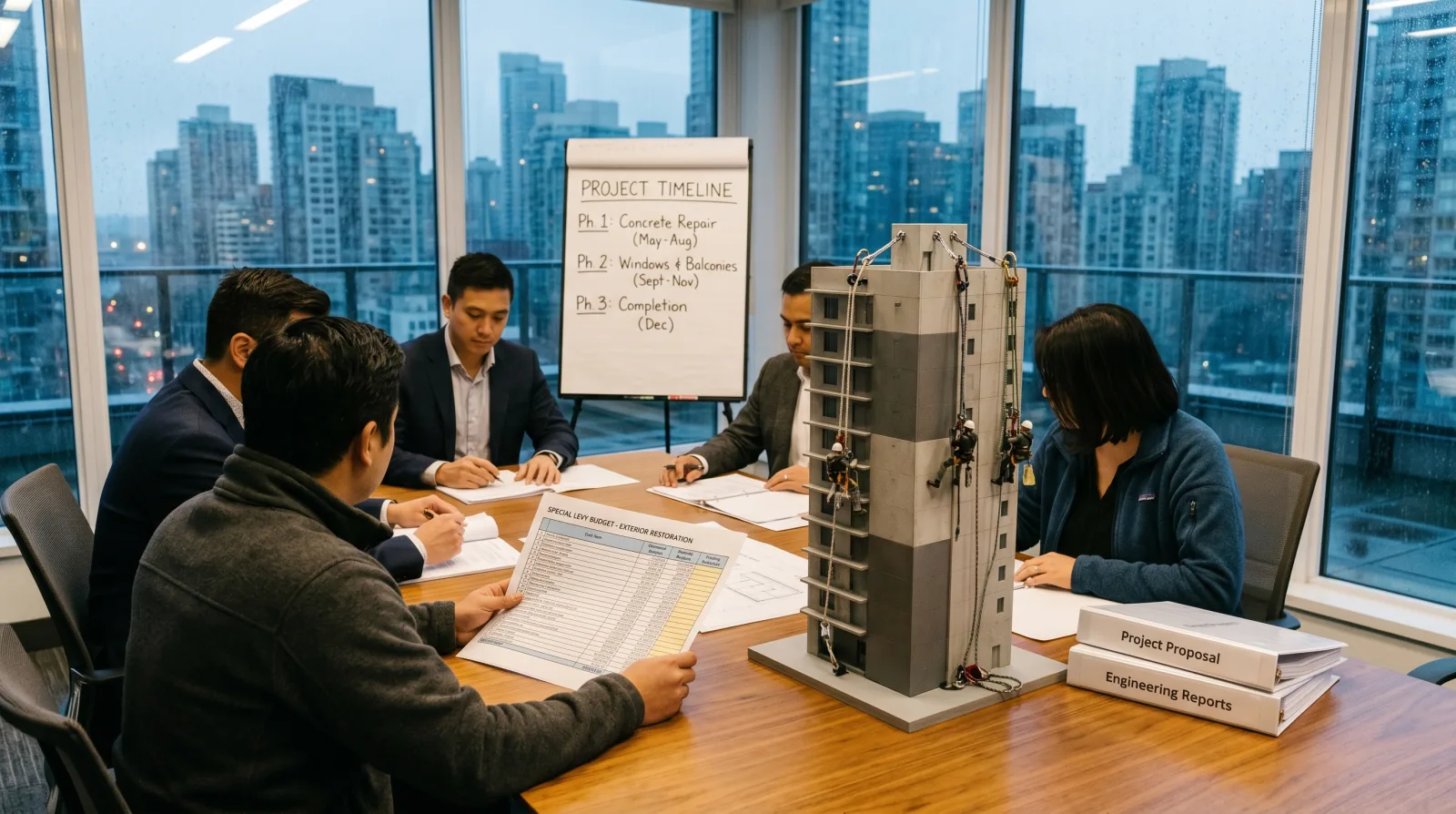
Why the funding decision comes before the construction decision
By the time a Metro Vancouver strata is looking at a full envelope restoration, the engineering scope is usually clear: which elevations are failing, what the sealant and membrane condition is, whether the concrete needs repair. What is rarely clear is how the building will pay for it. That funding question decides whether the project happens this year or gets deferred until the damage is worse and the cost is higher. We have seen good scopes sit on a shelf for two winters because the council could not agree on how to raise the money, and by the time they did, the water had reached more units.
There are three sources of money for a major project: the contingency reserve fund, a special levy, and a strata corporation loan. Most large envelope projects use a mix. The reserve fund rarely holds enough on its own for a full recladding, so the real decision for the balance is a levy, a loan, or a combination of the two. Getting that decision right protects both the building and the owners who live in it. Getting it wrong can mean a failed vote, a delayed repair, owners in arrears, or years of interest the building did not need to pay.
One point to settle early: the funding vote should sit on a firm scope and a firm number, not an estimate. If owners approve a levy or loan for a rough figure and the real cost comes in higher, the council is back at another general meeting asking for a second, harder vote partway through the job. Pin the scope down first, then decide how to pay for it.
How a special levy actually works
A special levy is a one-time charge collected directly from owners for a specific, named project. Under section 108 of the Strata Property Act it needs a 3/4 vote at a general meeting, and each owner\'s share is normally set by unit entitlement, the same basis used to split regular strata fees under sections 99 and 100. The resolution owners vote on should state the total amount, each lot\'s share, and the due dates. Once approved, the strata collects the money, holds it, and pays the contractor from it.
The math is simpler than owners fear. Each lot\'s share is its unit entitlement divided by the total unit entitlement of the building, applied to the project total. A larger unit pays more than a smaller one, in the same proportion it already pays fees. If a council wants to divide the levy in a different way it considers fairer for that one expense, that different split needs a unanimous vote under section 100, which is very hard to reach and rarely worth chasing on a big project. For almost every envelope restoration, the practical route is the 3/4 vote with shares by unit entitlement.
Levies are often collected in a few instalments rather than one payment. The resolution can set, for example, a first payment on approval and further payments over the following months. This softens the blow, but it also paces the money. Large restoration work often cannot start until enough instalments are in hand, so the collection schedule can set the construction schedule. If the work is urgent, that lag matters.
There is one narrow relief valve in s.108. If the levy is for maintenance or repair of common property that is necessary to ensure safety or prevent significant loss or damage, and the resolution gets a majority but falls short of 3/4, the strata can apply to the BC Supreme Court to have the levy approved. This is a backstop for genuine safety work that a minority is blocking, not a normal path. Do not plan around it. Confirm the resolution wording with a strata lawyer or licensed property manager before the meeting, because a levy that is worded incorrectly can be challenged by owners later.
How a strata corporation loan actually works
Section 111 of the Strata Property Act lets the corporation borrow the money it needs, again on a 3/4 vote at a general meeting. The corporation, not the individual owners, is the borrower, and it stays responsible for repayment for the whole term no matter who buys or sells units along the way. Several lenders in BC specialize in strata financing and understand how a strata\'s cash flow and voting work.
The mechanics are straightforward. Owners approve the borrowing, the lender advances the full project amount so work can begin at once, and the corporation repays principal and interest on a set schedule. Repayment is funded either by an increase in regular strata fees for the term, or by a levy that is spread across the loan period and collected in step with the loan payments. Terms usually run several years; ask the lender for the exact term and the total cost of credit over that term.
Security is the part owners often misunderstand. The corporation may secure repayment of the borrowed money and interest, subject to section 81. In practice lenders rely on the strata\'s statutory power to levy owners over the term as their security, rather than hard collateral like a mortgage on the building. That is why a loan is workable even for a corporation with few assets: the lender is trusting the corporation\'s legal right to charge its owners. Because security arrangements interact with s.81, have the structure reviewed by a strata lawyer before the vote.
The cost of that flexibility is interest. The strata pays it to the lender across the whole term, and every owner carries a share of it through their fees. On a large loan over a multi-year term, the interest premium above the base project cost is real money. The building is also carrying debt for years, which appears in the financial statements a buyer reviews and competes with future reserve contributions in the annual budget. None of that is a dealbreaker. It is the price of not asking owners for a lump sum, and for the right building it is a price worth paying.
The two options compared
Special levy
A one-time charge collected directly from owners, on top of regular strata fees, to pay for one named project. Each owner pays their share up front or across a short set of scheduled instalments written into the resolution.
Strata corporation loan
The strata corporation borrows the project cost from a lender (often a strata-specialist financier) and repays it over several years through increased strata fees, or through a levy that is spread across the loan term.
Why Metro Vancouver changes the answer
The law is the same across BC, but the buildings and the people in them are not. Metro Vancouver holds a large stock of wood-frame and concrete buildings from the 1980s and 1990s, many from the leaky-condo era, and they are hitting the age where the envelope needs major work all at once. When a building of that vintage needs attention, it usually needs a lot of it, not a small patch.
The weather makes it worse. Heavy, wind-driven rain pushes water into failing cladding, sealant, and membranes, so envelope projects here tend to be full recladdings or large-scale restoration rather than minor repairs. That drives the per-unit cost up, which is exactly when the levy-or-loan question gets hard. A repair that would be a modest levy in a drier climate can be a five-figure share per unit here.
Then there are the owners. Many Metro Vancouver buildings hold retirees on fixed incomes alongside people who bought recently and stretched their budget to do it. For both groups, a large lump-sum levy hits far harder than the dollar figure alone suggests. A retiree may have equity but little cash flow; a recent buyer may have neither. This is why more Metro Vancouver stratas end up leaning toward a loan or a blended plan, so the repair goes ahead and no owner is forced to sell. The region does not change what the Strata Property Act allows. It changes which option actually fits the people who have to pay.
The failure modes owners never budget for
Both options have a clean version on paper and a messier version in real life. Knowing the failure modes before the vote is how a council avoids them.
For a levy, the main failure is arrears. A special levy is a legal debt to the corporation, like unpaid fees. If an owner cannot pay, the strata can charge interest at the regulated rate, register a lien against the lot, and eventually force a sale to recover the money. That process is slow, costly, and hard on everyone, and it can leave the project short of cash while the collection plays out. On a building with several stretched owners, a large levy can trigger more than one of these at once. A levy that pushes owners into arrears is not a clean outcome even if the building itself stays debt-free.
For a loan, the main failure is the interest owners underestimate and the debt that outlives the good feeling of a finished project. Interest compounds over the term, so the total paid can sit well above the base project cost, and every owner shares it whether or not they needed to borrow. Owners also forget the debt is still there years later, weighing on the annual budget and competing with reserve contributions. A second failure is refinancing or rate risk if the loan is not fixed for the full term: a payment that was comfortable at approval can climb if the terms reset. Ask the lender directly whether the rate is fixed for the whole term and what the total cost of credit is.
There is a shared failure mode too: a funding vote that fails. If owners are split and neither a levy nor a loan reaches 3/4, the repair stalls and the damage grows. Presenting both options honestly, side by side, with real numbers and honest risk, is the best defence against a failed vote.
How the reserve fund and depreciation report shrink the problem
The most common mistake is treating the levy-or-loan decision as the whole question. It is not. A building with a healthy contingency reserve fund faces a much smaller balance to raise, because the fund covers part of the project. The reserve is established under section 92, and it is built up through a minimum annual contribution of at least 10% of the operating fund budget, with section 93 governing the amount. Years of steady contribution are what turn a future crisis into a manageable top-up.
The depreciation report is the other lever. Existing stratas of five or more lots must obtain a report on a five-year cycle. The deadline is July 1, 2026 for Metro Vancouver, the Fraser Valley, and the Capital Regional District, and July 1, 2027 for the rest of BC, including the Southern Gulf Islands and Bowen Island. As of October 27, 2025 the report must be prepared by a designated qualified professional: an engineer, architect, architectural technologist, applied science technologist or certified technician, accredited appraiser, certified reserve planner, or professional quantity surveyor. The report tells owners what is coming and roughly when, so the envelope work is a planned item rather than a shock.
Here is the funding link that matters most. Spending from the reserve normally needs a 3/4 vote under section 96, but it needs only a majority vote when the expenditure is for repair, maintenance, or replacement recommended in your most current depreciation report, or when it is authorized under section 98. So if your envelope work is named in the current report, you can fund the reserve\'s share on an easier majority vote and only take the harder 3/4 vote for the balance you cover by levy or loan. That single fact changes the size and the difficulty of the funding question. For how the reserve and a levy interact, see our CRF vs. special levy guide, and for the report itself see our depreciation report and building envelope guide.
Emergency spending: when you cannot wait for a vote
Sometimes the water is already inside and there is no time for a general meeting. Section 98(3) allows the strata to spend from the operating fund or the contingency reserve fund without a prior vote when there are reasonable grounds to believe an immediate expenditure is necessary to ensure safety or prevent significant loss or damage. Two limits go with that power: the strata must spend only the minimum amount needed to deal with the emergency, and it must inform owners of the expenditure as soon as feasible.
This is a stabilization tool, not a funding plan. It lets a council stop active ingress that is damaging units right now, tarp a failed area, or make a section safe. It is not a way to fund a full planned restoration without a vote. After the emergency work, the strata still needs a proper 3/4 vote to fund the complete repair through a levy, a loan, the reserve, or a blend. Because owners can challenge spending that did not truly meet the emergency test, confirm with a strata lawyer or licensed property manager that your situation qualifies before relying on s.98(3).
Resale and disclosure: what a buyer sees either way
Owners often ask whether a levy or a loan hurts their ability to sell. Neither is hidden from a buyer, and trying to hide either is a mistake. A special levy and its payment schedule appear on the Information Certificate (Form B) that a buyer and their lender review. A strata loan shows up in the corporation\'s financial statements and in the higher monthly fees the buyer will inherit. Both change what a careful buyer is willing to pay, so the honest approach is to disclose clearly and let the price reflect it.
The one point sellers should understand is the timing difference. Under section 108, an unpaid levy splits at the conveyance date: the seller owes the portion payable before that date, the buyer owes the portion payable on or after it. Sellers and buyers can adjust how they handle any unpaid levy between themselves by contract, but the s.108 default is the starting point. A loan does not split that way, because the debt sits with the corporation and travels with the unit as higher fees. So a levy can mean a larger one-time cost at closing, while a loan means a smaller sale-time hit but a higher ongoing fee the buyer must accept. If a lot of units in your building are likely to change hands during the project, walk through the split with a strata lawyer before the vote, because it affects who carries the cost.
What each option cannot do, and where it is the wrong tool
A special levy cannot make a lump sum affordable for an owner who does not have it. No matter how the council frames it, a levy asks each owner to find their share now, and on a building with many fixed-income or stretched owners that is the wrong tool, because it manufactures arrears. A levy also cannot deliver the full project budget faster than owners pay it, so it is the wrong tool for urgent work that must start immediately.
A strata loan cannot make interest disappear, and it cannot be the right tool for a building where owners could easily pay cash. On that building, a loan just adds years of shared interest for no cash-flow reason, and it leaves debt on the books that a buyer will notice. A loan also cannot fix a budget that was never going to balance: if the strata is already carrying debt or running thin reserves, adding loan payments can strain the annual budget and crowd out the reserve contribution the building still needs. In that case a levy that clears the cost, or a smaller loan paired with a levy, may be safer than piling on more debt.
Neither tool is a substitute for a real scope. If the construction scope is not pinned down by a qualified professional, both a levy and a loan can come up short, and a short funding plan forces a second vote partway through the job. Fund the project once, on a firm number.
How to read a lender\'s or council\'s funding proposal
When a proposal lands in front of the council, read past the headline monthly payment. For a loan, the number that matters is the total cost of credit over the full term, in dollars, not just the interest rate. Ask whether the rate is fixed for the whole term, what the security is and whether it touches the reserve or needs a further vote under section 81, and whether the loan can be prepaid without penalty so owners who later want to clear their share can do so.
For a levy, read the resolution wording as carefully as the number. It should state the total amount, each lot\'s share by unit entitlement, and the exact due dates, and it should have been checked by a strata lawyer. For either option, make sure the depreciation report has been reviewed, so you are not borrowing for work you could fund from the reserve on an easier majority vote. And make sure the funding amount rests on a firm scope, not an estimate. Our building envelope repair team scopes the work, and for phased or full building restoration projects we help sequence the work so it fits the funding plan the strata approves. The checklist further down turns all of this into questions you can put to the council, lender, or contractor before the vote.
Realistic Metro Vancouver scenarios
The right call depends on the building. Here are four situations we see across the region, and the honest reasoning behind each recommendation. Notice that the obvious answer is not always the right one.
1980s wood-frame 4-storey on the North Shore, full recladding
SituationA 28-unit wood-frame building from the late 1980s on the North Shore needs a full recladding after years of wind-driven rain got behind the cladding. Many original owners are retired and on fixed incomes. The reserve holds only a fraction of the project cost.
The callStrata loan for the balance after the reserve, with a levy option offered to owners who prefer to pay cash.
Honest reasonA levy large enough to fund a full recladding would push several fixed-income owners into arrears or a forced sale. A loan spreads the cost into fees they can carry month to month, and the reserve covers the part the depreciation report already flagged. Owners who can pay their share up front can still do so, which lowers the amount borrowed and the interest everyone else shares.
Downtown concrete high-rise, mostly investor-owned, underfunded reserve
SituationA concrete tower downtown with mostly investor-owned units needs sealant renewal and window-wall repairs. Owner incomes are healthy, but the reserve was kept low for years to hold fees down. The work is important but not an emergency.
The callSpecial levy, not a loan, even though a loan looks easier on paper.
Honest reasonThis is the case where the less obvious answer is right. Investor owners can usually fund a lump sum or borrow against their own equity more cheaply than the corporation can. A loan would make every owner share years of interest for no real cash-flow need. A levy clears the cost, keeps the building debt-free for resale, and pushes the borrowing decision down to each owner who can shop their own rate.
Small 12-unit strata, urgent water ingress, reserve nearly empty
SituationA small 12-unit strata has active water coming into two units. The reserve is nearly empty. Owners are a mix, and the council has no time to run a long instalment collection before the leak does more damage.
The callEmergency stabilization under s.98(3) first, then a strata loan (or loan-plus-levy) for the full repair.
Honest reasonSection 98(3) lets the council spend the minimum needed right now to stop the immediate damage, without waiting for a vote, and inform owners after. For the full repair, a loan puts the whole budget in hand at once so the work is not paced by how fast 12 owners can pay. With the reserve empty, a levy alone would either be too slow or too large for a small owner group to absorb.
Mixed 60-unit complex, healthy reserve, phased envelope work
SituationA 60-unit low-rise complex has a healthy reserve and a depreciation report that recommends envelope work in phases over a few years. Owners are a broad mix of incomes. The work can be sequenced.
The callReserve fund for the report-recommended phases (majority vote under s.96), topped up by a modest special levy where the reserve falls short.
Honest reasonBecause the phases are named in the current depreciation report, spending from the reserve needs only a majority vote, which is easier to pass than a 3/4 loan or levy vote. Phasing lets the reserve refill between stages through the annual contribution. A small levy covers any gap without the interest cost of a loan or the shock of one large assessment.
For the deeper trade-off between fixing everything at once and fixing only the failing parts, which changes the size of any levy or loan, see our guide on full envelope replacement vs. targeted repair.
Decision framework: questions that point to the right funding route
| Question | Recommendation | Reason |
|---|---|---|
| Most owners have savings or their own credit line? | Lean special levy | If owners can fund their share privately, the strata avoids paying loan interest across every unit for years. Owners who need to borrow can usually do it more cheaply on their own home equity than the corporation can borrow. |
| A meaningful number of owners cannot raise a lump sum? | Lean strata loan | A large levy on a building with many fixed-income or recently-purchased owners creates arrears, hardship, and sometimes forced sales. Spreading the cost through a loan keeps people housed and keeps the project funded. |
| The envelope work is urgent (active water ingress, safety)? | Lean strata loan | A loan delivers the full project budget at once, so work can start now. A levy collected in instalments may not put enough cash in hand to begin major restoration for months. |
| Council wants zero debt on the corporation's books? | Special levy | A levy leaves the strata debt-free once collected. Some councils and buyers prefer a balance sheet with no borrowing, which can read better during a sale. |
| Total project cost is very large relative to unit values? | Model both | On a full recladding, the per-unit levy can rival a down payment. Run the loan interest total against the hardship and arrears risk of a big levy before the vote, so owners choose with real numbers. |
| Will many units likely sell during the project? | Understand the split | A levy splits at the conveyance date under s.108, so timing matters for sellers. A loan transfers as higher fees to the buyer. Both must be disclosed on the Information Certificate (Form B), so neither hides the cost. |
| Is the repair recommended in your current depreciation report? | Check the reserve first | If the work is named in the current depreciation report, spending from the contingency reserve fund needs only a majority vote under section 96, not 3/4. Using the reserve for part of the job shrinks the levy or loan you still need to approve. |
| Is the situation an emergency (immediate safety or significant loss)? | Emergency spending, then decide | Section 98(3) lets the strata spend from the operating fund or reserve without a prior vote when an immediate expenditure is needed to ensure safety or prevent significant loss or damage. Spend only the minimum, inform owners as soon as feasible, then hold a proper vote on how to fund the full repair. |
| Does the corporation carry other debt or thin reserves already? | Lean special levy or model carefully | Adding loan payments on top of existing debt service can strain the annual budget and crowd out reserve contributions. If the building is already stretched, a levy that clears the cost may be safer than piling on more debt. |
| Are owners split and the vote at risk of failing? | Model both and present clearly | A funding vote that fails delays the repair and can make the damage worse. Give owners both options side by side with real numbers, honest arrears risk, and the total cost of credit, so the resolution that passes is one owners understand and can sustain. |
Questions to ask before you approve the funding resolution
Put these to the council, the lender, and the contractor before the owners vote. The red-flag answers tell you where a proposal needs more work. Related questions on who pays for specific envelope elements are covered in our who pays for balcony waterproofing guide.
-
What is the total cost of credit over the full loan term, in dollars, not just the rate?
Red flagA proposal that only shows a monthly payment or an interest rate, and will not state the total interest paid across the whole term. If they dodge the total, model it yourself before you vote.
-
What exactly secures the loan, and does it touch the contingency reserve fund or need a further vote under section 81?
Red flagVague answers about security, or a plan to pledge the reserve without telling owners clearly. Security should be spelled out in writing and consistent with the Strata Property Act.
-
Is the envelope work named in our current depreciation report, and can we fund part of it from the reserve on a majority vote under section 96?
Red flagNobody has checked the depreciation report. Skipping this can mean borrowing for work you could have funded from the reserve with an easier majority vote.
-
For a levy, does the resolution state the total amount, each lot's share by unit entitlement, and the exact due dates?
Red flagA loosely worded levy resolution. A levy resolution that is unclear or uses the wrong split can be challenged later. Have a strata lawyer check the wording before the meeting.
-
What happens, step by step, if owners fall into arrears, and who bears that risk under each option?
Red flagNo plan for arrears. Under a levy, unpaid shares can end in liens and forced sales; under a loan, fee arrears still leave the corporation owing the lender on schedule. Both need a written collection plan.
-
Is the construction scope and cost pinned down by a qualified professional, or are we voting on an estimate?
Red flagA funding resolution built on a rough guess. If the scope is not firm, the levy or loan can come up short and force a second, harder vote partway through the job.
-
How does each option show up on the Form B Information Certificate and in the financial statements a buyer will read?
Red flagA promise that the cost can be kept quiet. It cannot. A levy shows on Form B; a loan shows in the financials and higher fees. Plan to disclose it plainly.
-
If we borrow, can the loan be prepaid without penalty, and can owners buy out their share early?
Red flagHeavy prepayment penalties or no buyout option. Owners who later want to clear their portion should be able to, and the corporation should be able to pay the loan down if reserves allow.
-
How does the loan's annual debt service fit with our future reserve contributions and the minimum contribution rule?
Red flagA budget that funds the loan by starving the reserve. The reserve still needs its minimum annual contribution (at least 10% of the operating budget) while the loan is repaid, or the next problem arrives with no money set aside.
-
Have we confirmed the legal steps and resolution wording with a strata lawyer or licensed property manager?
Red flagThe council is drafting the resolution alone. Funding resolutions for large YMYL-scale projects should be reviewed by a strata lawyer or licensed property manager before owners vote.
Getting the scope right before the money question
Every funding decision on this page assumes one thing: that owners know what they are paying for. The levy or loan number is only as good as the scope behind it. That means an assessment by a qualified professional, a clear statement of which elevations and systems need work, and a firm cost, ideally with the depreciation report cross-checked so you know what the reserve can carry. If you are still deciding whether you need a depreciation report or a building envelope condition assessment for this, our BECA vs. depreciation report guide explains the difference. Once the scope and number are firm, the levy-versus-loan choice becomes a real decision your owners can make with confidence, and you can return to the strata guide hub for the rest of the funding and envelope topics.
Quick answers
What vote does a BC strata need to approve a special levy for envelope work?
A special levy must be approved by a 3/4 vote at an annual or special general meeting under section 108 of the Strata Property Act. Each strata lot's share is normally calculated by unit entitlement, the same way strata fees are split, under sections 99 and 100. If the council wants to divide the levy in a different way that it considers fairer for that specific expense, that needs a unanimous vote under section 100, which is much harder to get. There is also a narrow path under s.108: if the levy is for maintenance or repair of common property needed to ensure safety or prevent significant loss or damage, and the resolution gets a majority but less than 3/4, the strata can apply to the BC Supreme Court to have the levy approved. For a large building envelope restoration, the practical route is almost always the 3/4 vote with shares by unit entitlement. Confirm the exact wording of your resolution with your strata lawyer or licensed property manager before the meeting, because a levy resolution that is worded incorrectly can be challenged later.
Can a BC strata corporation borrow money for a building envelope project?
Yes. Section 111 of the Strata Property Act lets a strata corporation borrow the money it needs, after approval by a 3/4 vote at a general meeting. The corporation may secure repayment of the borrowed money and the interest, subject to section 81. Several lenders in BC specialize in strata financing and structure repayment over a term of several years, collected through increased strata fees or a levy spread across the loan period. A strata loan is a real option when owners cannot easily fund a lump sum, or when the work is too urgent to wait for a levy to be collected in instalments. Because the security usually rests on the corporation's power to levy owners over the term, confirm the exact structure with your strata lawyer or licensed property manager before the vote.
Is a special levy or a strata loan cheaper overall?
A special levy is usually cheaper for the building as a whole because the strata pays no interest, so the building's cost is just the project cost. Owners who cannot pay from savings arrange their own financing, and a homeowner borrowing against their own equity often gets a lower rate than a strata corporation loan. A strata loan spreads the pain and lets the project start immediately, but every owner shares the interest cost across the full term, which adds a real premium above the base project cost. We do not quote loan rates or project costs on this page, because both depend on your lender, your building, and the scope. The right comparison is your building's actual levy share against the total loan repayment, including the full cost of credit, and that should be modelled for your specific project before the owners vote. Ask your lender for the total interest paid over the term, not just the monthly payment.
Special levy and strata loan questions
What vote does a BC strata need to approve a special levy for envelope work?
A special levy must be approved by a 3/4 vote at an annual or special general meeting under section 108 of the Strata Property Act. Each strata lot's share is normally calculated by unit entitlement, the same way strata fees are split, under sections 99 and 100. If the council wants to divide the levy in a different way that it considers fairer for that specific expense, that needs a unanimous vote under section 100, which is much harder to get. There is also a narrow path under s.108: if the levy is for maintenance or repair of common property needed to ensure safety or prevent significant loss or damage, and the resolution gets a majority but less than 3/4, the strata can apply to the BC Supreme Court to have the levy approved. For a large building envelope restoration, the practical route is almost always the 3/4 vote with shares by unit entitlement. Confirm the exact wording of your resolution with your strata lawyer or licensed property manager before the meeting, because a levy resolution that is worded incorrectly can be challenged later.
Can a BC strata corporation borrow money for a building envelope project?
Yes. Section 111 of the Strata Property Act lets a strata corporation borrow the money it needs, after approval by a 3/4 vote at a general meeting. The corporation may secure repayment of the borrowed money and the interest, subject to section 81. Several lenders in BC specialize in strata financing and structure repayment over a term of several years, collected through increased strata fees or a levy spread across the loan period. A strata loan is a real option when owners cannot easily fund a lump sum, or when the work is too urgent to wait for a levy to be collected in instalments. Because the security usually rests on the corporation's power to levy owners over the term, confirm the exact structure with your strata lawyer or licensed property manager before the vote.
Is a special levy or a strata loan cheaper overall?
A special levy is usually cheaper for the building as a whole because the strata pays no interest, so the building's cost is just the project cost. Owners who cannot pay from savings arrange their own financing, and a homeowner borrowing against their own equity often gets a lower rate than a strata corporation loan. A strata loan spreads the pain and lets the project start immediately, but every owner shares the interest cost across the full term, which adds a real premium above the base project cost. We do not quote loan rates or project costs on this page, because both depend on your lender, your building, and the scope. The right comparison is your building's actual levy share against the total loan repayment, including the full cost of credit, and that should be modelled for your specific project before the owners vote. Ask your lender for the total interest paid over the term, not just the monthly payment.
If I sell my unit before the special levy is paid, who pays it?
Under section 108 of the Strata Property Act, a special levy is split at the conveyance date. The portion that is payable before the date the strata lot is conveyed is the seller's responsibility, and the portion payable on or after that date is the buyer's. In practice, the levy amount and its payment schedule appear on the Information Certificate (Form B) that a buyer and their lender review during the sale, so nothing is hidden. Sellers and buyers usually negotiate how any unpaid levy is handled as part of the purchase agreement, and the split can be adjusted between them by contract. This is a legal and contractual question, so confirm the split with your realtor and a strata lawyer before you list or make an offer.
How does a strata loan affect a unit sale?
A strata corporation loan stays with the corporation, not with the individual owner, so a seller does not clear a lump sum at closing the way they would with an unpaid levy. Instead, the repayment shows up as higher monthly strata fees that continue after the sale, and the buyer takes on those higher fees. A well-informed buyer and their lender will see the loan in the strata's financial statements and factor the elevated fees into what they are willing to pay. It is not hidden, and it does not disqualify a mortgage on its own, but it does change the monthly carrying cost of the unit. Disclose the loan clearly, because a buyer who discovers it late may walk away or renegotiate. If you are unsure how to present it, ask your realtor or a strata lawyer.
Can we use the contingency reserve fund instead of a levy or a loan?
Sometimes, and that is often the best outcome. The contingency reserve fund is established under section 92, and it is built up through a minimum annual contribution of at least 10% of the operating fund budget. Spending from the reserve normally needs a 3/4 vote under section 96, but there is an important exception: it needs only a majority vote when the expenditure is for repair, maintenance, or replacement that is recommended in your most current depreciation report, or when it is authorized under section 98. The problem for most buildings is that a full envelope restoration costs far more than a typical reserve fund holds, so the fund covers part and a levy or loan covers the rest. A healthy reserve, guided by the depreciation report, is what shrinks the levy owners eventually face. See our guide on the contingency reserve fund versus a special levy for how these interact, and confirm the vote thresholds for your situation with a licensed property manager.
What happens if an owner refuses to pay their special levy share?
A special levy is a legal debt owed to the strata corporation, the same as unpaid strata fees. The strata can charge interest on the late amount up to the rate set in the regulations, and that interest becomes part of the levy rather than a fine. If the owner still does not pay, the corporation can register a lien against the strata lot and, in the end, force the sale of the unit to recover the debt. This is one reason councils on buildings with many owners who cannot afford a lump sum sometimes choose a loan instead: it avoids pushing owners into arrears and the legal cost of collection. Any lien or forced-sale step should be handled with a strata lawyer, not by the council alone.
Can the strata spend on emergency envelope repairs without a vote?
Yes, within limits. Section 98(3) of the Strata Property Act lets the strata spend from the operating fund or the contingency reserve fund without a prior vote when there are reasonable grounds to believe an immediate expenditure is necessary to ensure safety or prevent significant loss or damage. The council must spend only the minimum amount needed to deal with the emergency, and it must inform owners of the expenditure as soon as feasible. This is meant for urgent stabilization, such as stopping active water ingress that is damaging units, not for funding a full planned restoration. After the emergency work, the strata still needs a proper vote to fund the complete repair through a levy, a loan, or the reserve. Confirm that your situation truly meets the emergency test with a strata lawyer or licensed property manager, because spending outside the rules can be challenged by owners.
How does our depreciation report affect the funding choice?
The depreciation report is the plan that tells owners what major work is coming and roughly when, so it turns a surprise levy into a budgeted one. Existing stratas of five or more lots must obtain a report on a five-year cycle. The deadline is July 1, 2026 for Metro Vancouver, the Fraser Valley, and the Capital Regional District, and July 1, 2027 for the rest of BC, including the Southern Gulf Islands and Bowen Island. As of October 27, 2025, the report must be prepared by a designated qualified professional, such as an engineer, architect, architectural technologist, applied science technologist or certified technician, accredited appraiser, certified reserve planner, or professional quantity surveyor. The funding link matters: when envelope work is named in your current report, spending from the reserve for it needs only a majority vote under section 96, which lowers the amount you must raise by levy or loan. See our depreciation report and building envelope guide, and confirm your building's deadline with a licensed property manager.
Why does Metro Vancouver change the answer to levy or loan?
Metro Vancouver has a large stock of wood-frame and concrete buildings from the 1980s and 1990s, many of them from the leaky-condo era, and they are reaching the age where the envelope needs major work at the same time. The region's heavy, wind-driven rain drives water into failing cladding, sealant, and membranes, so envelope projects here are often full recladdings rather than small repairs, and the price per unit is high. Many buildings also hold owners on fixed incomes or people who bought recently and stretched to do it, so a large lump-sum levy hits harder here than the raw dollar figure suggests. That mix pushes more Metro Vancouver stratas toward a loan or a blended plan, so no owner is forced to sell. It does not change the law, only which option fits the people in the building. Model both for your specific building with a licensed property manager before the vote.
What is the difference between a special levy and a strata loan for the person selling a unit?
The core difference for a seller is timing and who carries the debt. With an unpaid special levy, the cost splits at the conveyance date under section 108, so you clear your portion at or before closing and the buyer takes the rest, and the amount shows on the Form B Information Certificate. With a strata loan, there is no lump sum to clear at closing, because the debt sits with the corporation; instead the buyer inherits the higher strata fees that fund repayment, and the loan appears in the strata's financial statements. A levy can mean a larger one-time cost at sale, while a loan means a smaller sale-time hit but a higher ongoing fee the buyer must accept. Neither can be hidden, and both affect what a careful buyer will pay. Talk to your realtor and a strata lawyer about how to present your building's situation before you list.
Should we split a big envelope project between the reserve, a levy, and a loan?
Often, yes, and a blend is common on large Metro Vancouver projects. A typical structure funds the report-recommended part from the reserve (majority vote under section 96 if it is named in the current depreciation report), then covers the balance with a levy for owners who can pay cash and a loan for the rest. This lowers the amount borrowed, so the interest everyone shares is smaller, while still protecting owners who cannot produce a lump sum. It also keeps some reserve intact for the next problem instead of draining it. The right mix depends on your reserve balance, your owners' finances, and how urgent the work is, so it should be modelled with real numbers before the vote. Confirm the vote thresholds and the resolution wording for a blended plan with a strata lawyer or licensed property manager.
Pin down the scope and cost before your funding vote
We assess and scope building envelope restoration for strata and commercial buildings across Vancouver, North Vancouver, West Vancouver, and Burnaby, so your council brings owners a real project number, not a guess, when it presents a levy or loan resolution. Confirm the legal steps with your strata lawyer or property manager.