In-house strata maintenance vs. specialist envelope contractor: where the line should sit
Keep the routine, ground-level, and interior upkeep in-house. A good caretaker who clears the drains, keeps the walkways clean, and reports a new stain early saves the strata real money. Hand off anything envelope-critical, at height, warranty-bound, or tied to an engineer\'s scope to a certified specialist. Membranes, coatings, sealant joints, concrete repair, and all roof and facade work belong there.
This is not a judgement about in-house staff. It is about matching the risk of a task to the training, certification, and insurance it actually requires. The moment work leaves the ground, touches a warranted membrane or coating, or falls under a depreciation report scope, the stakes change: a well-meaning in-house repair can void a warranty, fail in a season, and leave the corporation carrying the liability. Here is where the line falls, task by task, and how to write it into a maintenance plan.
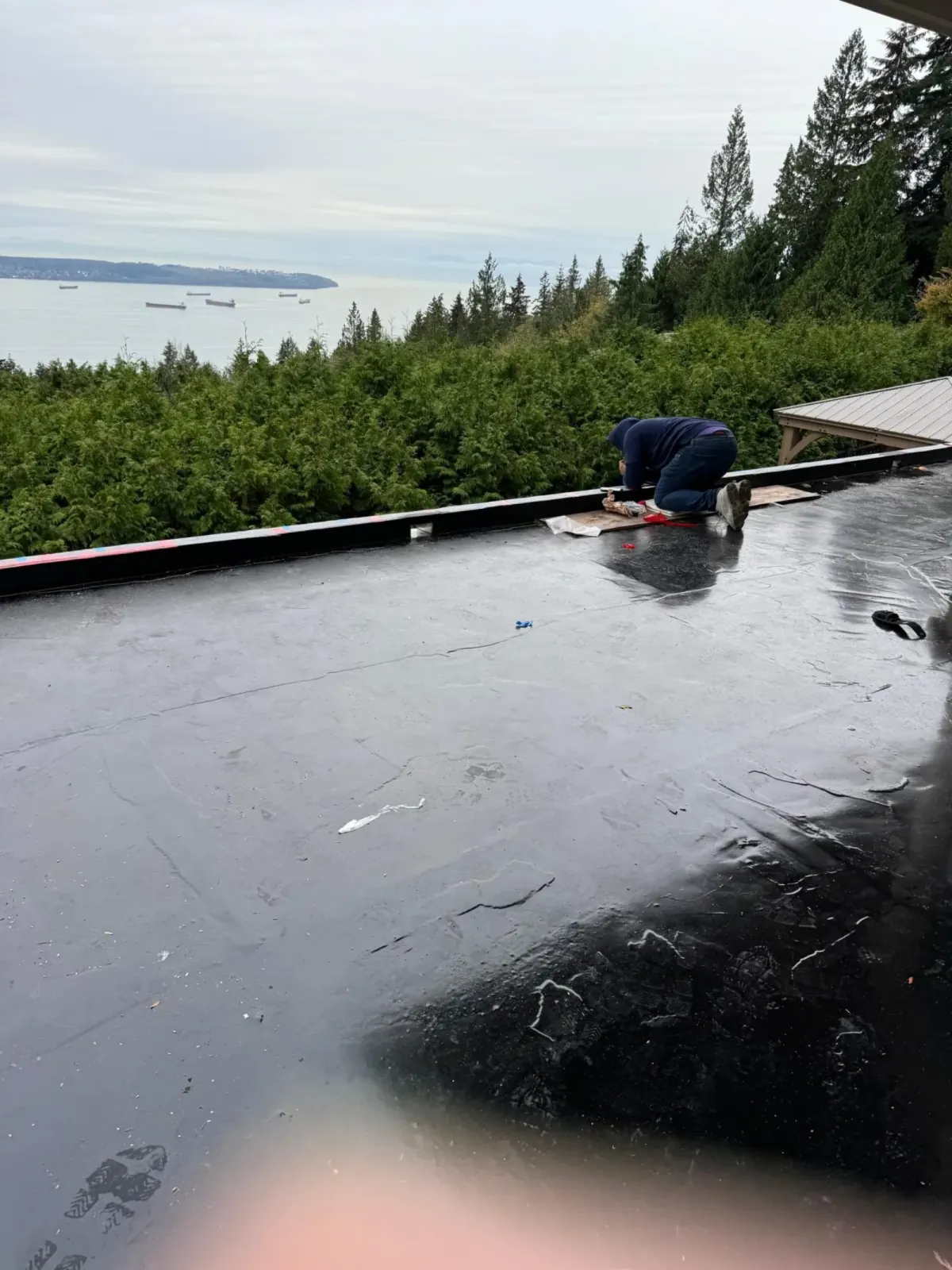
The line falls where the work leaves the ground
There is a simple test that gets most of these decisions right: does the task leave the ground, touch a warranted envelope system, or fall under an engineered scope? If the answer to all three is no, it is in-house work. If the answer to any one is yes, it is specialist work. That single test sorts the great majority of strata maintenance tasks, and it does it in a way that protects both the caretaker and the corporation.
The reason the line sits there is that those three things, height, warranty, and engineered scope, are exactly the places where the risk stops being about a task done slightly imperfectly and starts being about safety, money, and liability. A smudge on a repaint is cosmetic. A sealant joint applied wrong on the fourteenth floor is water in the wall and a voided warranty. The consequences are not on the same scale, so the people doing the work should not be either.
What belongs in-house, concretely
The routine upkeep that keeps a building healthy between major projects is in-house work, and a strata is better off having a caretaker who owns it. Cleaning and tidying at ground level. Clearing leaves from roof drains and scuppers where there is safe, guarded access, which matters enormously in Metro Vancouver where a blocked scupper before the fall rains means ponding and leaks. Minor interior repairs and interior paint touch-ups. And, most valuable of all, walking the building regularly to spot and report the early signs of trouble.
That last one is underrated. A caretaker who notices a fresh stain on a top-floor ceiling, a hairline crack that opened over the winter, or a balcony that holds water after rain gives the strata the chance to fix a small problem before it becomes a major envelope project. None of that requires certification. It requires familiarity with the building and a habit of paying attention, which is precisely what good in-house staff provide.
Why envelope work voids the warranty in the wrong hands
Manufacturer and material warranties on waterproofing membranes, elastomeric coatings, and sealant systems typically require a certified applicator and documented surface preparation. That is not fine print for its own sake. These products only perform when the substrate is prepped correctly and the material is applied to specification, so the manufacturer ties the warranty to proof that both happened. When a handyman applies the product without the certification and without recording the prep, the manufacturer can decline a future claim.
The practical result is harsh: a well-meaning in-house patch can cost the strata the entire remaining value of a warranty that took a proper contractor to earn. On a roof or balcony membrane with years of coverage left, that is real money thrown away to save a small repair cost. Interior painting and cleaning carry no such risk, which is why they stay safely in-house. The warranty line, like the height line, tracks the same underlying split between routine work and envelope-critical work. The chemistry behind why prep and film build matter so much is covered in the elastomeric versus acrylic guide.
Working at height: the liability the corporation carries
Work at height in British Columbia is governed by WorkSafeBC fall-protection rules, with general fall protection under Part 11 of the OHS Regulation and rope access specifically under Part 34, and they apply whether the worker is a hired contractor or in-house staff. A strata that sends an untrained caretaker onto a roof edge or over a facade without the required training, equipment, and engineered anchors takes on a genuine safety and liability exposure. If someone is hurt, the strata corporation can be held responsible.
A certified envelope contractor carries its own compliant fall-protection program, trained IRATA or SPRAT rope access technicians, engineered anchor use, and insurance, all of which moves that exposure off the strata council for the work it performs. This is why any task at height, however simple it looks, belongs to the specialist. It is also why in-house staff should never rig from or adjust roof anchors, which have to be engineered and certified. The whole subject of who owns the safety plan is covered further in the rope-access specialist versus general contractor guide.
Who pays when in-house envelope work fails
Under the Strata Property Act, the building envelope is common property, and the strata corporation carries the responsibility for maintaining it and the liability when maintenance fails. So when in-house or handyman work on the envelope goes wrong, a coating that blisters, a membrane patch that leaks, a sealant joint that lets water track behind the cladding, the damage and the repair cost land on the corporation and its owners. There is no third party to absorb it.
A specialist contractor carries insurance and warranty backing that shifts much of that risk off the corporation. That is a large part of what a strata is actually buying when it hires a specialist for envelope work: not just the repair, but the transfer of the liability and the warranty protection that come with a certified, insured, documented job. Councils reviewing their maintenance plan should look hard at which envelope tasks are quietly being handled in-house, because the corporation is the party that pays when those tasks fail.
The hidden cost of the cheaper in-house repair
On paper, an in-house envelope repair looks like the frugal choice, and for routine work it is. For envelope-critical work it is usually the more expensive path once you count everything. A handyman membrane patch that voids the warranty throws away the remaining coverage. A sealant bead applied over a dirty joint fails within a season and has to be cut out and redone by a certified applicator at full cost, on top of the water damage it let in while it was failing. And if the work was at height, the corporation wore the liability the whole time.
A specialist repair costs more up front but keeps the warranty, satisfies the depreciation report, lasts because it was prepped and applied correctly, and carries the liability on the contractor. Add up the redo, the lost warranty, and the risk, and the "cheaper" in-house envelope repair is usually the costlier one. The honest exception is routine, ground-level, non-envelope work, where a specialist would add cost for no benefit. Matching each task to the right party is how a strata spends the least in total, not the least per job.
How depreciation reports set the boundary
A depreciation report maps the building\'s future maintenance and the reserve fund needed to pay for it, and major envelope repairs are usually costed and scheduled inside it. When a repair is tied to that report, or carried out under a building envelope condition assessment, it has to be done to the engineer\'s specification and documented so it satisfies the scope it was funded against. That is contractor territory. If a council lets in-house staff attempt a repair the report assumed a certified contractor would perform, the work may miss the engineered spec, the warranty may be lost, and the reserve planning behind it unravels.
The routine upkeep between those major projects is exactly what in-house staff should keep handling, and a well-maintained building with an attentive caretaker often reaches its depreciation-report milestones in better shape than the report assumed. The two roles reinforce each other: in-house staff keep the building clean, drained, and watched, and the specialist executes the funded, engineered work when it comes due. For how the reserve and levy side of that works, see the contingency reserve fund versus special levy guide.
The two roles compared
In-house / handyman maintenance
A building caretaker, resident volunteer, or general handyman handling day-to-day upkeep. Valuable for routine, low-risk, ground-level tasks that catch small problems before they grow.
Specialist envelope contractor
A certified building envelope and restoration contractor with IRATA or SPRAT rope access technicians, trained crews, and documented procedures. Built for envelope-critical, at-height, and warranty-bound work.
Decision framework: where each task belongs
| Task | Who does it | Reason |
|---|---|---|
| Clearing leaves from roof drains and scuppers (safe, guarded access) | In-house | Routine drainage upkeep is exactly the kind of task a caretaker should own, provided the roof has guarded, safe access. Blocked scuppers cause ponding and leaks, so regular clearing between the Metro Vancouver rain seasons is genuinely useful. |
| Pressure washing walkways and entries at grade | In-house | Cleaning at ground level with both feet on the ground is low-risk and well within a handyman's scope. It keeps surfaces safe and lets someone notice cracking or spalling early. |
| Spotting and reporting water stains, cracks, or damp | In-house | A caretaker who walks the building weekly catches small problems long before a scheduled inspection would. Reporting early is one of the most valuable things in-house staff do. |
| Interior repaint or minor interior repair | In-house | Interior work carries no envelope-performance requirement and no fall-protection exposure. It is well within in-house scope and paying a specialist for it adds cost without value. |
| Recaulking a window perimeter on an upper floor | Specialist | Perimeter sealant is an envelope-critical joint, the work sits at height, and the sealant warranty usually requires a certified applicator with documented prep. Applied over a dirty or wet joint by an untrained hand, it fails and lets water in behind the wall. |
| Roof membrane repair or patch | Specialist | The roof is common property, the membrane carries a material warranty that DIY patching voids, and the work is at height. A patch done without the correct primer and prep peels within a season and the leak returns. |
| Balcony membrane patch on an occupied tower | Specialist | Balcony traffic membranes protect the structural slab below. A handyman patch that does not bond correctly traps water against the concrete and drives rebar corrosion. This needs a certified applicator and, often, coordination with the depreciation report scope. |
| Installing, adjusting, or relying on roof anchors | Specialist / engineer | Rope-access anchors have to be engineered, rated, and certified. In-house staff should never rig from or modify anchors, and any work depending on them belongs to a certified crew under a fall-protection plan. |
| Any work on a roof edge or facade at height | Specialist | Work at height in BC falls under WorkSafeBC fall-protection rules (OHS Regulation Parts 11 and 34). Putting untrained in-house labour on a roof edge or over a facade is a safety and liability exposure the strata corporation should never take on. |
Four real Vancouver scenarios
North Shore strata, blocked scuppers before the fall rains
Situation: A caretaker notices leaves piling up at the roof scuppers as autumn starts, and the roof has a guarded parapet and safe, gated access.
Call: In-house, and keep it on a schedule.
Why: Clearing scuppers with safe guarded access is textbook in-house work, and doing it before the wind-driven rains is one of the most valuable things a caretaker does. Ponding from blocked drains is a leading cause of roof leaks, so catching it early and keeping water moving off the building is exactly where in-house upkeep pays off.
Occupied tower, handyman offers to recaulk leaking windows
Situation: A few upper-floor windows are letting water in, and a well-meaning building handyman offers to recaulk them from inside or off a ladder to save the strata money.
Call: Specialist, do not let the handyman do it.
Why: Perimeter sealant is an envelope-critical joint, the work is at height, and the sealant warranty needs a certified applicator with documented prep. A bead run over a dirty or damp joint looks fixed but fails within a season and sends water behind the cladding. The apparent saving turns into a bigger repair, and the at-height work is a liability the corporation should not carry.
Strata council eyeing a roof patch to defer a levy
Situation: A depreciation report has the roof membrane slated for replacement, but the council wants the caretaker to patch a leak to buy another year and avoid a special levy.
Call: Specialist patch, coordinated with the report scope.
Why: The roof is common property under a material warranty, the work is at height, and it is tied to an engineered scope. A handyman patch voids the warranty and rarely holds. A specialist can do a proper interim repair that buys real time without wrecking the reserve planning, and the council should treat it as bridging to the funded replacement, not as a permanent fix.
Ground-level entry needs cleaning and a fresh coat
Situation: The lobby entry and ground-level walkways look tired. The strata wants them cleaned and the interior entry repainted.
Call: In-house.
Why: This is routine, ground-level, non-envelope work with no fall-protection exposure and no warranty at stake. A caretaker or handyman handles it well at low cost, and it is the kind of upkeep that keeps a building presentable between major projects. Hiring a specialist here would add cost for nothing.
Questions to ask before assigning a task in-house
- Is the task at height, on a roof, or on the facade? If yes, it is specialist work under a fall-protection plan, not in-house, regardless of how simple it looks.
- Does the work touch a membrane, coating, or sealant that carries a material warranty? Handyman application usually voids it; confirm the product warranty terms first.
- Is the repair tied to a depreciation report or an engineer's specification? Engineered scopes need a certified contractor that documents the work, not informal in-house labour.
- Who carries the liability if an in-house worker is hurt or an in-house repair fails? On common property that is the strata corporation, so weigh the saving against the exposure.
- Is this routine, ground-level, or interior upkeep with no envelope-performance requirement? If yes, keep it in-house and do not pay specialist rates for it.
- Does the task involve roof anchors in any way? Anchors must be engineered and certified, and in-house staff should never rig from or modify them.
- Is the value of the task mostly early detection? Reporting a stain or crack early is high-value in-house work that lets a specialist scope the real repair.
- Has the split between in-house and specialist work been written into the maintenance plan, so it is a policy and not an ad-hoc decision each time?
Quick answers
What building maintenance should a strata keep in-house versus hiring a specialist?
Keep the routine, low-risk, ground-level work in-house. That means cleaning, clearing roof drains and scuppers where there is safe guarded access, tidying walkways and entries, minor interior repairs, interior paint touch-ups, and walking the building to spot and report problems early. A good caretaker who catches a small leak in October saves the strata a much larger repair by spring. Hand off anything that is envelope-critical, at height, warranty-bound, or tied to an engineer's scope: membranes, facade coatings, sealant joints, concrete repair, and all roof and facade work. The dividing line is not about respecting in-house staff less. It is about matching the risk of the task to the training, certification, and insurance the task actually requires.
Does in-house or handyman work on the building envelope void the warranty?
Usually, yes. Manufacturer and material warranties on waterproofing membranes, elastomeric coatings, and sealant systems typically require a certified applicator and documented surface preparation before and during application. When a handyman applies the product without that certification and without recording the prep steps, the manufacturer can decline a future warranty claim. This is a general industry practice across the major membrane and coating manufacturers, so read the specific warranty terms for the product on your building. The practical result is that a well-meaning in-house patch can cost the strata the entire remaining value of a warranty that took a proper contractor to earn. Interior painting and cleaning carry no such risk, so those stay safely in-house.
Is it legal for a strata caretaker to work at height on the roof or facade?
Work at height in British Columbia is governed by WorkSafeBC fall-protection requirements, with general fall protection under Part 11 of the OHS Regulation and rope access specifically under Part 34, and they apply regardless of whether the worker is a hired contractor or in-house staff. A strata that sends an untrained caretaker onto a roof edge or over a facade without the required fall-protection training, equipment, and engineered anchors takes on a real safety and liability exposure. If someone is hurt, the strata corporation can be held responsible. A certified envelope contractor carries its own compliant fall-protection program, trained IRATA or SPRAT rope access technicians, and insurance, which moves that exposure off the strata council. Ground-level tasks do not raise this issue, which is another reason the line between in-house and specialist work tends to fall at the point where the work leaves the ground.
In-house vs. specialist questions
What building maintenance should a strata keep in-house versus hiring a specialist?
Keep the routine, low-risk, ground-level work in-house. That means cleaning, clearing roof drains and scuppers where there is safe guarded access, tidying walkways and entries, minor interior repairs, interior paint touch-ups, and walking the building to spot and report problems early. A good caretaker who catches a small leak in October saves the strata a much larger repair by spring. Hand off anything that is envelope-critical, at height, warranty-bound, or tied to an engineer's scope: membranes, facade coatings, sealant joints, concrete repair, and all roof and facade work. The dividing line is not about respecting in-house staff less. It is about matching the risk of the task to the training, certification, and insurance the task actually requires.
Does in-house or handyman work on the building envelope void the warranty?
Usually, yes. Manufacturer and material warranties on waterproofing membranes, elastomeric coatings, and sealant systems typically require a certified applicator and documented surface preparation before and during application. When a handyman applies the product without that certification and without recording the prep steps, the manufacturer can decline a future warranty claim. This is a general industry practice across the major membrane and coating manufacturers, so read the specific warranty terms for the product on your building. The practical result is that a well-meaning in-house patch can cost the strata the entire remaining value of a warranty that took a proper contractor to earn. Interior painting and cleaning carry no such risk, so those stay safely in-house.
Is it legal for a strata caretaker to work at height on the roof or facade?
Work at height in British Columbia is governed by WorkSafeBC fall-protection requirements, with general fall protection under Part 11 of the OHS Regulation and rope access specifically under Part 34, and they apply regardless of whether the worker is a hired contractor or in-house staff. A strata that sends an untrained caretaker onto a roof edge or over a facade without the required fall-protection training, equipment, and engineered anchors takes on a real safety and liability exposure. If someone is hurt, the strata corporation can be held responsible. A certified envelope contractor carries its own compliant fall-protection program, trained IRATA or SPRAT rope access technicians, and insurance, which moves that exposure off the strata council. Ground-level tasks do not raise this issue, which is another reason the line between in-house and specialist work tends to fall at the point where the work leaves the ground.
Who is responsible if in-house envelope work fails on a BC strata building?
The strata corporation. Under the Strata Property Act, the building envelope is common property, and the strata corporation carries the responsibility for maintaining it and the liability if maintenance fails. When in-house or handyman work on the envelope goes wrong, whether it is a coating that blisters, a membrane patch that leaks, or a sealant joint that lets water track behind the cladding, the resulting damage and repair cost land on the corporation and its owners. A specialist contractor carries insurance and warranty backing that shifts much of that risk. This is why councils reviewing their maintenance plan should look closely at which envelope tasks are being handled informally in-house, because the corporation is the party that pays when those tasks fail.
What does a specialist envelope contractor do that a handyman cannot?
A specialist works to engineered specifications, uses certified applicators who preserve material warranties, and operates a compliant fall-protection program for work at height. On a Metro Vancouver high-rise, that means rope access technicians rigging under a WorkSafeBC fall-protection plan, correct surface preparation documented for the warranty, and membranes or coatings applied at the film thickness the manufacturer requires. A handyman is not equipped or certified for any of that, and asking one to do it exposes the strata to safety, warranty, and liability problems. Where the two roles overlap is early detection: a good caretaker who reports a stain lets the specialist scope the repair before it becomes a full envelope failure. The relationship works best when in-house staff and the specialist contractor cover different parts of the same job.
How does a depreciation report affect who should do the work?
A depreciation report maps out the building's future maintenance and the reserve fund needed to pay for it, and major envelope repairs are usually costed and scheduled inside it. When a repair is tied to that report, or carried out under a building envelope condition assessment, it needs to be done to the engineer's specification and documented so it satisfies the scope it was funded against. That is contractor territory, not handyman territory. If a council lets in-house staff attempt a repair that the depreciation report assumed a certified contractor would perform, the work may not meet the engineered spec, the warranty may be lost, and the reserve planning behind it falls apart. The routine upkeep between those major projects, though, is exactly what in-house staff should keep handling.
How should a council write the in-house versus specialist split into its maintenance plan?
Turn the dividing line into a written policy instead of an ad-hoc decision each time a task comes up. A simple, effective approach is to list the routine in-house tasks explicitly, cleaning, drain and scupper clearing where access is safe, ground-level upkeep, interior repairs, and building walk-throughs to report problems, and to state clearly that any work at height, any work on a membrane, coating, or sealant, and any repair tied to the depreciation report or an engineer's scope goes to a certified contractor. Writing it down does two things: it protects the caretaker from being asked to do work that is unsafe or that voids a warranty, and it protects the corporation from the liability of an informal decision made in the moment. Reviewing that policy alongside the depreciation report each cycle keeps the split current as the building ages and its needs change.
Can in-house staff do anything useful on the envelope at all?
Yes, and it is genuinely valuable: they are the building's early-warning system. In-house staff walk the property constantly, so they notice the new stain on a ceiling, the hairline crack that appeared over the winter, the sealant joint that has opened, or the balcony that is holding water long before a scheduled inspection would. Reporting those signs early lets a specialist scope and price the repair while it is still small, which is often the difference between a modest fix and a major envelope project. In-house staff also keep drainage clear and surfaces clean, which directly reduces the water load the envelope has to fight. So the role is not "do nothing on the envelope," it is "watch it closely, keep water moving off it, and hand the actual repairs to the certified crew." That partnership is how the best-run strata buildings stay ahead of trouble.
Is hiring a specialist not just more expensive for the same result?
For envelope-critical work it is cheaper over time, even though the direct cost per job is higher, and here is why. A specialist repair keeps the material warranty intact, is documented so it satisfies the depreciation report, lasts because it was prepped and applied correctly, and carries the liability on the contractor rather than the corporation. A handyman version of the same work often voids the warranty, fails within a season or two because the prep was wrong, has to be redone properly at full cost, and leaves the corporation exposed if someone was hurt doing it. Once you add the redo, the lost warranty, and the risk, the "cheaper" in-house envelope repair is usually the more expensive path. Where the specialist is genuinely not worth it is routine, ground-level, non-envelope work, which is precisely the work that should stay in-house. Match the task to the right party and you spend the least in total.
Why does Vancouver's coastal climate make this line matter more?
Metro Vancouver puts a heavy and constant water load on the building envelope, with wind-driven rain through the fall and winter and freeze-thaw cycles on higher-elevation North Shore buildings. That climate punishes any weak point in a membrane, coating, or sealant joint. A small application error that might go unnoticed in a dry climate turns into water ingress, staining, and eventually rebar corrosion or rot on a coastal tower. It is the same environment that produced the "leaky condo" era, when envelope failures cost owners enormous sums. So the stakes on getting envelope work right are higher here than in most of the country, which raises the cost of a well-meaning but incorrect in-house repair. Routine cleaning and drain clearing stay valuable in-house, because keeping water moving off the building is one of the best defences a caretaker provides.
Not sure which tasks your strata should keep in-house?
We help strata councils and property managers across Vancouver, North Vancouver, West Vancouver, and Burnaby draw the line between routine in-house upkeep and the envelope-critical, at-height, and warranty-bound work that needs a certified crew, so nothing that matters falls through the gap.