PMMA vs Polyurethane Traffic Membranes for Vancouver Parkade Decks
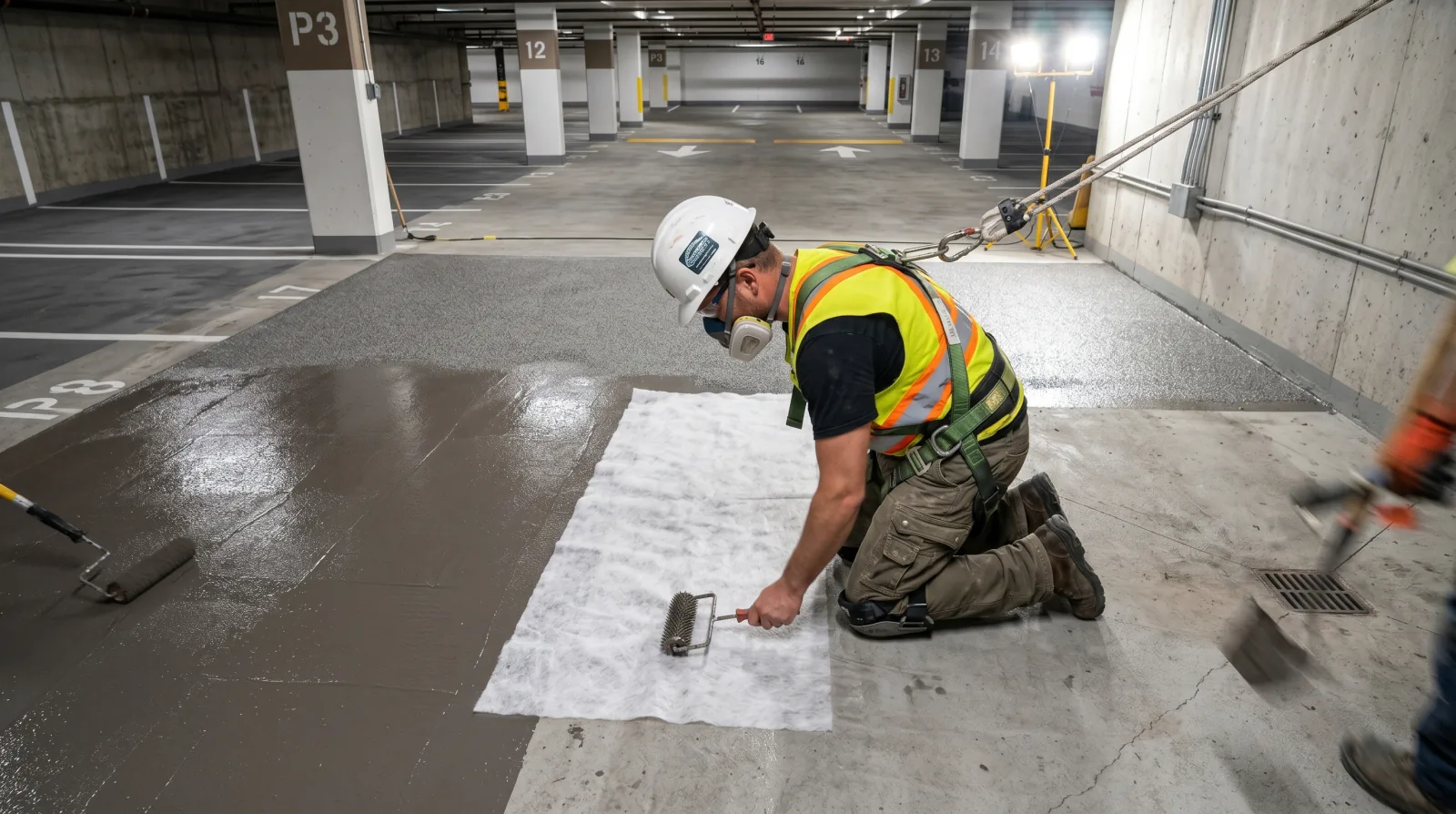
The membrane is the only thing between road salt and your structural slab
A parkade traffic membrane does a job most residents never think about. It is the waterproof, wearable surface that keeps water and road salt from soaking through the driving deck into the structural concrete and the steel inside it. When it works, nobody notices. When it fails, the bill stops being about waterproofing and starts being about structural concrete repair over occupied space.
So when a strata or commercial owner in Vancouver or Burnaby is choosing a traffic membrane, they are really choosing how that protection gets installed, how long the parkade is out of service while it happens, and how many years before they do it again. The two systems we install most — PMMA and polyurethane — answer those questions very differently.
PMMA: fast cure, premium price
PMMA stands for polymethyl methacrylate. It is a liquid resin applied in coats and reinforced with a polyester fleece, building up into a tough, monolithic membrane with no seams to split. Its defining trait is speed. PMMA is often trafficable within one to three hours of application, which means a crew can prime, apply the base coat, embed the reinforcement, and lay the wear coat — a complete system — in a single working day, and hand the bay back to residents that evening.
On an occupied parkade, that changes everything. A downtown Vancouver tower where every stall is spoken for cannot lose a section of its parkade for a week. PMMA lets us phase the work bay by bay, day by day, with residents barely losing access. It also tolerates colder application temperatures, which matters in a climate where the dry, mild windows are short and the wet season is long.
The trade-offs are real. PMMA costs more per square foot, the chemistry cures so fast that it demands experienced applicators who can work to it, and the fumes during application require proper ventilation planning in an enclosed parkade. For the right building, the speed and durability justify the premium. For others, it is more system than the situation needs.
Polyurethane: economical, proven, slower
Polyurethane traffic membranes are the workhorse of the industry. They are applied in coats — a primer, a base or membrane coat, and a wear coat with aggregate broadcast for slip resistance — and they cure more slowly, with each coat needing roughly 24 to 48 hours before the next. A full polyurethane system on a deck typically spreads across several days.
That slower timeline is the main cost. On a parkade that can be closed in sections for several days at a stretch, it is manageable, and the lower material cost and wide availability of qualified applicators make polyurethane the economical choice. On a parkade where every day of closure is a fight with residents, the extended cure becomes a genuine problem.
Polyurethane is also more sensitive to temperature and moisture during its longer cure. In Metro Vancouver’s climate, that narrows the application season and makes scheduling around dry weather windows more important. Get a rain event on a half-cured deck and the work is compromised.
Service life and where decks actually wear
Properly installed, both systems give long service — traffic deck membranes generally land roughly in the 10 to 25 year range depending on the system, the prep, and the traffic, with polyurethane toward the lower end and PMMA toward the upper. But that range hides an important detail: a parkade does not wear evenly.
The quiet parking bays at the back of a Richmond parkade can outlast the entry ramp by years. Ramps, drive lanes, and turning areas — where tires scrub and torque against the surface — wear fastest, and they are usually where we see the first failures. A smart membrane specification accounts for this with heavier-duty detailing in high-wear zones rather than treating the whole deck identically. Replacing a worn ramp detail on schedule is far cheaper than letting it fail through to the slab.
Why preparation decides the outcome
Here is the part that matters more than the PMMA-versus-polyurethane debate: a traffic membrane is only as good as its bond to the concrete, and that bond is made or broken during surface preparation. The slab has to be mechanically prepared — diamond ground or shot blasted to a clean, sound, profiled surface — and the cracks and joints treated before any membrane goes down.
When we open up a failed membrane on a Burnaby or Coquitlam parkade, the cause is usually preparation, not the product. A membrane applied over a dusty, unprofiled, or moisture-laden slab debonds no matter how good the resin is. This is why we are skeptical of the lowest bid on a deck job — the corner that gets cut is almost always prep, and it is invisible until the membrane lifts a couple of years later.
When waterproofing becomes structural
The reason early action matters so much on parkades is what happens when the membrane fails and nobody catches it. Water and chloride-laden road salt reach the structural slab, penetrate to the reinforcing steel, and start rebar corrosion. The rust expands, the concrete cracks and spalls, and now you have a structural concrete repair on a suspended deck above cars or living space — a far bigger project than a membrane renewal.
On older Metro Vancouver parkades showing visible spalling, the responsible sequence is to bring in an engineer to assess and design the concrete repair first, then apply the new membrane over sound, repaired concrete. Coating over hidden structural damage just buries the problem. Our parkade waterproofing problems to watch post covers the early warning signs, and the concrete restoration hub explains how slab repair fits in once a deck is opened up.
The details where decks actually leak
Ask where a parkade membrane fails and most people picture the open field of the deck cracking. It almost never does. Like balconies and walls, traffic decks leak at the details — and a membrane system is really a collection of details held together by a field coat.
The usual failure points are the transitions and penetrations: the cove where the deck membrane turns up the wall, the drains, the expansion joints, the column bases, and the cracks that telegraph through from the slab below. The cove detail is a frequent culprit. Where the horizontal deck meets a vertical wall or curb, the membrane has to turn up and be terminated properly; if that upturn is too short or poorly bonded, water tracks behind it and gets under the field membrane from the edge. Drains are another — a membrane that is not properly clamped and sealed into the drain assembly lets water run around the drain instead of into it, straight into the slab.
Expansion joints in a parkade deck deserve their own attention, because the deck moves and the joint has to move with it. A traffic membrane carried rigidly across a moving joint tears. These joints need a proper joint detail — a sealant or a purpose-made expansion joint system — integrated with the membrane, not just a coat of the same material brushed over the gap. We see plenty of Richmond and Coquitlam decks where the field membrane is fine but every expansion joint is split.
Cracks in the structural slab are the detail people forget. A live, moving crack in the concrete will reflect up through a membrane applied straight over it, reopening as a crack in the waterproofing. Active cracks have to be treated — routed and sealed, or bridged with a detail coat and reinforcement — before the field membrane goes down. Skipping that is how a brand-new deck develops leaks along the old crack lines within a year.
This is why the membrane material debate, while real, is secondary to detailing and prep. A PMMA or polyurethane field coat over badly detailed coves, drains, joints, and cracks will leak regardless of which resin it is. A well-detailed deck in either system stays dry. When we assess a parkade, we spend most of the time at the edges and penetrations, because that is where the next leak will start — and where the last one almost certainly did.
Choosing for your building
There is no universally better system — there is a better fit for a given deck. An occupied downtown parkade that cannot tolerate long closures points hard toward PMMA’s same-day return to service. A deck that can be sectioned off for several days, where budget is the priority, points toward polyurethane. The slab condition, the traffic pattern, the application season, and how much resident disruption the building can absorb all factor in.
That is the conversation worth having before anyone quotes a number. The balcony membrane types guide compares these same materials on residential decks, and the parkade waterproofing service page covers how we assess a deck and match the system to the building. Pick the membrane that fits how your parkade actually gets used, and the prep that makes it last — that is what keeps water off your structural slab for the next two decades.
Frequently Asked Questions
More from Parkade Waterproofing Guide
Expansion Joint Systems on Vancouver Parkade and Plaza Decks
A leak staining the cars in a Vancouver parkade often starts at a deck expansion joint above. How compression seals, strip seals, and membrane joints work — and fail.
Read article →Negative-Side Waterproofing of Below-Grade Walls in Vancouver
When you can't dig up a leaking foundation wall in Richmond's high water table, you waterproof from the inside. How crystalline coatings work, what they can and can't do, and where their limits are.
Read article →Cathodic Protection for Chloride-Contaminated Parkades in Vancouver
Road salt drives chloride deep into Surrey and Vancouver parkade slabs, and patch repair alone won't stop the corrosion it starts. When cathodic protection makes sense, how it works, and what it costs you to ignore it.
Read article →